

4 Phylogeny of Animals
133
and the cephalochordate amphioxus, such as segmented myomeres (Schubert et al.
2006), but it is supported by some other features such as the discovery of migratory neural crest-like cells in tunicates (Jeffery et al. 2004). The close relationship
between echinoderms and cephalochordates reported in this study was nevertheless
surprising and required further confirmation. This confirmation was obtained by
including the hemichordate taxon in the analysis: as a result, cephalochordates were
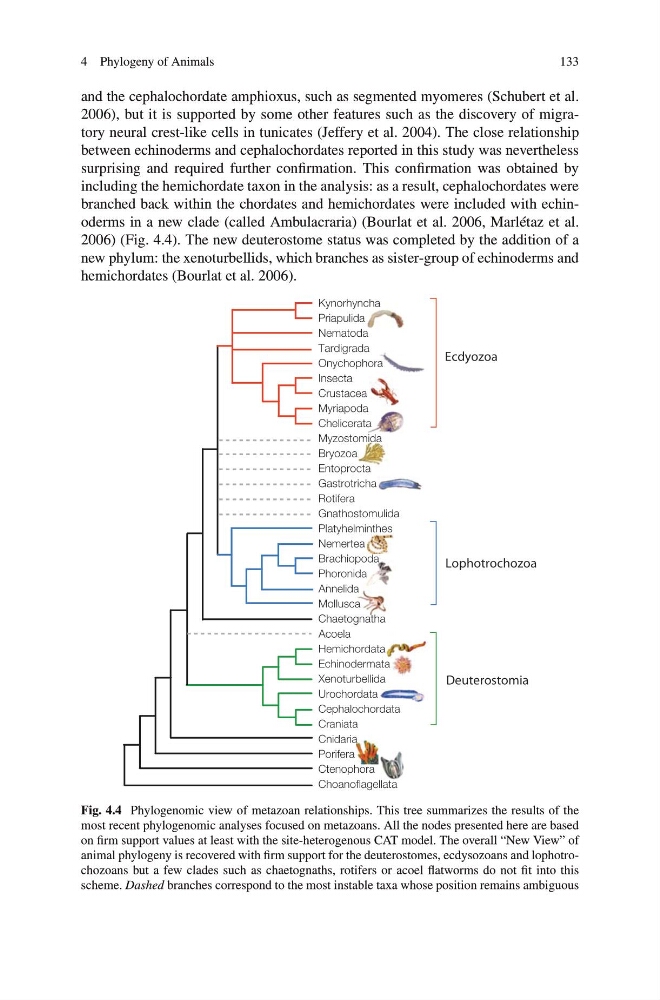
branched back within the chordates and hemichordates were included with echinoderms in a new clade (called Ambulacraria) (Bourlat et al. 2006, Marlétaz et al.
2006) (Fig. 4.4). The new deuterostome status was completed by the addition of a
new phylum: the xenoturbellids, which branches as sister-group of echinoderms and
hemichordates (Bourlat et al. 2006).
Kynorhyncha
Tardigrada
Chaetognatha
Insecta
Crustacea
Myriapoda
Chelicerata
Gastrotricha
Rotifera
Bryozoa
Gnathostomulida
Acoela
Entoprocta
Hemichordata
Echinodermata
Xenoturbellida
Urochordata
Cephalochordata
Craniata
Cnidaria
Ctenophora
Porifera
Choanoflagellata
Ecdyozoa
Lophotrochozoa
Deuterostomia
Myzostomida
Annelida
Mollusca
Nemertea
Brachiopoda
Phoronida
Platyhelminthes
Nematoda
Priapulida
Onychophora
Fig. 4.4 Phylogenomic view of metazoan relationships. This tree summarizes the results of the
most recent phylogenomic analyses focused on metazoans. All the nodes presented here are based
on firm support values at least with the site-heterogenous CAT model. The overall “New View” of
animal phylogeny is recovered with firm support for the deuterostomes, ecdysozoans and lophotrochozoans but a few clades such as chaetognaths, rotifers or acoel flatworms do not fit into this
scheme. Dashed branches correspond to the most instable taxa whose position remains ambiguous
133
and the cephalochordate amphioxus, such as segmented myomeres (Schubert et al.
2006), but it is supported by some other features such as the discovery of migratory neural crest-like cells in tunicates (Jeffery et al. 2004). The close relationship
between echinoderms and cephalochordates reported in this study was nevertheless
surprising and required further confirmation. This confirmation was obtained by
including the hemichordate taxon in the analysis: as a result, cephalochordates were
branched back within the chordates and hemichordates were included with echinoderms in a new clade (called Ambulacraria) (Bourlat et al. 2006, Marlétaz et al.
2006) (Fig. 4.4). The new deuterostome status was completed by the addition of a
new phylum: the xenoturbellids, which branches as sister-group of echinoderms and
hemichordates (Bourlat et al. 2006).
Kynorhyncha
Tardigrada
Chaetognatha
Insecta
Crustacea
Myriapoda
Chelicerata
Gastrotricha
Rotifera
Bryozoa
Gnathostomulida
Acoela
Entoprocta
Hemichordata
Echinodermata
Xenoturbellida
Urochordata
Cephalochordata
Craniata
Cnidaria
Ctenophora
Porifera
Choanoflagellata
Ecdyozoa
Lophotrochozoa
Deuterostomia
Myzostomida
Annelida
Mollusca
Nemertea
Brachiopoda
Phoronida
Platyhelminthes
Nematoda
Priapulida
Onychophora
Fig. 4.4 Phylogenomic view of metazoan relationships. This tree summarizes the results of the
most recent phylogenomic analyses focused on metazoans. All the nodes presented here are based
on firm support values at least with the site-heterogenous CAT model. The overall “New View” of
animal phylogeny is recovered with firm support for the deuterostomes, ecdysozoans and lophotrochozoans but a few clades such as chaetognaths, rotifers or acoel flatworms do not fit into this
scheme. Dashed branches correspond to the most instable taxa whose position remains ambiguous