

130
F. Marlétaz and Y. Le Parco
Caenorhadbitis | Nematode
Saccharomyces | Fungi
Schistosoma | Platyhelminthe
Homo | Vertebrate
Drosophila | Insect
A
B
Schizosaccharomyces
Caenorhadbitis | Nematode
Saccharomyces
Schistosoma | Platyhelminthe
Homo | Vertebrate
Drosophila | Insect
Monosiga | Choanoflagellata
Fungi
Hydra | Cnidarian
C
Schizosaccharomyces
Caenorhadbitis | Nematode
Saccharomyces
Schistosoma | Platyhelminthe
Homo | Vertebrate
Drosophila | Insect
Monosiga | Choanoflagellata
Fungi
Hydra | Cnidarian
Annelida
Mollusca
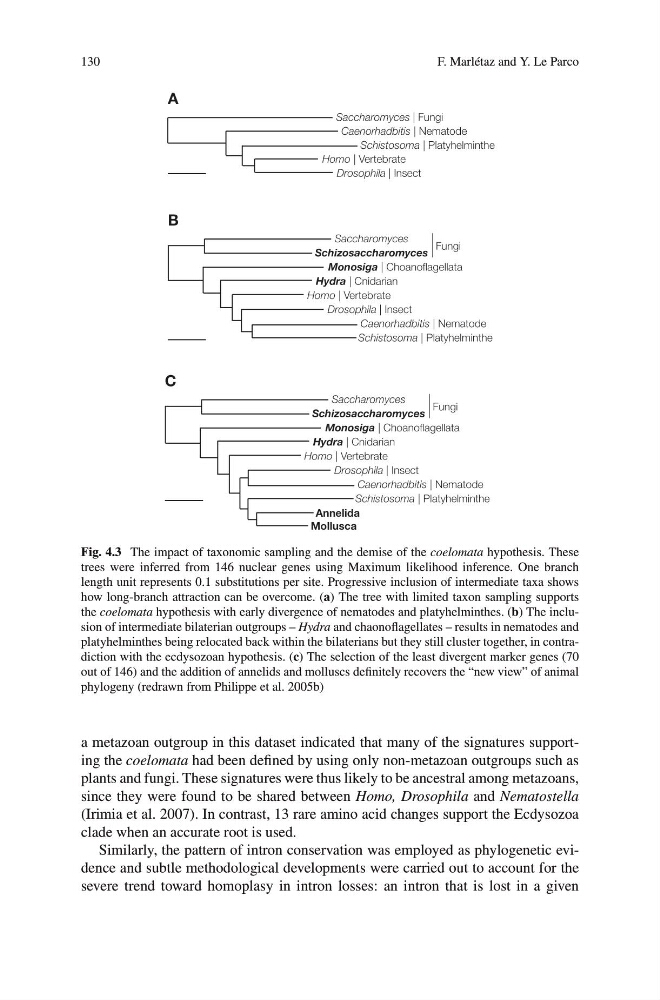
Fig. 4.3 The impact of taxonomic sampling and the demise of the coelomata hypothesis. These
trees were inferred from 146 nuclear genes using Maximum likelihood inference. One branch
length unit represents 0.1 substitutions per site. Progressive inclusion of intermediate taxa shows
how long-branch attraction can be overcome. (a) The tree with limited taxon sampling supports
the coelomata hypothesis with early divergence of nematodes and platyhelminthes. (b) The inclusion of intermediate bilaterian outgroups – Hydra and chaonoflagellates – results in nematodes and
platyhelminthes being relocated back within the bilaterians but they still cluster together, in contradiction with the ecdysozoan hypothesis. (c) The selection of the least divergent marker genes (70
out of 146) and the addition of annelids and molluscs definitely recovers the “new view” of animal
phylogeny (redrawn from Philippe et al. 2005b)
a metazoan outgroup in this dataset indicated that many of the signatures supporting the coelomata had been defined by using only non-metazoan outgroups such as
plants and fungi. These signatures were thus likely to be ancestral among metazoans,
since they were found to be shared between Homo, Drosophila and Nematostella
(Irimia et al. 2007). In contrast, 13 rare amino acid changes support the Ecdysozoa
clade when an accurate root is used.
Similarly, the pattern of intron conservation was employed as phylogenetic evidence and subtle methodological developments were carried out to account for the
severe trend toward homoplasy in intron losses: an intron that is lost in a given
F. Marlétaz and Y. Le Parco
Caenorhadbitis | Nematode
Saccharomyces | Fungi
Schistosoma | Platyhelminthe
Homo | Vertebrate
Drosophila | Insect
A
B
Schizosaccharomyces
Caenorhadbitis | Nematode
Saccharomyces
Schistosoma | Platyhelminthe
Homo | Vertebrate
Drosophila | Insect
Monosiga | Choanoflagellata
Fungi
Hydra | Cnidarian
C
Schizosaccharomyces
Caenorhadbitis | Nematode
Saccharomyces
Schistosoma | Platyhelminthe
Homo | Vertebrate
Drosophila | Insect
Monosiga | Choanoflagellata
Fungi
Hydra | Cnidarian
Annelida
Mollusca
Fig. 4.3 The impact of taxonomic sampling and the demise of the coelomata hypothesis. These
trees were inferred from 146 nuclear genes using Maximum likelihood inference. One branch
length unit represents 0.1 substitutions per site. Progressive inclusion of intermediate taxa shows
how long-branch attraction can be overcome. (a) The tree with limited taxon sampling supports
the coelomata hypothesis with early divergence of nematodes and platyhelminthes. (b) The inclusion of intermediate bilaterian outgroups – Hydra and chaonoflagellates – results in nematodes and
platyhelminthes being relocated back within the bilaterians but they still cluster together, in contradiction with the ecdysozoan hypothesis. (c) The selection of the least divergent marker genes (70
out of 146) and the addition of annelids and molluscs definitely recovers the “new view” of animal
phylogeny (redrawn from Philippe et al. 2005b)
a metazoan outgroup in this dataset indicated that many of the signatures supporting the coelomata had been defined by using only non-metazoan outgroups such as
plants and fungi. These signatures were thus likely to be ancestral among metazoans,
since they were found to be shared between Homo, Drosophila and Nematostella
(Irimia et al. 2007). In contrast, 13 rare amino acid changes support the Ecdysozoa
clade when an accurate root is used.
Similarly, the pattern of intron conservation was employed as phylogenetic evidence and subtle methodological developments were carried out to account for the
severe trend toward homoplasy in intron losses: an intron that is lost in a given