

120
F. Marlétaz and Y. Le Parco
from a modern phylogenetic perspective (Fig. 4.2). This anecdote illustrates the lack
of attention that we – as narrow-minded terrestrial animals – have paid to our marine
relatives but it also strengthens the major importance of studying the astounding
diversity of marine animal forms in order to understand our own ancestry.
The major difficulty with the classification of metazoans is the broad diversity
of animal forms and body organizations in the 36 commonly admitted phyla. This
diversity attains a maximum in marine organisms where, for example, the closest relatives of vertebrates have recently been demonstrated to be the urochordates
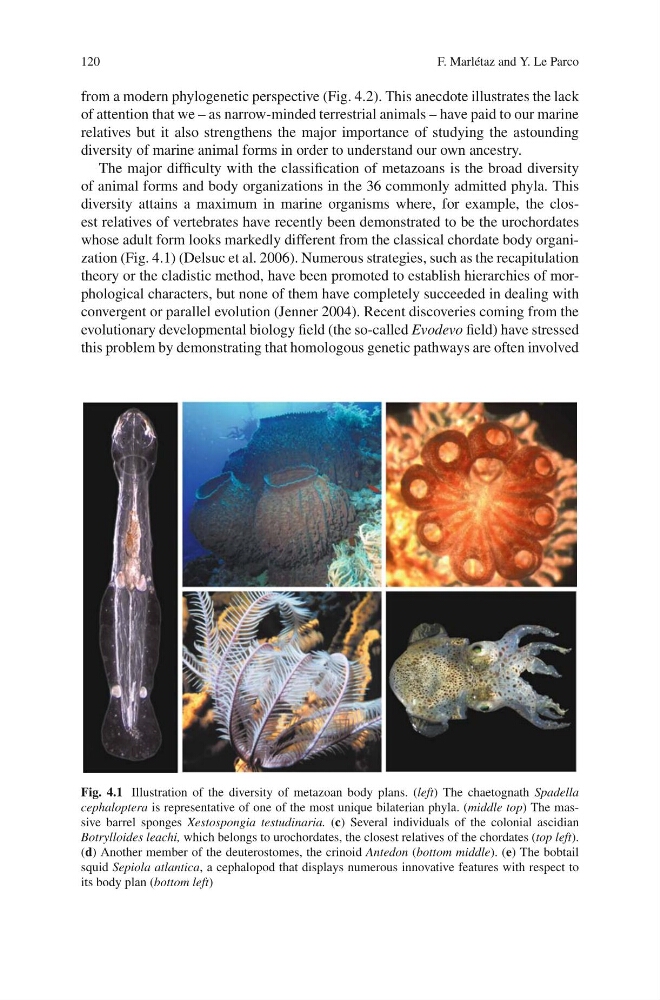
whose adult form looks markedly different from the classical chordate body organization (Fig. 4.1) (Delsuc et al. 2006). Numerous strategies, such as the recapitulation
theory or the cladistic method, have been promoted to establish hierarchies of morphological characters, but none of them have completely succeeded in dealing with
convergent or parallel evolution (Jenner 2004). Recent discoveries coming from the
evolutionary developmental biology field (the so-called Evodevo field) have stressed
this problem by demonstrating that homologous genetic pathways are often involved
Fig. 4.1 Illustration of the diversity of metazoan body plans. (left) The chaetognath Spadella
cephaloptera is representative of one of the most unique bilaterian phyla. (middle top) The massive barrel sponges Xestospongia testudinaria. (c) Several individuals of the colonial ascidian
Botrylloides leachi, which belongs to urochordates, the closest relatives of the chordates (top left).
(d) Another member of the deuterostomes, the crinoid Antedon (bottom middle). (e) The bobtail
squid Sepiola atlantica, a cephalopod that displays numerous innovative features with respect to
its body plan (bottom left)
F. Marlétaz and Y. Le Parco
from a modern phylogenetic perspective (Fig. 4.2). This anecdote illustrates the lack
of attention that we – as narrow-minded terrestrial animals – have paid to our marine
relatives but it also strengthens the major importance of studying the astounding
diversity of marine animal forms in order to understand our own ancestry.
The major difficulty with the classification of metazoans is the broad diversity
of animal forms and body organizations in the 36 commonly admitted phyla. This
diversity attains a maximum in marine organisms where, for example, the closest relatives of vertebrates have recently been demonstrated to be the urochordates
whose adult form looks markedly different from the classical chordate body organization (Fig. 4.1) (Delsuc et al. 2006). Numerous strategies, such as the recapitulation
theory or the cladistic method, have been promoted to establish hierarchies of morphological characters, but none of them have completely succeeded in dealing with
convergent or parallel evolution (Jenner 2004). Recent discoveries coming from the
evolutionary developmental biology field (the so-called Evodevo field) have stressed
this problem by demonstrating that homologous genetic pathways are often involved
Fig. 4.1 Illustration of the diversity of metazoan body plans. (left) The chaetognath Spadella
cephaloptera is representative of one of the most unique bilaterian phyla. (middle top) The massive barrel sponges Xestospongia testudinaria. (c) Several individuals of the colonial ascidian
Botrylloides leachi, which belongs to urochordates, the closest relatives of the chordates (top left).
(d) Another member of the deuterostomes, the crinoid Antedon (bottom middle). (e) The bobtail
squid Sepiola atlantica, a cephalopod that displays numerous innovative features with respect to
its body plan (bottom left)