

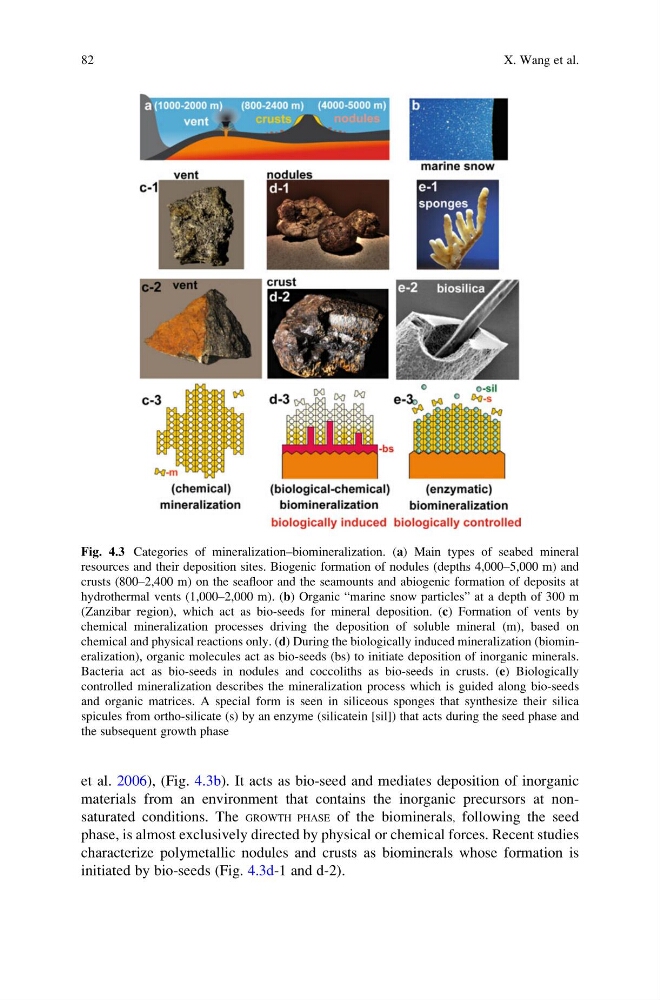
et al. 2006), (Fig. 4.3b). It acts as bio-seed and mediates deposition of inorganic
materials from an environment that contains the inorganic precursors at nonsaturated conditions. The GROWTH PHASE of the biominerals, following the seed
phase, is almost exclusively directed by physical or chemical forces. Recent studies
characterize polymetallic nodules and crusts as biominerals whose formation is
initiated by bio-seeds (Fig. 4.3d-1 and d-2).
Fig. 4.3 Categories of mineralization–biomineralization. (a) Main types of seabed mineral
resources and their deposition sites. Biogenic formation of nodules (depths 4,000–5,000 m) and
crusts (800–2,400 m) on the seafloor and the seamounts and abiogenic formation of deposits at
hydrothermal vents (1,000–2,000 m). (b) Organic “marine snow particles” at a depth of 300 m
(Zanzibar region), which act as bio-seeds for mineral deposition. (c) Formation of vents by
chemical mineralization processes driving the deposition of soluble mineral (m), based on
chemical and physical reactions only. (d) During the biologically induced mineralization (biomineralization), organic molecules act as bio-seeds (bs) to initiate deposition of inorganic minerals.
Bacteria act as bio-seeds in nodules and coccoliths as bio-seeds in crusts. (e) Biologically
controlled mineralization describes the mineralization process which is guided along bio-seeds
and organic matrices. A special form is seen in siliceous sponges that synthesize their silica
spicules from ortho-silicate (s) by an enzyme (silicatein [sil]) that acts during the seed phase and
the subsequent growth phase
82
X. Wang et al.
materials from an environment that contains the inorganic precursors at nonsaturated conditions. The GROWTH PHASE of the biominerals, following the seed
phase, is almost exclusively directed by physical or chemical forces. Recent studies
characterize polymetallic nodules and crusts as biominerals whose formation is
initiated by bio-seeds (Fig. 4.3d-1 and d-2).
Fig. 4.3 Categories of mineralization–biomineralization. (a) Main types of seabed mineral
resources and their deposition sites. Biogenic formation of nodules (depths 4,000–5,000 m) and
crusts (800–2,400 m) on the seafloor and the seamounts and abiogenic formation of deposits at
hydrothermal vents (1,000–2,000 m). (b) Organic “marine snow particles” at a depth of 300 m
(Zanzibar region), which act as bio-seeds for mineral deposition. (c) Formation of vents by
chemical mineralization processes driving the deposition of soluble mineral (m), based on
chemical and physical reactions only. (d) During the biologically induced mineralization (biomineralization), organic molecules act as bio-seeds (bs) to initiate deposition of inorganic minerals.
Bacteria act as bio-seeds in nodules and coccoliths as bio-seeds in crusts. (e) Biologically
controlled mineralization describes the mineralization process which is guided along bio-seeds
and organic matrices. A special form is seen in siliceous sponges that synthesize their silica
spicules from ortho-silicate (s) by an enzyme (silicatein [sil]) that acts during the seed phase and
the subsequent growth phase
82
X. Wang et al.