

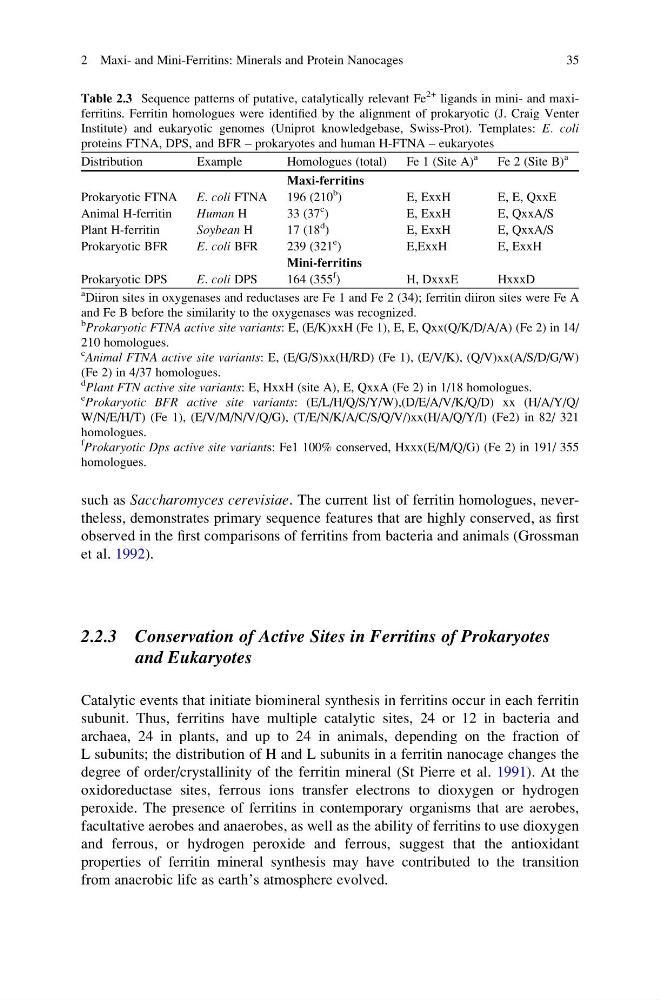
such as Saccharomyces cerevisiae. The current list of ferritin homologues, nevertheless, demonstrates primary sequence features that are highly conserved, as first
observed in the first comparisons of ferritins from bacteria and animals (Grossman
et al. 1992).
2.2.3 Conservation of Active Sites in Ferritins of Prokaryotes
and Eukaryotes
Catalytic events that initiate biomineral synthesis in ferritins occur in each ferritin
subunit. Thus, ferritins have multiple catalytic sites, 24 or 12 in bacteria and
archaea, 24 in plants, and up to 24 in animals, depending on the fraction of
L subunits; the distribution of H and L subunits in a ferritin nanocage changes the
degree of order/crystallinity of the ferritin mineral (St Pierre et al. 1991). At the
oxidoreductase sites, ferrous ions transfer electrons to dioxygen or hydrogen
peroxide. The presence of ferritins in contemporary organisms that are aerobes,
facultative aerobes and anaerobes, as well as the ability of ferritins to use dioxygen
and ferrous, or hydrogen peroxide and ferrous, suggest that the antioxidant
properties of ferritin mineral synthesis may have contributed to the transition
from anaerobic life as earth’s atmosphere evolved.
Table 2.3 Sequence patterns of putative, catalytically relevant Fe
2+ ligands in mini- and maxiferritins. Ferritin homologues were identified by the alignment of prokaryotic (J. Craig Venter
Institute) and eukaryotic genomes (Uniprot knowledgebase, Swiss-Prot). Templates: E. coli
proteins FTNA, DPS, and BFR – prokaryotes and human H-FTNA – eukaryotes
Distribution
Example
Homologues (total)
Fe 1 (Site A)
a
Fe 2 (Site B)
a
Maxi-ferritins
Prokaryotic FTNA
E. coli FTNA
196 (210
b
)
E, ExxH
E, E, QxxE
Animal H-ferritin
Human H
33 (37
c
)
E, ExxH
E, QxxA/S
Plant H-ferritin
Soybean H
17 (18
d
)
E, ExxH
E, QxxA/S
Prokaryotic BFR
E. coli BFR
239 (321
e
)
E,ExxH
E, ExxH
Mini-ferritins
Prokaryotic DPS
E. coli DPS
164 (355
f
)
H, DxxxE
HxxxD
a
Diiron sites in oxygenases and reductases are Fe 1 and Fe 2 (34); ferritin diiron sites were Fe A
and Fe B before the similarity to the oxygenases was recognized.
b
Prokaryotic FTNA active site variants: E, (E/K)xxH (Fe 1), E, E, Qxx(Q/K/D/A/A) (Fe 2) in 14/
210 homologues.
c
Animal FTNA active site variants: E, (E/G/S)xx(H/RD) (Fe 1), (E/V/K), (Q/V)xx(A/S/D/G/W)
(Fe 2) in 4/37 homologues.
d
Plant FTN active site variants: E, HxxH (site A), E, QxxA (Fe 2) in 1/18 homologues.
e
Prokaryotic BFR active site variants: (E/L/H/Q/S/Y/W),(D/E/A/V/K/Q/D) xx (H/A/Y/Q/
W/N/E/H/T) (Fe 1), (E/V/M/N/V/Q/G), (T/E/N/K/A/C/S/Q/V/)xx(H/A/Q/Y/I) (Fe2) in 82/ 321
homologues.
f
Prokaryotic Dps active site variants: Fe1 100% conserved, Hxxx(E/M/Q/G) (Fe 2) in 191/ 355
homologues.
2 Maxi- and Mini-Ferritins: Minerals and Protein Nanocages
35
observed in the first comparisons of ferritins from bacteria and animals (Grossman
et al. 1992).
2.2.3 Conservation of Active Sites in Ferritins of Prokaryotes
and Eukaryotes
Catalytic events that initiate biomineral synthesis in ferritins occur in each ferritin
subunit. Thus, ferritins have multiple catalytic sites, 24 or 12 in bacteria and
archaea, 24 in plants, and up to 24 in animals, depending on the fraction of
L subunits; the distribution of H and L subunits in a ferritin nanocage changes the
degree of order/crystallinity of the ferritin mineral (St Pierre et al. 1991). At the
oxidoreductase sites, ferrous ions transfer electrons to dioxygen or hydrogen
peroxide. The presence of ferritins in contemporary organisms that are aerobes,
facultative aerobes and anaerobes, as well as the ability of ferritins to use dioxygen
and ferrous, or hydrogen peroxide and ferrous, suggest that the antioxidant
properties of ferritin mineral synthesis may have contributed to the transition
from anaerobic life as earth’s atmosphere evolved.
Table 2.3 Sequence patterns of putative, catalytically relevant Fe
2+ ligands in mini- and maxiferritins. Ferritin homologues were identified by the alignment of prokaryotic (J. Craig Venter
Institute) and eukaryotic genomes (Uniprot knowledgebase, Swiss-Prot). Templates: E. coli
proteins FTNA, DPS, and BFR – prokaryotes and human H-FTNA – eukaryotes
Distribution
Example
Homologues (total)
Fe 1 (Site A)
a
Fe 2 (Site B)
a
Maxi-ferritins
Prokaryotic FTNA
E. coli FTNA
196 (210
b
)
E, ExxH
E, E, QxxE
Animal H-ferritin
Human H
33 (37
c
)
E, ExxH
E, QxxA/S
Plant H-ferritin
Soybean H
17 (18
d
)
E, ExxH
E, QxxA/S
Prokaryotic BFR
E. coli BFR
239 (321
e
)
E,ExxH
E, ExxH
Mini-ferritins
Prokaryotic DPS
E. coli DPS
164 (355
f
)
H, DxxxE
HxxxD
a
Diiron sites in oxygenases and reductases are Fe 1 and Fe 2 (34); ferritin diiron sites were Fe A
and Fe B before the similarity to the oxygenases was recognized.
b
Prokaryotic FTNA active site variants: E, (E/K)xxH (Fe 1), E, E, Qxx(Q/K/D/A/A) (Fe 2) in 14/
210 homologues.
c
Animal FTNA active site variants: E, (E/G/S)xx(H/RD) (Fe 1), (E/V/K), (Q/V)xx(A/S/D/G/W)
(Fe 2) in 4/37 homologues.
d
Plant FTN active site variants: E, HxxH (site A), E, QxxA (Fe 2) in 1/18 homologues.
e
Prokaryotic BFR active site variants: (E/L/H/Q/S/Y/W),(D/E/A/V/K/Q/D) xx (H/A/Y/Q/
W/N/E/H/T) (Fe 1), (E/V/M/N/V/Q/G), (T/E/N/K/A/C/S/Q/V/)xx(H/A/Q/Y/I) (Fe2) in 82/ 321
homologues.
f
Prokaryotic Dps active site variants: Fe1 100% conserved, Hxxx(E/M/Q/G) (Fe 2) in 191/ 355
homologues.
2 Maxi- and Mini-Ferritins: Minerals and Protein Nanocages
35