

formation by heteroepitaxial nucleation growth (Weiner and Traub 1984). Nacreous layer formation in the shell may process in four stages, such as assembly of the
matrix, the first formation of the mineral phase, nucleation of individual aragonite
tablets, and formation of the mature nacreous layer (Addadi et al. 2006). Formation
of the nacre starts with the assembly of the organic matrix. Two sheets of b-chitin
construct the framework onto which the acidic proteins are adsorbed and form
aragonite nucleation sites. The silk-like proteins, which inhibit nonspecific crystallization, fill the space between the two sheets of b-chitin in a hydrated gel-like state
prior to mineral formation, and are finally incorporated into the intertablets and
interlamellar matrices in mature nacreous layers (Nudelman et al. 2008). Therefore,
the high uniform thickness of the crystals is controlled by the distance between two
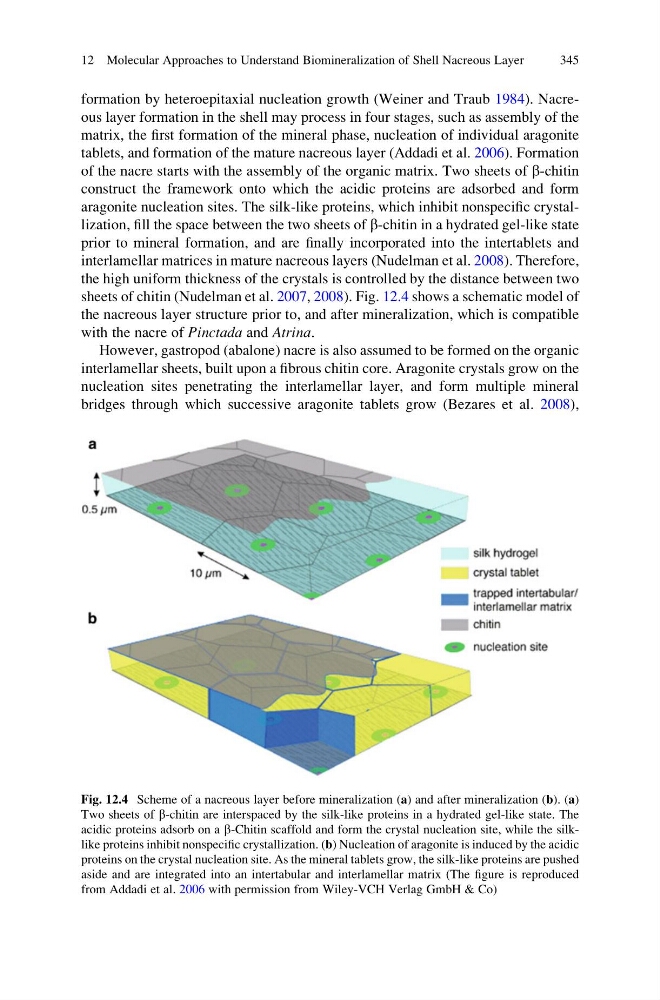
sheets of chitin (Nudelman et al. 2007, 2008). Fig. 12.4 shows a schematic model of
the nacreous layer structure prior to, and after mineralization, which is compatible
with the nacre of Pinctada and Atrina.
However, gastropod (abalone) nacre is also assumed to be formed on the organic
interlamellar sheets, built upon a fibrous chitin core. Aragonite crystals grow on the
nucleation sites penetrating the interlamellar layer, and form multiple mineral
bridges through which successive aragonite tablets grow (Bezares et al. 2008),
Fig. 12.4 Scheme of a nacreous layer before mineralization (a) and after mineralization (b). (a)
Two sheets of b-chitin are interspaced by the silk-like proteins in a hydrated gel-like state. The
acidic proteins adsorb on a b-Chitin scaffold and form the crystal nucleation site, while the silklike proteins inhibit nonspecific crystallization. (b) Nucleation of aragonite is induced by the acidic
proteins on the crystal nucleation site. As the mineral tablets grow, the silk-like proteins are pushed
aside and are integrated into an intertabular and interlamellar matrix (The figure is reproduced
from Addadi et al. 2006 with permission from Wiley-VCH Verlag GmbH & Co)
12 Molecular Approaches to Understand Biomineralization of Shell Nacreous Layer
345
matrix, the first formation of the mineral phase, nucleation of individual aragonite
tablets, and formation of the mature nacreous layer (Addadi et al. 2006). Formation
of the nacre starts with the assembly of the organic matrix. Two sheets of b-chitin
construct the framework onto which the acidic proteins are adsorbed and form
aragonite nucleation sites. The silk-like proteins, which inhibit nonspecific crystallization, fill the space between the two sheets of b-chitin in a hydrated gel-like state
prior to mineral formation, and are finally incorporated into the intertablets and
interlamellar matrices in mature nacreous layers (Nudelman et al. 2008). Therefore,
the high uniform thickness of the crystals is controlled by the distance between two
sheets of chitin (Nudelman et al. 2007, 2008). Fig. 12.4 shows a schematic model of
the nacreous layer structure prior to, and after mineralization, which is compatible
with the nacre of Pinctada and Atrina.
However, gastropod (abalone) nacre is also assumed to be formed on the organic
interlamellar sheets, built upon a fibrous chitin core. Aragonite crystals grow on the
nucleation sites penetrating the interlamellar layer, and form multiple mineral
bridges through which successive aragonite tablets grow (Bezares et al. 2008),
Fig. 12.4 Scheme of a nacreous layer before mineralization (a) and after mineralization (b). (a)
Two sheets of b-chitin are interspaced by the silk-like proteins in a hydrated gel-like state. The
acidic proteins adsorb on a b-Chitin scaffold and form the crystal nucleation site, while the silklike proteins inhibit nonspecific crystallization. (b) Nucleation of aragonite is induced by the acidic
proteins on the crystal nucleation site. As the mineral tablets grow, the silk-like proteins are pushed
aside and are integrated into an intertabular and interlamellar matrix (The figure is reproduced
from Addadi et al. 2006 with permission from Wiley-VCH Verlag GmbH & Co)
12 Molecular Approaches to Understand Biomineralization of Shell Nacreous Layer
345