

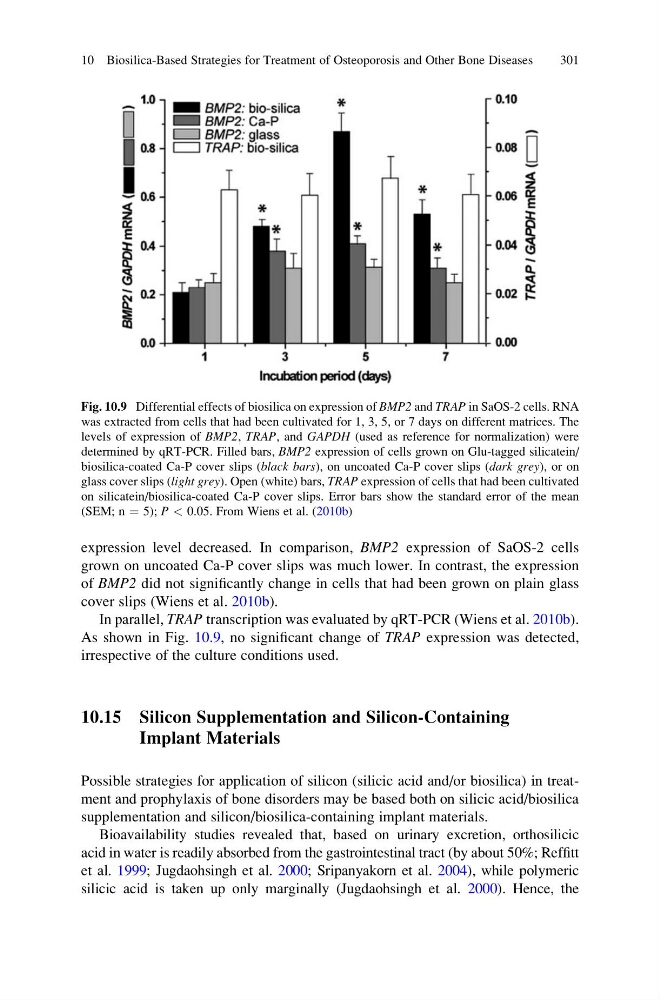
expression level decreased. In comparison, BMP2 expression of SaOS-2 cells
grown on uncoated Ca-P cover slips was much lower. In contrast, the expression
of BMP2 did not significantly change in cells that had been grown on plain glass
cover slips (Wiens et al. 2010b).
In parallel, TRAP transcription was evaluated by qRT-PCR (Wiens et al. 2010b).
As shown in Fig. 10.9, no significant change of TRAP expression was detected,
irrespective of the culture conditions used.
10.15 Silicon Supplementation and Silicon-Containing
Implant Materials
Possible strategies for application of silicon (silicic acid and/or biosilica) in treatment and prophylaxis of bone disorders may be based both on silicic acid/biosilica
supplementation and silicon/biosilica-containing implant materials.
Bioavailability studies revealed that, based on urinary excretion, orthosilicic
acid in water is readily absorbed from the gastrointestinal tract (by about 50%; Reffitt
et al. 1999; Jugdaohsingh et al. 2000; Sripanyakorn et al. 2004), while polymeric
silicic acid is taken up only marginally (Jugdaohsingh et al. 2000). Hence, the
Fig. 10.9 Differential effects of biosilica on expression of BMP2 and TRAP in SaOS-2 cells. RNA
was extracted from cells that had been cultivated for 1, 3, 5, or 7 days on different matrices. The
levels of expression of BMP2, TRAP, and GAPDH (used as reference for normalization) were
determined by qRT-PCR. Filled bars, BMP2 expression of cells grown on Glu-tagged silicatein/
biosilica-coated Ca-P cover slips (black bars), on uncoated Ca-P cover slips (dark grey), or on
glass cover slips (light grey). Open (white) bars, TRAP expression of cells that had been cultivated
on silicatein/biosilica-coated Ca-P cover slips. Error bars show the standard error of the mean
(SEM; n ¼ 5); P < 0.05. From Wiens et al. (2010b)
10 Biosilica-Based Strategies for Treatment of Osteoporosis and Other Bone Diseases
301
grown on uncoated Ca-P cover slips was much lower. In contrast, the expression
of BMP2 did not significantly change in cells that had been grown on plain glass
cover slips (Wiens et al. 2010b).
In parallel, TRAP transcription was evaluated by qRT-PCR (Wiens et al. 2010b).
As shown in Fig. 10.9, no significant change of TRAP expression was detected,
irrespective of the culture conditions used.
10.15 Silicon Supplementation and Silicon-Containing
Implant Materials
Possible strategies for application of silicon (silicic acid and/or biosilica) in treatment and prophylaxis of bone disorders may be based both on silicic acid/biosilica
supplementation and silicon/biosilica-containing implant materials.
Bioavailability studies revealed that, based on urinary excretion, orthosilicic
acid in water is readily absorbed from the gastrointestinal tract (by about 50%; Reffitt
et al. 1999; Jugdaohsingh et al. 2000; Sripanyakorn et al. 2004), while polymeric
silicic acid is taken up only marginally (Jugdaohsingh et al. 2000). Hence, the
Fig. 10.9 Differential effects of biosilica on expression of BMP2 and TRAP in SaOS-2 cells. RNA
was extracted from cells that had been cultivated for 1, 3, 5, or 7 days on different matrices. The
levels of expression of BMP2, TRAP, and GAPDH (used as reference for normalization) were
determined by qRT-PCR. Filled bars, BMP2 expression of cells grown on Glu-tagged silicatein/
biosilica-coated Ca-P cover slips (black bars), on uncoated Ca-P cover slips (dark grey), or on
glass cover slips (light grey). Open (white) bars, TRAP expression of cells that had been cultivated
on silicatein/biosilica-coated Ca-P cover slips. Error bars show the standard error of the mean
(SEM; n ¼ 5); P < 0.05. From Wiens et al. (2010b)
10 Biosilica-Based Strategies for Treatment of Osteoporosis and Other Bone Diseases
301