

of Monorhaphis (choanosomal body), which is arranged around the single giant
basal spicule, 14 further siliceous spicule types with lengths from a few
micrometers to 50 mm are found (Schulze 1904; M€ uller et al. 2007a; Wang et al.
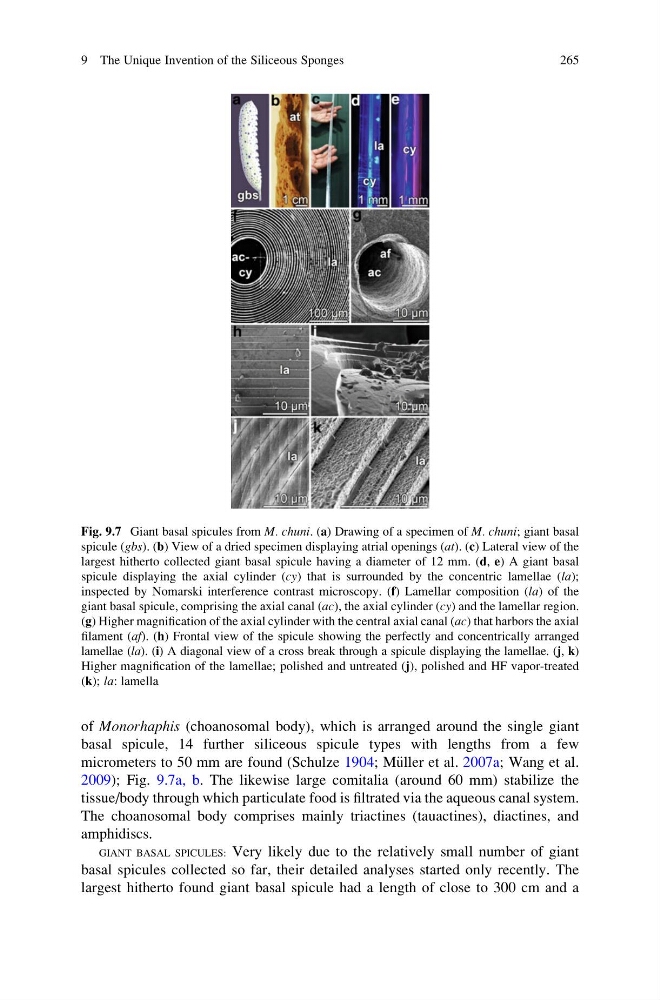
2009); Fig. 9.7a, b. The likewise large comitalia (around 60 mm) stabilize the
tissue/body through which particulate food is filtrated via the aqueous canal system.
The choanosomal body comprises mainly triactines (tauactines), diactines, and
amphidiscs.
GIANT BASAL SPICULES: Very likely due to the relatively small number of giant
basal spicules collected so far, their detailed analyses started only recently. The
largest hitherto found giant basal spicule had a length of close to 300 cm and a
Fig. 9.7 Giant basal spicules from M. chuni. (a) Drawing of a specimen of M. chuni; giant basal
spicule (gbs). (b) View of a dried specimen displaying atrial openings (at). (c) Lateral view of the
largest hitherto collected giant basal spicule having a diameter of 12 mm. (d, e) A giant basal
spicule displaying the axial cylinder (cy) that is surrounded by the concentric lamellae (la);
inspected by Nomarski interference contrast microscopy. (f) Lamellar composition (la) of the
giant basal spicule, comprising the axial canal (ac), the axial cylinder (cy) and the lamellar region.
(g) Higher magnification of the axial cylinder with the central axial canal (ac) that harbors the axial
filament (af). (h) Frontal view of the spicule showing the perfectly and concentrically arranged
lamellae (la). (i) A diagonal view of a cross break through a spicule displaying the lamellae. (j, k)
Higher magnification of the lamellae; polished and untreated (j), polished and HF vapor-treated
(k); la: lamella
9 The Unique Invention of the Siliceous Sponges
265
basal spicule, 14 further siliceous spicule types with lengths from a few
micrometers to 50 mm are found (Schulze 1904; M€ uller et al. 2007a; Wang et al.
2009); Fig. 9.7a, b. The likewise large comitalia (around 60 mm) stabilize the
tissue/body through which particulate food is filtrated via the aqueous canal system.
The choanosomal body comprises mainly triactines (tauactines), diactines, and
amphidiscs.
GIANT BASAL SPICULES: Very likely due to the relatively small number of giant
basal spicules collected so far, their detailed analyses started only recently. The
largest hitherto found giant basal spicule had a length of close to 300 cm and a
Fig. 9.7 Giant basal spicules from M. chuni. (a) Drawing of a specimen of M. chuni; giant basal
spicule (gbs). (b) View of a dried specimen displaying atrial openings (at). (c) Lateral view of the
largest hitherto collected giant basal spicule having a diameter of 12 mm. (d, e) A giant basal
spicule displaying the axial cylinder (cy) that is surrounded by the concentric lamellae (la);
inspected by Nomarski interference contrast microscopy. (f) Lamellar composition (la) of the
giant basal spicule, comprising the axial canal (ac), the axial cylinder (cy) and the lamellar region.
(g) Higher magnification of the axial cylinder with the central axial canal (ac) that harbors the axial
filament (af). (h) Frontal view of the spicule showing the perfectly and concentrically arranged
lamellae (la). (i) A diagonal view of a cross break through a spicule displaying the lamellae. (j, k)
Higher magnification of the lamellae; polished and untreated (j), polished and HF vapor-treated
(k); la: lamella
9 The Unique Invention of the Siliceous Sponges
265