

While the Ca-bound alkalinity is removed in the course of CaCO 3 deposition, the
Na-bound alkalinity requires long-term processes and reverse weathering in deep
floor hydrothermal reactions during which soluble OH
- is removed. Worth mentioning is that in contrast to weathering of carbonate rocks, followed by the
precipitation of an equivalent amount of carbonate minerals by marine organisms,
the dissolution process of silicate minerals, e.g., plagioclase, is followed by a net
consumption of atmospheric CO 2 (reviewed in Street-Perrott and Barker 2008). The
absorption/sink of atmospheric CO 2 during weathering of Ca- and Mg silicates is
followed by rinsing of the weathered minerals into rivers and groundwater. Besides
of atmospheric CO 2 , also organic carbonic acids contribute decisively to the
weathering processes (Berner and Berner 1996).
In the present oceans, sulfate [(SO 4 )
2À ] reduction processes are insignificant,
with the exception of the deep anaerobic basins and the Black Sea (Kazmierczak
et al. 2004). However, in the Precambrian oceans, the sulfate ions consumption
contributed considerably to the increase in alkalinity due to the production of anion
equivalents, which is (HCO 3 )
À
. Noteworthy is also the fact that during the transition from the Precambrian (Sturtian and Marinoan glaciations) to the Phanerozoic,
the level of sulfate increased strongly from 1 to 10 mM (Canfield and Farquhar
2009). Simultaneous and in consequence of silicate weathering, calcium was
liberated. However, the level of free Ca
2+ remained relatively low, in comparison
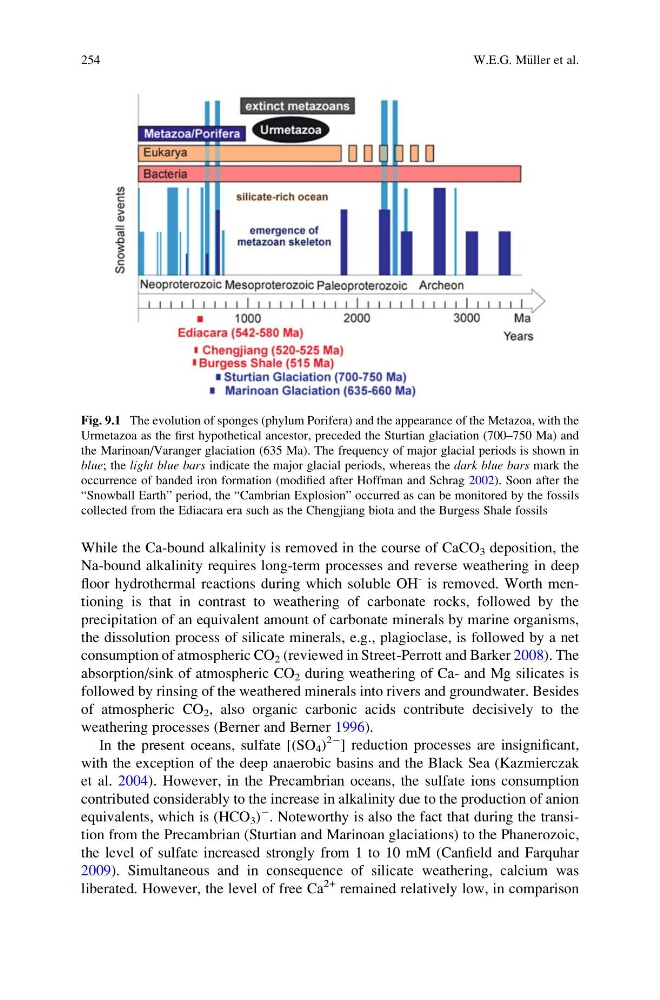
Fig. 9.1 The evolution of sponges (phylum Porifera) and the appearance of the Metazoa, with the
Urmetazoa as the first hypothetical ancestor, preceded the Sturtian glaciation (700–750 Ma) and
the Marinoan/Varanger glaciation (635 Ma). The frequency of major glacial periods is shown in
blue; the light blue bars indicate the major glacial periods, whereas the dark blue bars mark the
occurrence of banded iron formation (modified after Hoffman and Schrag 2002). Soon after the
“Snowball Earth” period, the “Cambrian Explosion” occurred as can be monitored by the fossils
collected from the Ediacara era such as the Chengjiang biota and the Burgess Shale fossils
254
W.E.G. M€ uller et al.
Na-bound alkalinity requires long-term processes and reverse weathering in deep
floor hydrothermal reactions during which soluble OH
- is removed. Worth mentioning is that in contrast to weathering of carbonate rocks, followed by the
precipitation of an equivalent amount of carbonate minerals by marine organisms,
the dissolution process of silicate minerals, e.g., plagioclase, is followed by a net
consumption of atmospheric CO 2 (reviewed in Street-Perrott and Barker 2008). The
absorption/sink of atmospheric CO 2 during weathering of Ca- and Mg silicates is
followed by rinsing of the weathered minerals into rivers and groundwater. Besides
of atmospheric CO 2 , also organic carbonic acids contribute decisively to the
weathering processes (Berner and Berner 1996).
In the present oceans, sulfate [(SO 4 )
2À ] reduction processes are insignificant,
with the exception of the deep anaerobic basins and the Black Sea (Kazmierczak
et al. 2004). However, in the Precambrian oceans, the sulfate ions consumption
contributed considerably to the increase in alkalinity due to the production of anion
equivalents, which is (HCO 3 )
À
. Noteworthy is also the fact that during the transition from the Precambrian (Sturtian and Marinoan glaciations) to the Phanerozoic,
the level of sulfate increased strongly from 1 to 10 mM (Canfield and Farquhar
2009). Simultaneous and in consequence of silicate weathering, calcium was
liberated. However, the level of free Ca
2+ remained relatively low, in comparison
Fig. 9.1 The evolution of sponges (phylum Porifera) and the appearance of the Metazoa, with the
Urmetazoa as the first hypothetical ancestor, preceded the Sturtian glaciation (700–750 Ma) and
the Marinoan/Varanger glaciation (635 Ma). The frequency of major glacial periods is shown in
blue; the light blue bars indicate the major glacial periods, whereas the dark blue bars mark the
occurrence of banded iron formation (modified after Hoffman and Schrag 2002). Soon after the
“Snowball Earth” period, the “Cambrian Explosion” occurred as can be monitored by the fossils
collected from the Ediacara era such as the Chengjiang biota and the Burgess Shale fossils
254
W.E.G. M€ uller et al.