

biomineralization-related proteins, potential spicule matrix proteins are categorized
as such when having at least one of the following characteristics: a lectin domain
(or a C-type lectin domain), a signal sequence, pro/gly-rich or asp-rich regions
(Livingston et al. 2006; Mann et al. 2010).
Despite extensive information at the gene level, there is still very little
information about the cellular and/or molecular mechanisms behind the biomineralization occurring in sea urchin embryos. More studies are required for a
thorough description of the process which might proceed following a few main
experimental directions. The first, aimed at the characterization of the role of each
protein could involve in vitro crystallization tests showing the inhibition of
calcium carbonate precipitation, as shown for the calprismin and caspartin, two
small acidic proteins, purified from the mollusc Pinna nobilis (Marin et al. 2005).
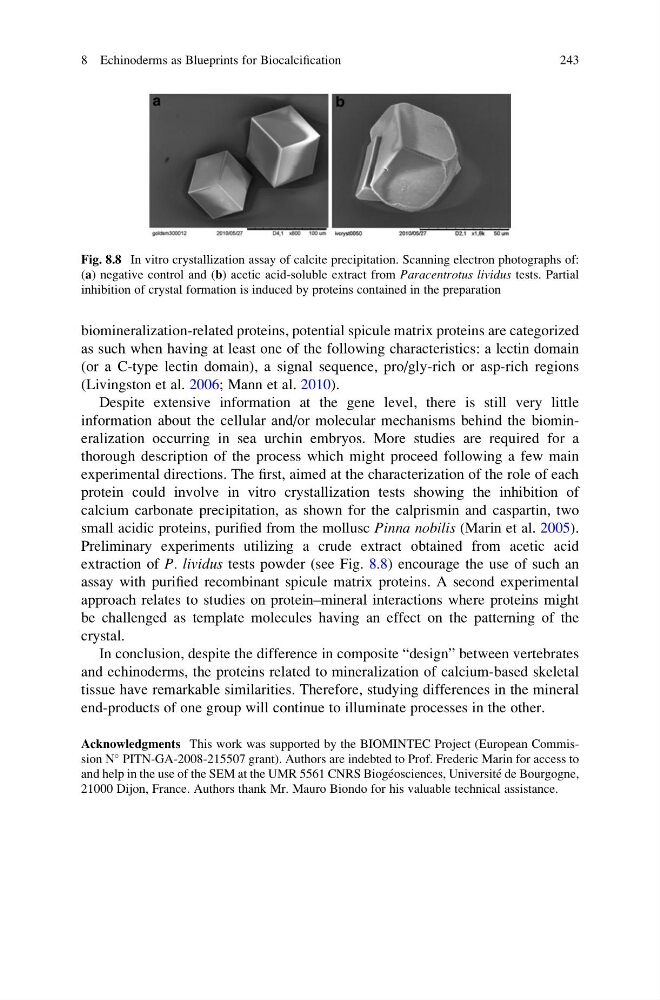
Preliminary experiments utilizing a crude extract obtained from acetic acid
extraction of P. lividus tests powder (see Fig. 8.8) encourage the use of such an
assay with purified recombinant spicule matrix proteins. A second experimental
approach relates to studies on protein–mineral interactions where proteins might
be challenged as template molecules having an effect on the patterning of the
crystal.
In conclusion, despite the difference in composite “design” between vertebrates
and echinoderms, the proteins related to mineralization of calcium-based skeletal
tissue have remarkable similarities. Therefore, studying differences in the mineral
end-products of one group will continue to illuminate processes in the other.
Acknowledgments This work was supported by the BIOMINTEC Project (European Commission N
PITN-GA-2008-215507 grant). Authors are indebted to Prof. Frederic Marin for access to
and help in the use of the SEM at the UMR 5561 CNRS Bioge ´osciences, Universite ´ de Bourgogne,
21000 Dijon, France. Authors thank Mr. Mauro Biondo for his valuable technical assistance.
Fig. 8.8 In vitro crystallization assay of calcite precipitation. Scanning electron photographs of:
(a) negative control and (b) acetic acid-soluble extract from Paracentrotus lividus tests. Partial
inhibition of crystal formation is induced by proteins contained in the preparation
8 Echinoderms as Blueprints for Biocalcification
243
as such when having at least one of the following characteristics: a lectin domain
(or a C-type lectin domain), a signal sequence, pro/gly-rich or asp-rich regions
(Livingston et al. 2006; Mann et al. 2010).
Despite extensive information at the gene level, there is still very little
information about the cellular and/or molecular mechanisms behind the biomineralization occurring in sea urchin embryos. More studies are required for a
thorough description of the process which might proceed following a few main
experimental directions. The first, aimed at the characterization of the role of each
protein could involve in vitro crystallization tests showing the inhibition of
calcium carbonate precipitation, as shown for the calprismin and caspartin, two
small acidic proteins, purified from the mollusc Pinna nobilis (Marin et al. 2005).
Preliminary experiments utilizing a crude extract obtained from acetic acid
extraction of P. lividus tests powder (see Fig. 8.8) encourage the use of such an
assay with purified recombinant spicule matrix proteins. A second experimental
approach relates to studies on protein–mineral interactions where proteins might
be challenged as template molecules having an effect on the patterning of the
crystal.
In conclusion, despite the difference in composite “design” between vertebrates
and echinoderms, the proteins related to mineralization of calcium-based skeletal
tissue have remarkable similarities. Therefore, studying differences in the mineral
end-products of one group will continue to illuminate processes in the other.
Acknowledgments This work was supported by the BIOMINTEC Project (European Commission N
PITN-GA-2008-215507 grant). Authors are indebted to Prof. Frederic Marin for access to
and help in the use of the SEM at the UMR 5561 CNRS Bioge ´osciences, Universite ´ de Bourgogne,
21000 Dijon, France. Authors thank Mr. Mauro Biondo for his valuable technical assistance.
Fig. 8.8 In vitro crystallization assay of calcite precipitation. Scanning electron photographs of:
(a) negative control and (b) acetic acid-soluble extract from Paracentrotus lividus tests. Partial
inhibition of crystal formation is induced by proteins contained in the preparation
8 Echinoderms as Blueprints for Biocalcification
243