

8.4.2 Growth Factors
Besides the synthesis and secretion of spicule matrix proteins and the regulation of
matrix–mineral interactions, PMCs require several types of cues from the
surrounding embryo, including axial, temporal, and scalar signals, in order to
synthesize a normal sized and patterned skeleton. Such cues have been shown to
originate from the overlying ectoderm and the apical ECM (Guss and Ettensohn
1997; Zito et al. 2003; Kiyomoto et al. 2004; Duloquin et al. 2007; R€ ottinger et al.
2008). The attractive idea that skeleton formation is regulated by the ectodermal
cues was first proposed more than 70 years ago (von Ubish, 1937), although the
molecular cues implicated in such interactions are being identified only in recent
years. So far, essential signals released by the ectoderm have been identified among
growth factors and include univin, VEGF, and FGF (Zito et al. 2003; Duloquin et al.
2007; R€ ottinger et al. 2008). It seems that each of these growth factors is required
for controlling skeleton morphogenesis, probably using independent pathways that
are not functionally redundant.
Univin is the first gene encoding a member of the TGF-b superfamily to be
identified in the sea urchin embryo (Stenzel et al. 1994). The univin amino acid
sequence is closely related to zDVR-1 (zebrafish), BMPs-2 and 4 (human),
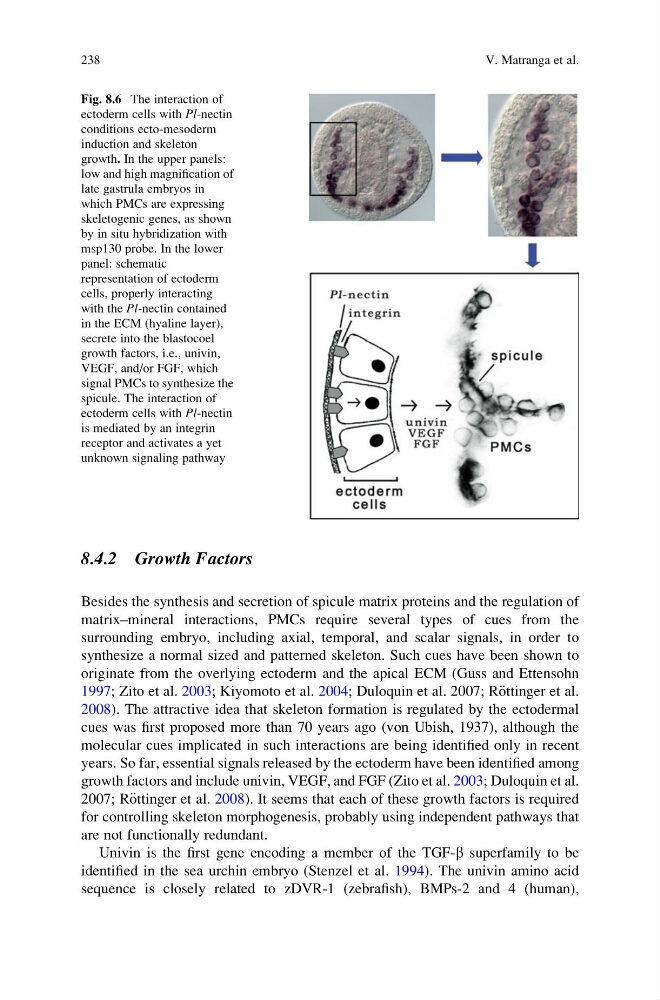
Fig. 8.6 The interaction of
ectoderm cells with Pl-nectin
conditions ecto-mesoderm
induction and skeleton
growth. In the upper panels:
low and high magnification of
late gastrula embryos in
which PMCs are expressing
skeletogenic genes, as shown
by in situ hybridization with
msp130 probe. In the lower
panel: schematic
representation of ectoderm
cells, properly interacting
with the Pl-nectin contained
in the ECM (hyaline layer),
secrete into the blastocoel
growth factors, i.e., univin,
VEGF, and/or FGF, which
signal PMCs to synthesize the
spicule. The interaction of
ectoderm cells with Pl-nectin
is mediated by an integrin
receptor and activates a yet
unknown signaling pathway
238
V. Matranga et al.
Besides the synthesis and secretion of spicule matrix proteins and the regulation of
matrix–mineral interactions, PMCs require several types of cues from the
surrounding embryo, including axial, temporal, and scalar signals, in order to
synthesize a normal sized and patterned skeleton. Such cues have been shown to
originate from the overlying ectoderm and the apical ECM (Guss and Ettensohn
1997; Zito et al. 2003; Kiyomoto et al. 2004; Duloquin et al. 2007; R€ ottinger et al.
2008). The attractive idea that skeleton formation is regulated by the ectodermal
cues was first proposed more than 70 years ago (von Ubish, 1937), although the
molecular cues implicated in such interactions are being identified only in recent
years. So far, essential signals released by the ectoderm have been identified among
growth factors and include univin, VEGF, and FGF (Zito et al. 2003; Duloquin et al.
2007; R€ ottinger et al. 2008). It seems that each of these growth factors is required
for controlling skeleton morphogenesis, probably using independent pathways that
are not functionally redundant.
Univin is the first gene encoding a member of the TGF-b superfamily to be
identified in the sea urchin embryo (Stenzel et al. 1994). The univin amino acid
sequence is closely related to zDVR-1 (zebrafish), BMPs-2 and 4 (human),
Fig. 8.6 The interaction of
ectoderm cells with Pl-nectin
conditions ecto-mesoderm
induction and skeleton
growth. In the upper panels:
low and high magnification of
late gastrula embryos in
which PMCs are expressing
skeletogenic genes, as shown
by in situ hybridization with
msp130 probe. In the lower
panel: schematic
representation of ectoderm
cells, properly interacting
with the Pl-nectin contained
in the ECM (hyaline layer),
secrete into the blastocoel
growth factors, i.e., univin,
VEGF, and/or FGF, which
signal PMCs to synthesize the
spicule. The interaction of
ectoderm cells with Pl-nectin
is mediated by an integrin
receptor and activates a yet
unknown signaling pathway
238
V. Matranga et al.