

In sea urchin embryos, 231 proteins were identified in spicule matrix extracts
(Mann et al. 2010). Among the most abundant proteins found are SM30 and SM50,
which were originally purified biochemically and belong to the C-type lectin
family. Various other lectins include: SM29, SM32, SM37, PM27 and SpClect_13, as well as metalloproteases and carbonic anhydrase. Some of these
proteins are expressed both in embryonic spicules and adult mineralized parts,
e.g., the phosphoproteins P16 and P19 (Alvares et al. 2009) and isoforms of the
C-type lectin SM30 (Killian et al. 2010). The great number of proteins identified
in the above-mentioned studies has been possible thanks to the genome-wide
analysis of biomineralization-related proteins (Livingston et al. 2006). Most of
the proteins were found to be sea urchin specific, meaning they have no apparent
homologues in other invertebrate deuterostomes or vertebrates. They include several families: the spicule-matrix proteins, the msp-130 family, cyclophilins,
collagens, carbonic anhydrase, P-16, P-19, secreted Ca-binding phosphoproteins,
transcription factors, ECM molecules, and proteins involved in cell-ECM
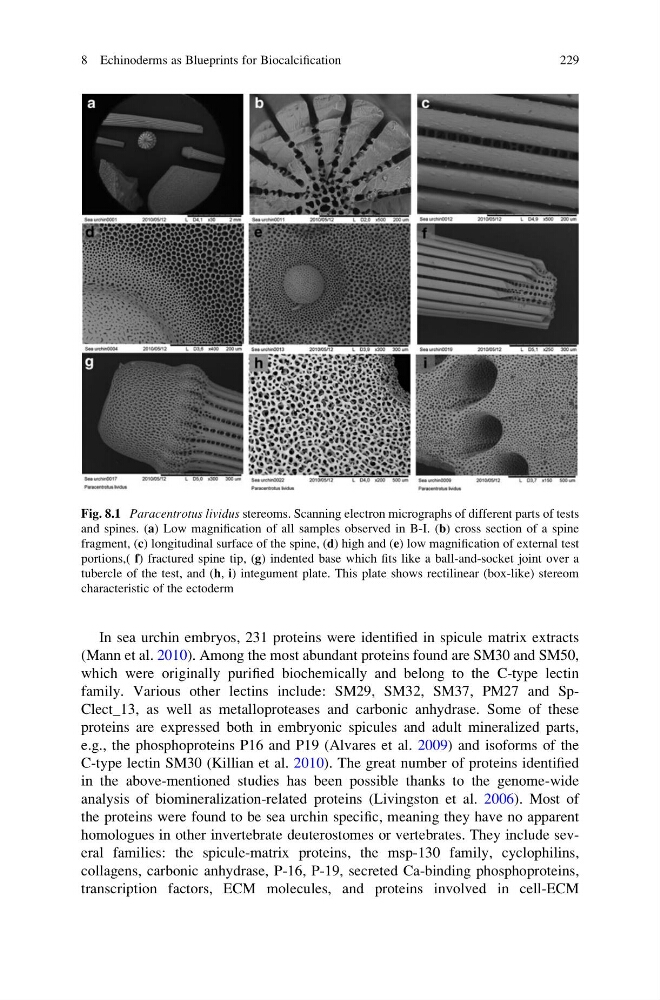
Fig. 8.1 Paracentrotus lividus stereoms. Scanning electron micrographs of different parts of tests
and spines. (a) Low magnification of all samples observed in B-I. (b) cross section of a spine
fragment, (c) longitudinal surface of the spine, (d) high and (e) low magnification of external test
portions,( f) fractured spine tip, (g) indented base which fits like a ball-and-socket joint over a
tubercle of the test, and (h, i) integument plate. This plate shows rectilinear (box-like) stereom
characteristic of the ectoderm
8 Echinoderms as Blueprints for Biocalcification
229
(Mann et al. 2010). Among the most abundant proteins found are SM30 and SM50,
which were originally purified biochemically and belong to the C-type lectin
family. Various other lectins include: SM29, SM32, SM37, PM27 and SpClect_13, as well as metalloproteases and carbonic anhydrase. Some of these
proteins are expressed both in embryonic spicules and adult mineralized parts,
e.g., the phosphoproteins P16 and P19 (Alvares et al. 2009) and isoforms of the
C-type lectin SM30 (Killian et al. 2010). The great number of proteins identified
in the above-mentioned studies has been possible thanks to the genome-wide
analysis of biomineralization-related proteins (Livingston et al. 2006). Most of
the proteins were found to be sea urchin specific, meaning they have no apparent
homologues in other invertebrate deuterostomes or vertebrates. They include several families: the spicule-matrix proteins, the msp-130 family, cyclophilins,
collagens, carbonic anhydrase, P-16, P-19, secreted Ca-binding phosphoproteins,
transcription factors, ECM molecules, and proteins involved in cell-ECM
Fig. 8.1 Paracentrotus lividus stereoms. Scanning electron micrographs of different parts of tests
and spines. (a) Low magnification of all samples observed in B-I. (b) cross section of a spine
fragment, (c) longitudinal surface of the spine, (d) high and (e) low magnification of external test
portions,( f) fractured spine tip, (g) indented base which fits like a ball-and-socket joint over a
tubercle of the test, and (h, i) integument plate. This plate shows rectilinear (box-like) stereom
characteristic of the ectoderm
8 Echinoderms as Blueprints for Biocalcification
229