

Calcium phosphates are among the most advanced structural composite
materials known to be made of macromolecular building blocks. A wide range of
tissues, each possessing very different properties, are successfully synthesized in
natural environments with only the same basic macromolecular design. These
tissues show some common features – they are assembled in numerous assembly
ways that allow control of the formation of varying hierarchical structures, from the
nanometer scale to macroscale. The concept of hierarchical assembly has been
recognized and emphasized by more and more scientists over the last decades, as
exemplified by the investigations of numerous biological materials. The hierarchical levels of organization with highly specific interconnectivity and with unique
architectures are designed to give the required spectrum of properties for each
oriented composite system. Based on these lessons in biology, the laws for the
formation of complex composite systems for functional macromolecular
assemblies have been probed ((Mann 2001); (Dove et al. 2003)). In addition to
gaining knowledge of the fundamental mechanisms for assembly of such materials,
the ability to build architectures as a direct consequence of the precision in
assembly would certainly open the gate to some new areas of materials science.
Examples could be the design and construction of inorganic materials with
specified structure, size, shape, crystal orientation, and number of defects and the
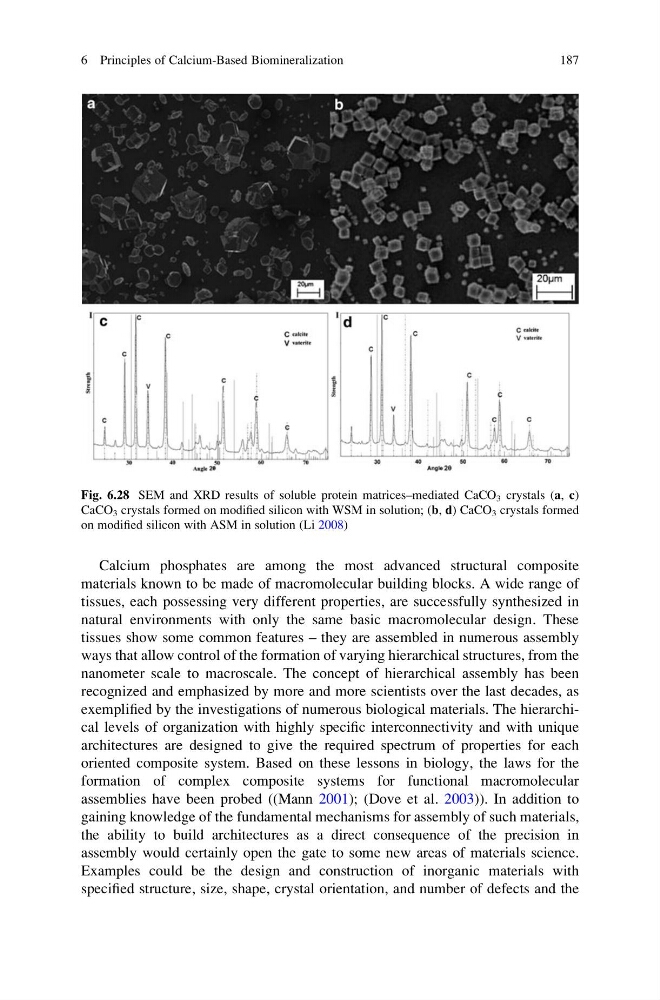
Fig. 6.28 SEM and XRD results of soluble protein matrices–mediated CaCO 3 crystals (a, c)
CaCO 3 crystals formed on modified silicon with WSM in solution; (b, d) CaCO 3 crystals formed
on modified silicon with ASM in solution (Li 2008)
6 Principles of Calcium-Based Biomineralization
187
materials known to be made of macromolecular building blocks. A wide range of
tissues, each possessing very different properties, are successfully synthesized in
natural environments with only the same basic macromolecular design. These
tissues show some common features – they are assembled in numerous assembly
ways that allow control of the formation of varying hierarchical structures, from the
nanometer scale to macroscale. The concept of hierarchical assembly has been
recognized and emphasized by more and more scientists over the last decades, as
exemplified by the investigations of numerous biological materials. The hierarchical levels of organization with highly specific interconnectivity and with unique
architectures are designed to give the required spectrum of properties for each
oriented composite system. Based on these lessons in biology, the laws for the
formation of complex composite systems for functional macromolecular
assemblies have been probed ((Mann 2001); (Dove et al. 2003)). In addition to
gaining knowledge of the fundamental mechanisms for assembly of such materials,
the ability to build architectures as a direct consequence of the precision in
assembly would certainly open the gate to some new areas of materials science.
Examples could be the design and construction of inorganic materials with
specified structure, size, shape, crystal orientation, and number of defects and the
Fig. 6.28 SEM and XRD results of soluble protein matrices–mediated CaCO 3 crystals (a, c)
CaCO 3 crystals formed on modified silicon with WSM in solution; (b, d) CaCO 3 crystals formed
on modified silicon with ASM in solution (Li 2008)
6 Principles of Calcium-Based Biomineralization
187