

In mineralization process, not only crystal forms, but also morphologies are
influenced by amino acids. In very low solution height systems (Hou & Feng
2006a), which is more likely to happen in biominerals, only calcite crystals were
formed, vaterite and aragonite were avoided. The calcite morphologies changed
with different amino acids in the solution. Aggregates were found in both glycine
and aspartic acid systems, and the difference between glycine and aspartic acid is
that aspartic acid is an acidic amino acid that has two –COO
À groups in one
molecule. This is a possible reason for which aspartic acid has the ability of
agglutinating two or more nuclei, glycine does not seem to have this ability.
6.4.1.3 Magnesium Ions and Collagen in Solution as Additives
Since sea water contains 0.13 wt.% of Mg, people have been interested in how Mg
2+
influences calcium carbonate mineralization in marine animals for a long time. It is
found that Mg
2+ can replace Ca
2+ in calcite, but cannot inter crystal lattice in
aragonite. So, in the condition of high Mg/Ca concentration, the formation of
calcite crystal nucleus would be inhibited, which promoted aragonite nucleus
formation; in this way, calcium carbonate crystal form was mediated (Mann
2001). People also discovered that Mg
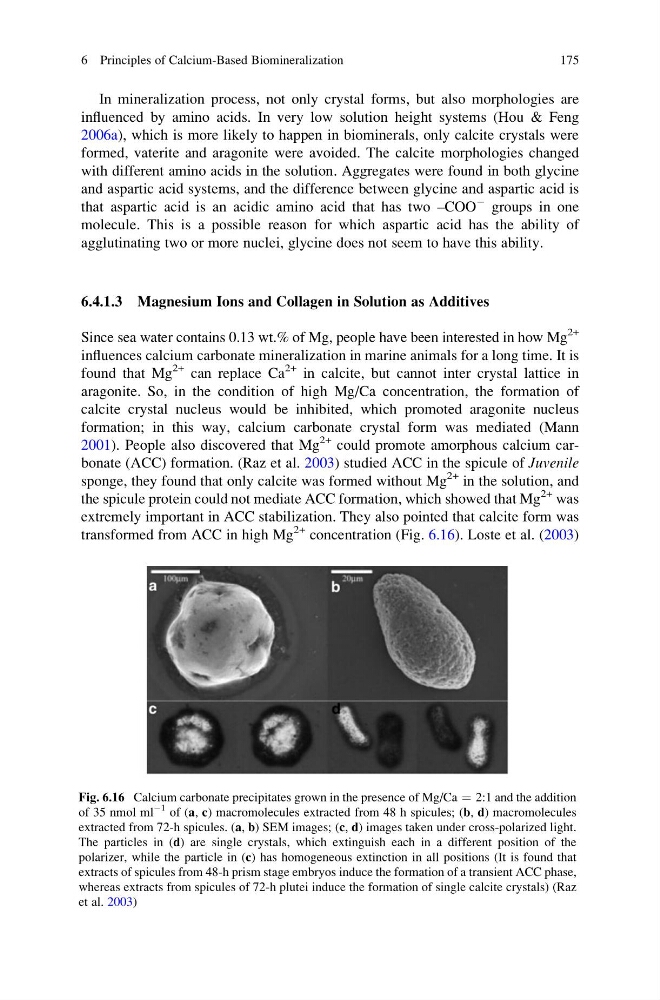
2+ could promote amorphous calcium carbonate (ACC) formation. (Raz et al. 2003) studied ACC in the spicule of Juvenile
sponge, they found that only calcite was formed without Mg
2+ in the solution, and
the spicule protein could not mediate ACC formation, which showed that Mg
2+ was
extremely important in ACC stabilization. They also pointed that calcite form was
transformed from ACC in high Mg
2+ concentration (Fig. 6.16). Loste et al. (2003)
Fig. 6.16 Calcium carbonate precipitates grown in the presence of Mg/Ca ¼ 2:1 and the addition
of 35 nmol ml
À1 of (a, c) macromolecules extracted from 48 h spicules; (b, d) macromolecules
extracted from 72-h spicules. (a, b) SEM images; (c, d) images taken under cross-polarized light.
The particles in (d) are single crystals, which extinguish each in a different position of the
polarizer, while the particle in (c) has homogeneous extinction in all positions (It is found that
extracts of spicules from 48-h prism stage embryos induce the formation of a transient ACC phase,
whereas extracts from spicules of 72-h plutei induce the formation of single calcite crystals) (Raz
et al. 2003)
6 Principles of Calcium-Based Biomineralization
175
influenced by amino acids. In very low solution height systems (Hou & Feng
2006a), which is more likely to happen in biominerals, only calcite crystals were
formed, vaterite and aragonite were avoided. The calcite morphologies changed
with different amino acids in the solution. Aggregates were found in both glycine
and aspartic acid systems, and the difference between glycine and aspartic acid is
that aspartic acid is an acidic amino acid that has two –COO
À groups in one
molecule. This is a possible reason for which aspartic acid has the ability of
agglutinating two or more nuclei, glycine does not seem to have this ability.
6.4.1.3 Magnesium Ions and Collagen in Solution as Additives
Since sea water contains 0.13 wt.% of Mg, people have been interested in how Mg
2+
influences calcium carbonate mineralization in marine animals for a long time. It is
found that Mg
2+ can replace Ca
2+ in calcite, but cannot inter crystal lattice in
aragonite. So, in the condition of high Mg/Ca concentration, the formation of
calcite crystal nucleus would be inhibited, which promoted aragonite nucleus
formation; in this way, calcium carbonate crystal form was mediated (Mann
2001). People also discovered that Mg
2+ could promote amorphous calcium carbonate (ACC) formation. (Raz et al. 2003) studied ACC in the spicule of Juvenile
sponge, they found that only calcite was formed without Mg
2+ in the solution, and
the spicule protein could not mediate ACC formation, which showed that Mg
2+ was
extremely important in ACC stabilization. They also pointed that calcite form was
transformed from ACC in high Mg
2+ concentration (Fig. 6.16). Loste et al. (2003)
Fig. 6.16 Calcium carbonate precipitates grown in the presence of Mg/Ca ¼ 2:1 and the addition
of 35 nmol ml
À1 of (a, c) macromolecules extracted from 48 h spicules; (b, d) macromolecules
extracted from 72-h spicules. (a, b) SEM images; (c, d) images taken under cross-polarized light.
The particles in (d) are single crystals, which extinguish each in a different position of the
polarizer, while the particle in (c) has homogeneous extinction in all positions (It is found that
extracts of spicules from 48-h prism stage embryos induce the formation of a transient ACC phase,
whereas extracts from spicules of 72-h plutei induce the formation of single calcite crystals) (Raz
et al. 2003)
6 Principles of Calcium-Based Biomineralization
175