

Although several early reports by Salvatore Bellini described the observation of
bacteria, in which the swimming direction was apparently affected by magnetic
fields, this research was only translated and published very recently (Bellini 2009a, b).
Therefore, it was Richard Blakemore’s report of MTB that initiated the research
activities during the last few decades (Blakemore 1975). Since then, the subject of
magnetosome biomineralization has evolved into an interdisciplinary and unique
field of research. The aim of this review is to give a broad overview of the current
state of knowledge on the bacteria with an emphasis on the materials that are
formed. Thus, we will point out the given properties that make this material so
special, and explain the molecular processes that enable such a property. Finally,
we will discuss what we believe to be possible new perspectives and directions for
future studies.
1.2 Magnetotactic Bacteria
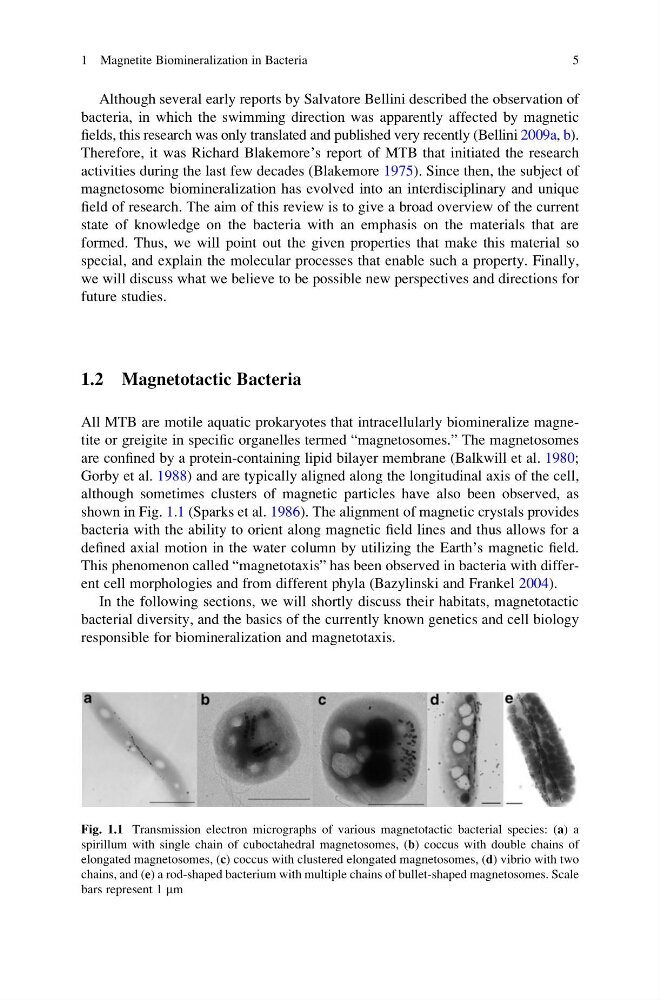
All MTB are motile aquatic prokaryotes that intracellularly biomineralize magnetite or greigite in specific organelles termed “magnetosomes.” The magnetosomes
are confined by a protein-containing lipid bilayer membrane (Balkwill et al. 1980;
Gorby et al. 1988) and are typically aligned along the longitudinal axis of the cell,
although sometimes clusters of magnetic particles have also been observed, as
shown in Fig. 1.1 (Sparks et al. 1986). The alignment of magnetic crystals provides
bacteria with the ability to orient along magnetic field lines and thus allows for a
defined axial motion in the water column by utilizing the Earth’s magnetic field.
This phenomenon called “magnetotaxis” has been observed in bacteria with different cell morphologies and from different phyla (Bazylinski and Frankel 2004).
In the following sections, we will shortly discuss their habitats, magnetotactic
bacterial diversity, and the basics of the currently known genetics and cell biology
responsible for biomineralization and magnetotaxis.
Fig. 1.1 Transmission electron micrographs of various magnetotactic bacterial species: (a) a
spirillum with single chain of cuboctahedral magnetosomes, (b) coccus with double chains of
elongated magnetosomes, (c) coccus with clustered elongated magnetosomes, (d) vibrio with two
chains, and (e) a rod-shaped bacterium with multiple chains of bullet-shaped magnetosomes. Scale
bars represent 1 mm
1 Magnetite Biomineralization in Bacteria
5
bacteria, in which the swimming direction was apparently affected by magnetic
fields, this research was only translated and published very recently (Bellini 2009a, b).
Therefore, it was Richard Blakemore’s report of MTB that initiated the research
activities during the last few decades (Blakemore 1975). Since then, the subject of
magnetosome biomineralization has evolved into an interdisciplinary and unique
field of research. The aim of this review is to give a broad overview of the current
state of knowledge on the bacteria with an emphasis on the materials that are
formed. Thus, we will point out the given properties that make this material so
special, and explain the molecular processes that enable such a property. Finally,
we will discuss what we believe to be possible new perspectives and directions for
future studies.
1.2 Magnetotactic Bacteria
All MTB are motile aquatic prokaryotes that intracellularly biomineralize magnetite or greigite in specific organelles termed “magnetosomes.” The magnetosomes
are confined by a protein-containing lipid bilayer membrane (Balkwill et al. 1980;
Gorby et al. 1988) and are typically aligned along the longitudinal axis of the cell,
although sometimes clusters of magnetic particles have also been observed, as
shown in Fig. 1.1 (Sparks et al. 1986). The alignment of magnetic crystals provides
bacteria with the ability to orient along magnetic field lines and thus allows for a
defined axial motion in the water column by utilizing the Earth’s magnetic field.
This phenomenon called “magnetotaxis” has been observed in bacteria with different cell morphologies and from different phyla (Bazylinski and Frankel 2004).
In the following sections, we will shortly discuss their habitats, magnetotactic
bacterial diversity, and the basics of the currently known genetics and cell biology
responsible for biomineralization and magnetotaxis.
Fig. 1.1 Transmission electron micrographs of various magnetotactic bacterial species: (a) a
spirillum with single chain of cuboctahedral magnetosomes, (b) coccus with double chains of
elongated magnetosomes, (c) coccus with clustered elongated magnetosomes, (d) vibrio with two
chains, and (e) a rod-shaped bacterium with multiple chains of bullet-shaped magnetosomes. Scale
bars represent 1 mm
1 Magnetite Biomineralization in Bacteria
5