

and nerves, which is called “haversian system” (level 5). The levels 6 and 7 refer to
solid versus spongy bone and whole bones, respectively.
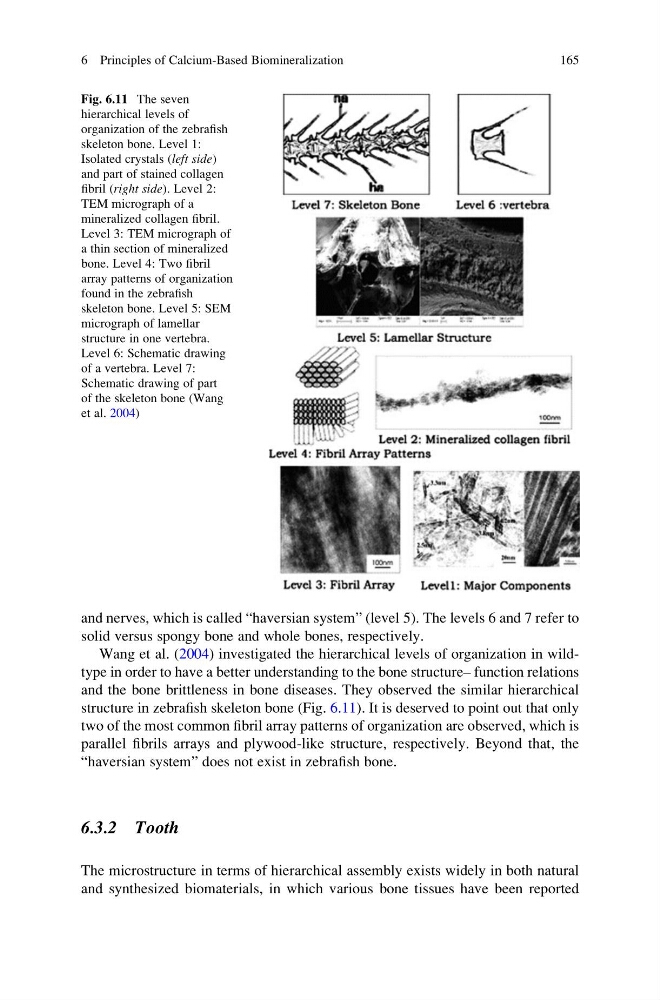
Wang et al. (2004) investigated the hierarchical levels of organization in wildtype in order to have a better understanding to the bone structure– function relations
and the bone brittleness in bone diseases. They observed the similar hierarchical
structure in zebrafish skeleton bone (Fig. 6.11). It is deserved to point out that only
two of the most common fibril array patterns of organization are observed, which is
parallel fibrils arrays and plywood-like structure, respectively. Beyond that, the
“haversian system” does not exist in zebrafish bone.
6.3.2 Tooth
The microstructure in terms of hierarchical assembly exists widely in both natural
and synthesized biomaterials, in which various bone tissues have been reported
Fig. 6.11 The seven
hierarchical levels of
organization of the zebrafish
skeleton bone. Level 1:
Isolated crystals (left side)
and part of stained collagen
fibril (right side). Level 2:
TEM micrograph of a
mineralized collagen fibril.
Level 3: TEM micrograph of
a thin section of mineralized
bone. Level 4: Two fibril
array patterns of organization
found in the zebrafish
skeleton bone. Level 5: SEM
micrograph of lamellar
structure in one vertebra.
Level 6: Schematic drawing
of a vertebra. Level 7:
Schematic drawing of part
of the skeleton bone (Wang
et al. 2004)
6 Principles of Calcium-Based Biomineralization
165
solid versus spongy bone and whole bones, respectively.
Wang et al. (2004) investigated the hierarchical levels of organization in wildtype in order to have a better understanding to the bone structure– function relations
and the bone brittleness in bone diseases. They observed the similar hierarchical
structure in zebrafish skeleton bone (Fig. 6.11). It is deserved to point out that only
two of the most common fibril array patterns of organization are observed, which is
parallel fibrils arrays and plywood-like structure, respectively. Beyond that, the
“haversian system” does not exist in zebrafish bone.
6.3.2 Tooth
The microstructure in terms of hierarchical assembly exists widely in both natural
and synthesized biomaterials, in which various bone tissues have been reported
Fig. 6.11 The seven
hierarchical levels of
organization of the zebrafish
skeleton bone. Level 1:
Isolated crystals (left side)
and part of stained collagen
fibril (right side). Level 2:
TEM micrograph of a
mineralized collagen fibril.
Level 3: TEM micrograph of
a thin section of mineralized
bone. Level 4: Two fibril
array patterns of organization
found in the zebrafish
skeleton bone. Level 5: SEM
micrograph of lamellar
structure in one vertebra.
Level 6: Schematic drawing
of a vertebra. Level 7:
Schematic drawing of part
of the skeleton bone (Wang
et al. 2004)
6 Principles of Calcium-Based Biomineralization
165