

It is well known that protein can modulate calcium carbonates not only in
polymorphs but also in morphology. The batten-like vaterite tablet found in lackluster pearls is a new kind of morphology, the reason for which may be considered
to contribute to changeable crystal face-specific growth rates under biological
control. Protein modifies the surface energies via preferential adsorption on crystal
surfaces; the final form of crystals would show the slow-growing surfaces. On the
other hand, another function of a matrix is a structure-matching template. The
matrix acts as an organic template to only align crystals perpendicular to the matrix
or array crystal iso-oriented with three-dimension crystallographic alignment. Due
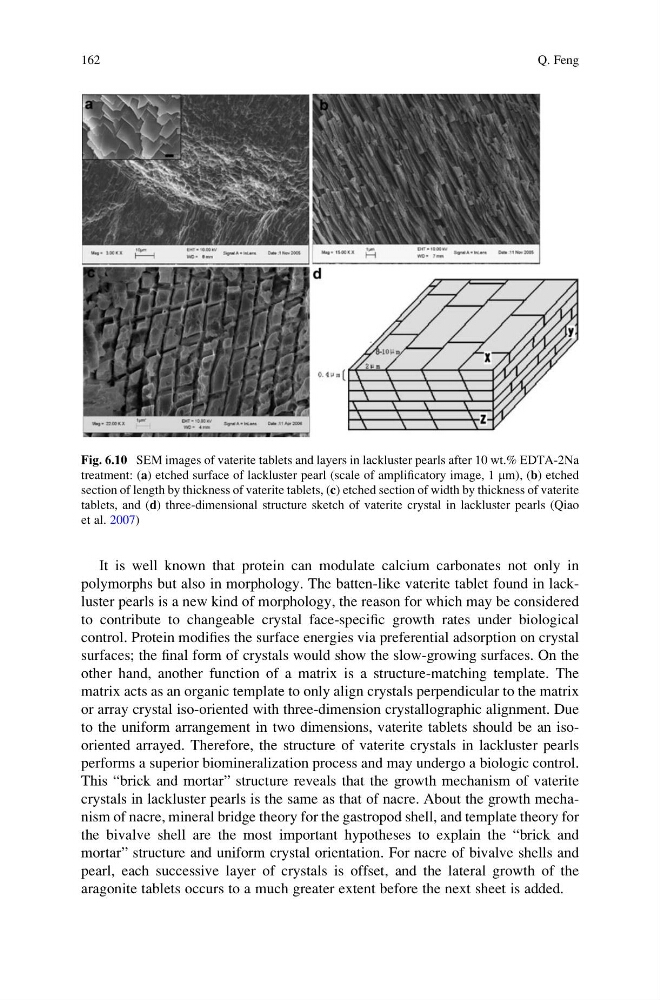
to the uniform arrangement in two dimensions, vaterite tablets should be an isooriented arrayed. Therefore, the structure of vaterite crystals in lackluster pearls
performs a superior biomineralization process and may undergo a biologic control.
This “brick and mortar” structure reveals that the growth mechanism of vaterite
crystals in lackluster pearls is the same as that of nacre. About the growth mechanism of nacre, mineral bridge theory for the gastropod shell, and template theory for
the bivalve shell are the most important hypotheses to explain the “brick and
mortar” structure and uniform crystal orientation. For nacre of bivalve shells and
pearl, each successive layer of crystals is offset, and the lateral growth of the
aragonite tablets occurs to a much greater extent before the next sheet is added.
Fig. 6.10 SEM images of vaterite tablets and layers in lackluster pearls after 10 wt.% EDTA-2Na
treatment: (a) etched surface of lackluster pearl (scale of amplificatory image, 1 mm), (b) etched
section of length by thickness of vaterite tablets, (c) etched section of width by thickness of vaterite
tablets, and (d) three-dimensional structure sketch of vaterite crystal in lackluster pearls (Qiao
et al. 2007)
162
Q. Feng
polymorphs but also in morphology. The batten-like vaterite tablet found in lackluster pearls is a new kind of morphology, the reason for which may be considered
to contribute to changeable crystal face-specific growth rates under biological
control. Protein modifies the surface energies via preferential adsorption on crystal
surfaces; the final form of crystals would show the slow-growing surfaces. On the
other hand, another function of a matrix is a structure-matching template. The
matrix acts as an organic template to only align crystals perpendicular to the matrix
or array crystal iso-oriented with three-dimension crystallographic alignment. Due
to the uniform arrangement in two dimensions, vaterite tablets should be an isooriented arrayed. Therefore, the structure of vaterite crystals in lackluster pearls
performs a superior biomineralization process and may undergo a biologic control.
This “brick and mortar” structure reveals that the growth mechanism of vaterite
crystals in lackluster pearls is the same as that of nacre. About the growth mechanism of nacre, mineral bridge theory for the gastropod shell, and template theory for
the bivalve shell are the most important hypotheses to explain the “brick and
mortar” structure and uniform crystal orientation. For nacre of bivalve shells and
pearl, each successive layer of crystals is offset, and the lateral growth of the
aragonite tablets occurs to a much greater extent before the next sheet is added.
Fig. 6.10 SEM images of vaterite tablets and layers in lackluster pearls after 10 wt.% EDTA-2Na
treatment: (a) etched surface of lackluster pearl (scale of amplificatory image, 1 mm), (b) etched
section of length by thickness of vaterite tablets, (c) etched section of width by thickness of vaterite
tablets, and (d) three-dimensional structure sketch of vaterite crystal in lackluster pearls (Qiao
et al. 2007)
162
Q. Feng