

electronegative nature of the cell membranes (crystal nucleation sites, see
Sect. 5.4), this can create a unique precipitation environment on microscale
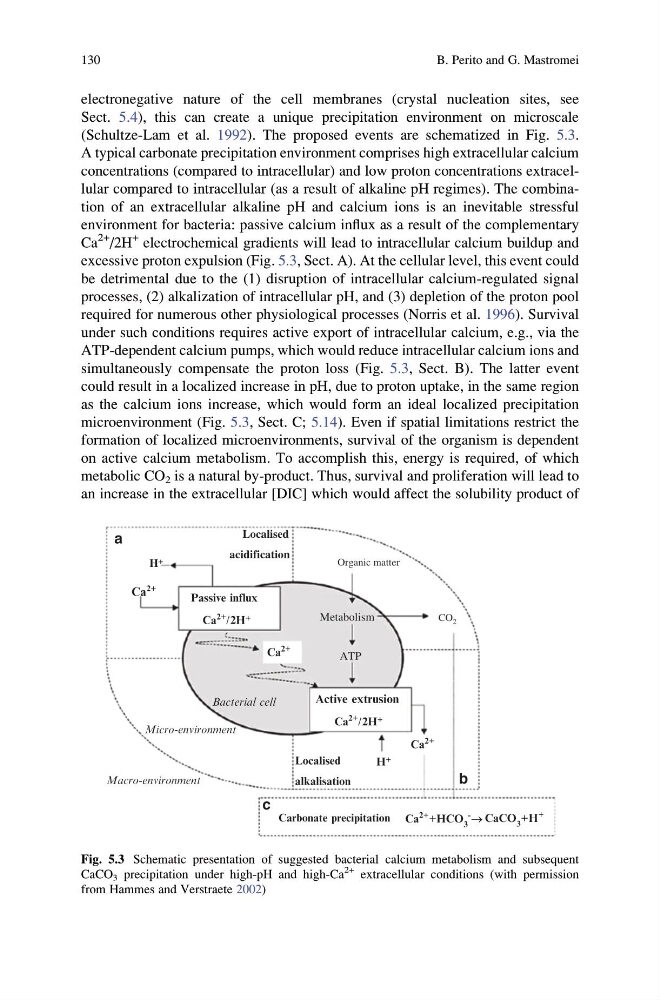
(Schultze-Lam et al. 1992). The proposed events are schematized in Fig. 5.3.
A typical carbonate precipitation environment comprises high extracellular calcium
concentrations (compared to intracellular) and low proton concentrations extracellular compared to intracellular (as a result of alkaline pH regimes). The combination of an extracellular alkaline pH and calcium ions is an inevitable stressful
environment for bacteria: passive calcium influx as a result of the complementary
Ca
2+ /2H
+ electrochemical gradients will lead to intracellular calcium buildup and
excessive proton expulsion (Fig. 5.3, Sect. A). At the cellular level, this event could
be detrimental due to the (1) disruption of intracellular calcium-regulated signal
processes, (2) alkalization of intracellular pH, and (3) depletion of the proton pool
required for numerous other physiological processes (Norris et al. 1996). Survival
under such conditions requires active export of intracellular calcium, e.g., via the
ATP-dependent calcium pumps, which would reduce intracellular calcium ions and
simultaneously compensate the proton loss (Fig. 5.3, Sect. B). The latter event
could result in a localized increase in pH, due to proton uptake, in the same region
as the calcium ions increase, which would form an ideal localized precipitation
microenvironment (Fig. 5.3, Sect. C; 5.14). Even if spatial limitations restrict the
formation of localized microenvironments, survival of the organism is dependent
on active calcium metabolism. To accomplish this, energy is required, of which
metabolic CO 2 is a natural by-product. Thus, survival and proliferation will lead to
an increase in the extracellular [DIC] which would affect the solubility product of
Localised
Localised
alkalisation
Carbonate precipitation
acidification
Passive influx
ATP
Metabolism
Active extrusion
Micro-environment
Bacterial cell
Macro-environment
Ca
2+
/2H +
Ca
2+
Ca
2+
/2H +
H +
Ca
2+
Ca
2+
H +
Organic matter
CO 2
Ca
2+
+HCO 3
- ® CaCO 3 +H
+
a
b
c
Fig. 5.3 Schematic presentation of suggested bacterial calcium metabolism and subsequent
CaCO 3 precipitation under high-pH and high-Ca
2+ extracellular conditions (with permission
from Hammes and Verstraete 2002)
130
B. Perito and G. Mastromei
Sect. 5.4), this can create a unique precipitation environment on microscale
(Schultze-Lam et al. 1992). The proposed events are schematized in Fig. 5.3.
A typical carbonate precipitation environment comprises high extracellular calcium
concentrations (compared to intracellular) and low proton concentrations extracellular compared to intracellular (as a result of alkaline pH regimes). The combination of an extracellular alkaline pH and calcium ions is an inevitable stressful
environment for bacteria: passive calcium influx as a result of the complementary
Ca
2+ /2H
+ electrochemical gradients will lead to intracellular calcium buildup and
excessive proton expulsion (Fig. 5.3, Sect. A). At the cellular level, this event could
be detrimental due to the (1) disruption of intracellular calcium-regulated signal
processes, (2) alkalization of intracellular pH, and (3) depletion of the proton pool
required for numerous other physiological processes (Norris et al. 1996). Survival
under such conditions requires active export of intracellular calcium, e.g., via the
ATP-dependent calcium pumps, which would reduce intracellular calcium ions and
simultaneously compensate the proton loss (Fig. 5.3, Sect. B). The latter event
could result in a localized increase in pH, due to proton uptake, in the same region
as the calcium ions increase, which would form an ideal localized precipitation
microenvironment (Fig. 5.3, Sect. C; 5.14). Even if spatial limitations restrict the
formation of localized microenvironments, survival of the organism is dependent
on active calcium metabolism. To accomplish this, energy is required, of which
metabolic CO 2 is a natural by-product. Thus, survival and proliferation will lead to
an increase in the extracellular [DIC] which would affect the solubility product of
Localised
Localised
alkalisation
Carbonate precipitation
acidification
Passive influx
ATP
Metabolism
Active extrusion
Micro-environment
Bacterial cell
Macro-environment
Ca
2+
/2H +
Ca
2+
Ca
2+
/2H +
H +
Ca
2+
Ca
2+
H +
Organic matter
CO 2
Ca
2+
+HCO 3
- ® CaCO 3 +H
+
a
b
c
Fig. 5.3 Schematic presentation of suggested bacterial calcium metabolism and subsequent
CaCO 3 precipitation under high-pH and high-Ca
2+ extracellular conditions (with permission
from Hammes and Verstraete 2002)
130
B. Perito and G. Mastromei