

produced H 2 S, and the resulting pH increase, is a prerequisite for carbonate
precipitation to occur. In a natural environment, sulfide can be removed as gas or
combined with iron to produce pyrite (Wright 1999), or it can be converted by
anoxygenic sulfide phototrophic bacteria to elemental sulfur.
Precipitation via this pathway has been described in seawater, geological
formations, during the biological treatment of acid mine drainage, in microbial
mats (Hammes and Verstraete 2002). The reaction often starts with the dissolution
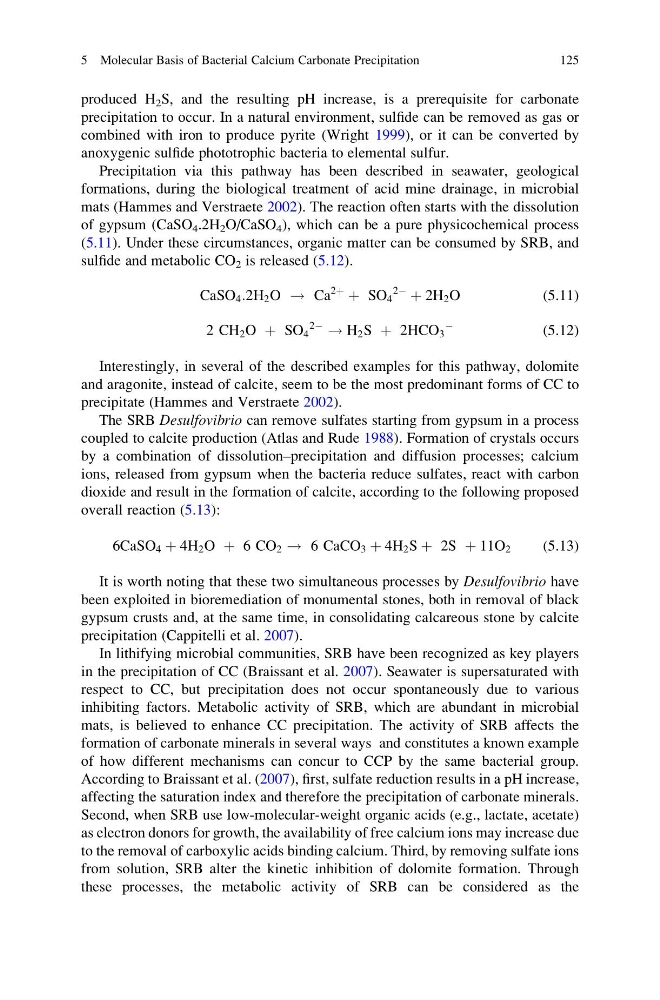
of gypsum (CaSO 4 .2H 2 O/CaSO 4 ), which can be a pure physicochemical process
(5.11). Under these circumstances, organic matter can be consumed by SRB, and
sulfide and metabolic CO 2 is released (5.12).
CaSO 4 :2H 2 O ! Ca
2þ
þ SO 4
2À
þ 2H 2 O
(5.11)
2 CH 2 O þ SO 4
2À
! H 2 S þ 2HCO 3
À
(5.12)
Interestingly, in several of the described examples for this pathway, dolomite
and aragonite, instead of calcite, seem to be the most predominant forms of CC to
precipitate (Hammes and Verstraete 2002).
The SRB Desulfovibrio can remove sulfates starting from gypsum in a process
coupled to calcite production (Atlas and Rude 1988). Formation of crystals occurs
by a combination of dissolution–precipitation and diffusion processes; calcium
ions, released from gypsum when the bacteria reduce sulfates, react with carbon
dioxide and result in the formation of calcite, according to the following proposed
overall reaction (5.13):
6CaSO 4 þ 4H 2 O þ 6 CO 2 ! 6 CaCO 3 þ 4H 2 S þ 2S þ 11O 2
(5.13)
It is worth noting that these two simultaneous processes by Desulfovibrio have
been exploited in bioremediation of monumental stones, both in removal of black
gypsum crusts and, at the same time, in consolidating calcareous stone by calcite
precipitation (Cappitelli et al. 2007).
In lithifying microbial communities, SRB have been recognized as key players
in the precipitation of CC (Braissant et al. 2007). Seawater is supersaturated with
respect to CC, but precipitation does not occur spontaneously due to various
inhibiting factors. Metabolic activity of SRB, which are abundant in microbial
mats, is believed to enhance CC precipitation. The activity of SRB affects the
formation of carbonate minerals in several ways and constitutes a known example
of how different mechanisms can concur to CCP by the same bacterial group.
According to Braissant et al. (2007), first, sulfate reduction results in a pH increase,
affecting the saturation index and therefore the precipitation of carbonate minerals.
Second, when SRB use low-molecular-weight organic acids (e.g., lactate, acetate)
as electron donors for growth, the availability of free calcium ions may increase due
to the removal of carboxylic acids binding calcium. Third, by removing sulfate ions
from solution, SRB alter the kinetic inhibition of dolomite formation. Through
these processes, the metabolic activity of SRB can be considered as the
5 Molecular Basis of Bacterial Calcium Carbonate Precipitation
125
precipitation to occur. In a natural environment, sulfide can be removed as gas or
combined with iron to produce pyrite (Wright 1999), or it can be converted by
anoxygenic sulfide phototrophic bacteria to elemental sulfur.
Precipitation via this pathway has been described in seawater, geological
formations, during the biological treatment of acid mine drainage, in microbial
mats (Hammes and Verstraete 2002). The reaction often starts with the dissolution
of gypsum (CaSO 4 .2H 2 O/CaSO 4 ), which can be a pure physicochemical process
(5.11). Under these circumstances, organic matter can be consumed by SRB, and
sulfide and metabolic CO 2 is released (5.12).
CaSO 4 :2H 2 O ! Ca
2þ
þ SO 4
2À
þ 2H 2 O
(5.11)
2 CH 2 O þ SO 4
2À
! H 2 S þ 2HCO 3
À
(5.12)
Interestingly, in several of the described examples for this pathway, dolomite
and aragonite, instead of calcite, seem to be the most predominant forms of CC to
precipitate (Hammes and Verstraete 2002).
The SRB Desulfovibrio can remove sulfates starting from gypsum in a process
coupled to calcite production (Atlas and Rude 1988). Formation of crystals occurs
by a combination of dissolution–precipitation and diffusion processes; calcium
ions, released from gypsum when the bacteria reduce sulfates, react with carbon
dioxide and result in the formation of calcite, according to the following proposed
overall reaction (5.13):
6CaSO 4 þ 4H 2 O þ 6 CO 2 ! 6 CaCO 3 þ 4H 2 S þ 2S þ 11O 2
(5.13)
It is worth noting that these two simultaneous processes by Desulfovibrio have
been exploited in bioremediation of monumental stones, both in removal of black
gypsum crusts and, at the same time, in consolidating calcareous stone by calcite
precipitation (Cappitelli et al. 2007).
In lithifying microbial communities, SRB have been recognized as key players
in the precipitation of CC (Braissant et al. 2007). Seawater is supersaturated with
respect to CC, but precipitation does not occur spontaneously due to various
inhibiting factors. Metabolic activity of SRB, which are abundant in microbial
mats, is believed to enhance CC precipitation. The activity of SRB affects the
formation of carbonate minerals in several ways and constitutes a known example
of how different mechanisms can concur to CCP by the same bacterial group.
According to Braissant et al. (2007), first, sulfate reduction results in a pH increase,
affecting the saturation index and therefore the precipitation of carbonate minerals.
Second, when SRB use low-molecular-weight organic acids (e.g., lactate, acetate)
as electron donors for growth, the availability of free calcium ions may increase due
to the removal of carboxylic acids binding calcium. Third, by removing sulfate ions
from solution, SRB alter the kinetic inhibition of dolomite formation. Through
these processes, the metabolic activity of SRB can be considered as the
5 Molecular Basis of Bacterial Calcium Carbonate Precipitation
125