

Pacific Ocean, as well as in the Indian and Atlantic Oceans (Yihua and Yipu 2002;
Glasby 2006). The crusts are slightly older than nodules (can become 20 MYR old).
Like the nodules, the Co-rich crusts are formed at low temperatures on the cold
deep-sea floor at the interface between the aqueous phase and the seamount slopes
mainly basalts being the substrate. The growth rate of the crusts is also slow,
1–2 mm Ma
À1 (Glasby 2006).
4.5.2 Morphology of the Crusts
Crust samples used in our investigations (Wang et al. 2009a) were collected from
the Magellan seamount which is located in the northwest edge of the Mariana basin
and represents relatively independent guyots/flat-topped seamounts. The depth of
shallowest guyots is about 800–1,500 m and that of the adjacent marine basin is
about 5,000–6,500 m. The crust samples have a total thickness of 35 mm with an
upper layer of 23 mm, a lower layer of 9 mm, and a separating boundary layer of
3 mm. Since this latter layer has a bright, fatlike appearance, it was termed “speck
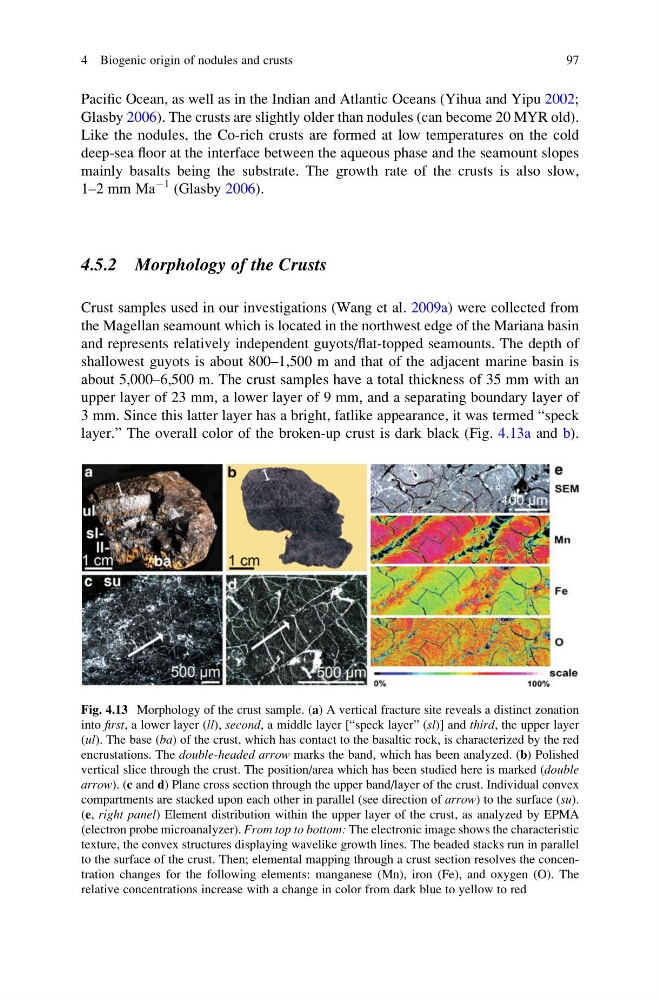
layer.” The overall color of the broken-up crust is dark black (Fig. 4.13a and b).
Fig. 4.13 Morphology of the crust sample. (a) A vertical fracture site reveals a distinct zonation
into first, a lower layer (ll), second, a middle layer [“speck layer” (sl)] and third, the upper layer
(ul). The base (ba) of the crust, which has contact to the basaltic rock, is characterized by the red
encrustations. The double-headed arrow marks the band, which has been analyzed. (b) Polished
vertical slice through the crust. The position/area which has been studied here is marked (double
arrow). (c and d) Plane cross section through the upper band/layer of the crust. Individual convex
compartments are stacked upon each other in parallel (see direction of arrow) to the surface (su).
(e, right panel) Element distribution within the upper layer of the crust, as analyzed by EPMA
(electron probe microanalyzer). From top to bottom: The electronic image shows the characteristic
texture, the convex structures displaying wavelike growth lines. The beaded stacks run in parallel
to the surface of the crust. Then; elemental mapping through a crust section resolves the concentration changes for the following elements: manganese (Mn), iron (Fe), and oxygen (O). The
relative concentrations increase with a change in color from dark blue to yellow to red
4 Biogenic origin of nodules and crusts
97
Glasby 2006). The crusts are slightly older than nodules (can become 20 MYR old).
Like the nodules, the Co-rich crusts are formed at low temperatures on the cold
deep-sea floor at the interface between the aqueous phase and the seamount slopes
mainly basalts being the substrate. The growth rate of the crusts is also slow,
1–2 mm Ma
À1 (Glasby 2006).
4.5.2 Morphology of the Crusts
Crust samples used in our investigations (Wang et al. 2009a) were collected from
the Magellan seamount which is located in the northwest edge of the Mariana basin
and represents relatively independent guyots/flat-topped seamounts. The depth of
shallowest guyots is about 800–1,500 m and that of the adjacent marine basin is
about 5,000–6,500 m. The crust samples have a total thickness of 35 mm with an
upper layer of 23 mm, a lower layer of 9 mm, and a separating boundary layer of
3 mm. Since this latter layer has a bright, fatlike appearance, it was termed “speck
layer.” The overall color of the broken-up crust is dark black (Fig. 4.13a and b).
Fig. 4.13 Morphology of the crust sample. (a) A vertical fracture site reveals a distinct zonation
into first, a lower layer (ll), second, a middle layer [“speck layer” (sl)] and third, the upper layer
(ul). The base (ba) of the crust, which has contact to the basaltic rock, is characterized by the red
encrustations. The double-headed arrow marks the band, which has been analyzed. (b) Polished
vertical slice through the crust. The position/area which has been studied here is marked (double
arrow). (c and d) Plane cross section through the upper band/layer of the crust. Individual convex
compartments are stacked upon each other in parallel (see direction of arrow) to the surface (su).
(e, right panel) Element distribution within the upper layer of the crust, as analyzed by EPMA
(electron probe microanalyzer). From top to bottom: The electronic image shows the characteristic
texture, the convex structures displaying wavelike growth lines. The beaded stacks run in parallel
to the surface of the crust. Then; elemental mapping through a crust section resolves the concentration changes for the following elements: manganese (Mn), iron (Fe), and oxygen (O). The
relative concentrations increase with a change in color from dark blue to yellow to red
4 Biogenic origin of nodules and crusts
97