

84
Plankton in Coral-Reef Waters
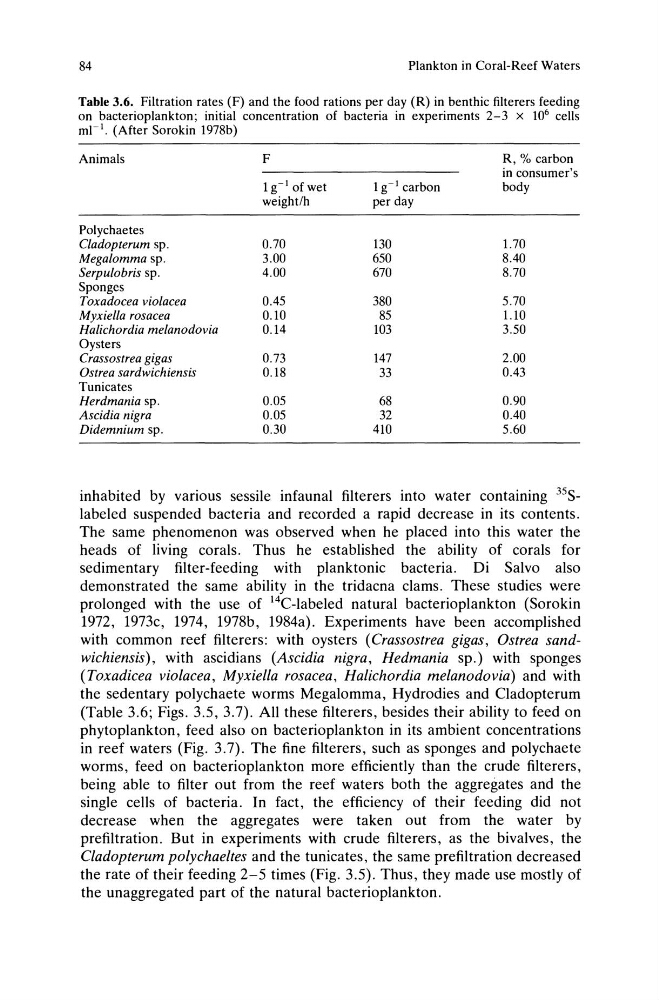
Table 3.6. Filtration rates (F) and the food rations per day (R) in benthic filterers feeding
on bacterioplankton; initial concentration of bacteria in experiments 2-3 x 10 6 cells
ml- 1 . (After Sorokin 1978b)
Animals
Polychaetes
Cladopterum sp.
Megalomma sp.
Serpulobris sp.
Sponges
Toxadocea violacea
Myxiella rosacea
Halichordia melanodovia
Oysters
Crassostrea gigas
Ostrea sardwichiensis
Tunicates
Herdmania sp.
Ascidia nigra
Didemnium sp.
F
Ig- 1 ofwet
weight/h
0.70
3.00
4.00
0.45
0.10
0.14
0.73
0.18
0.05
0.05
0.30
R, % carbon
in consumer's
1 g-l carbon
body
per day
130
1.70
650
8.40
670
8.70
380
5.70
85
1.10
103
3.50
147
2.00
33
0.43
68
0.90
32
0.40
410
5.60
inhabited by various sessile infaunal filterers into water contammg 35S_
labeled suspended bacteria and recorded a rapid decrease in its contents.
The same phenomenon was observed when he placed into this water the
heads of living corals. Thus he established the ability of corals for
sedimentary filter-feeding with planktonic bacteria. Di Salvo also
demonstrated the same ability in the tridacna clams. These studies were
prolonged with the use of 14C-labeled natural bacterioplankton (Sorokin
1972, 1973c, 1974, 1978b, 1984a). Experiments have been accomplished
with common reef filterers: with oysters (Crassostrea gigas, Ostrea sandwichiensis) , with ascidians (Ascidia nigra, Hedmania sp.) with sponges
(Toxadicea violacea, Myxiella rosacea, Halichordia melanodovia) and with
the sedentary polychaete worms Megalomma, Hydrodies and Cladopterum
(Table 3.6; Figs. 3.5, 3.7). All these filterers, besides their ability to feed on
phytoplankton, feed also on bacterioplankton in its ambient concentrations
in reef waters (Fig. 3.7). The fine filterers, such as sponges and polychaete
worms, feed on bacterioplankton more efficiently than the crude filterers,
being able to filter out from the reef waters both the aggregates and the
single cells of bacteria. In fact, the efficiency of their feeding did not
decrease when the aggregates were taken out from the water by
prefiltration. But in experiments with crude filterers, as the bivalves, the
Cladopterum polychaeltes and the tunicates, the same pre filtration decreased
the rate of their feeding 2-5 times (Fig. 3.5). Thus, they made use mostly of
the un aggregated part of the natural bacterioplankton.
Plankton in Coral-Reef Waters
Table 3.6. Filtration rates (F) and the food rations per day (R) in benthic filterers feeding
on bacterioplankton; initial concentration of bacteria in experiments 2-3 x 10 6 cells
ml- 1 . (After Sorokin 1978b)
Animals
Polychaetes
Cladopterum sp.
Megalomma sp.
Serpulobris sp.
Sponges
Toxadocea violacea
Myxiella rosacea
Halichordia melanodovia
Oysters
Crassostrea gigas
Ostrea sardwichiensis
Tunicates
Herdmania sp.
Ascidia nigra
Didemnium sp.
F
Ig- 1 ofwet
weight/h
0.70
3.00
4.00
0.45
0.10
0.14
0.73
0.18
0.05
0.05
0.30
R, % carbon
in consumer's
1 g-l carbon
body
per day
130
1.70
650
8.40
670
8.70
380
5.70
85
1.10
103
3.50
147
2.00
33
0.43
68
0.90
32
0.40
410
5.60
inhabited by various sessile infaunal filterers into water contammg 35S_
labeled suspended bacteria and recorded a rapid decrease in its contents.
The same phenomenon was observed when he placed into this water the
heads of living corals. Thus he established the ability of corals for
sedimentary filter-feeding with planktonic bacteria. Di Salvo also
demonstrated the same ability in the tridacna clams. These studies were
prolonged with the use of 14C-labeled natural bacterioplankton (Sorokin
1972, 1973c, 1974, 1978b, 1984a). Experiments have been accomplished
with common reef filterers: with oysters (Crassostrea gigas, Ostrea sandwichiensis) , with ascidians (Ascidia nigra, Hedmania sp.) with sponges
(Toxadicea violacea, Myxiella rosacea, Halichordia melanodovia) and with
the sedentary polychaete worms Megalomma, Hydrodies and Cladopterum
(Table 3.6; Figs. 3.5, 3.7). All these filterers, besides their ability to feed on
phytoplankton, feed also on bacterioplankton in its ambient concentrations
in reef waters (Fig. 3.7). The fine filterers, such as sponges and polychaete
worms, feed on bacterioplankton more efficiently than the crude filterers,
being able to filter out from the reef waters both the aggregates and the
single cells of bacteria. In fact, the efficiency of their feeding did not
decrease when the aggregates were taken out from the water by
prefiltration. But in experiments with crude filterers, as the bivalves, the
Cladopterum polychaeltes and the tunicates, the same pre filtration decreased
the rate of their feeding 2-5 times (Fig. 3.5). Thus, they made use mostly of
the un aggregated part of the natural bacterioplankton.