

Nutrients
55
Table 2.4. Calculated values of annual Nz-fixation (kgN hectare-I) according to results
of estimations in samples of bottom sediments and in periphyton
Substrate, biotope
Nz-fixation
Ranges
Periphyton on rubble
18-368
Same
41-506
Same
3-14
Periphyton on rocks
41-2500
(windward flat)
Same (leeward reef)
0-20
Same (outer slope)
2-153
Coral sand
3-384
Same
4-40
2.2 Dynamics of Nutrients
Average
493
684
4.4
20
91
15
Reference
Mague and Holm Hansen (1975)
Wiebe et al. (1975)
Burris (1976)
Hanson and Gundersen (1976)
Wilkinson et al. (1984)
Wilkinson et al. (1989)
Potts and Whitton (1977)
Odintsov and Propp (1985)
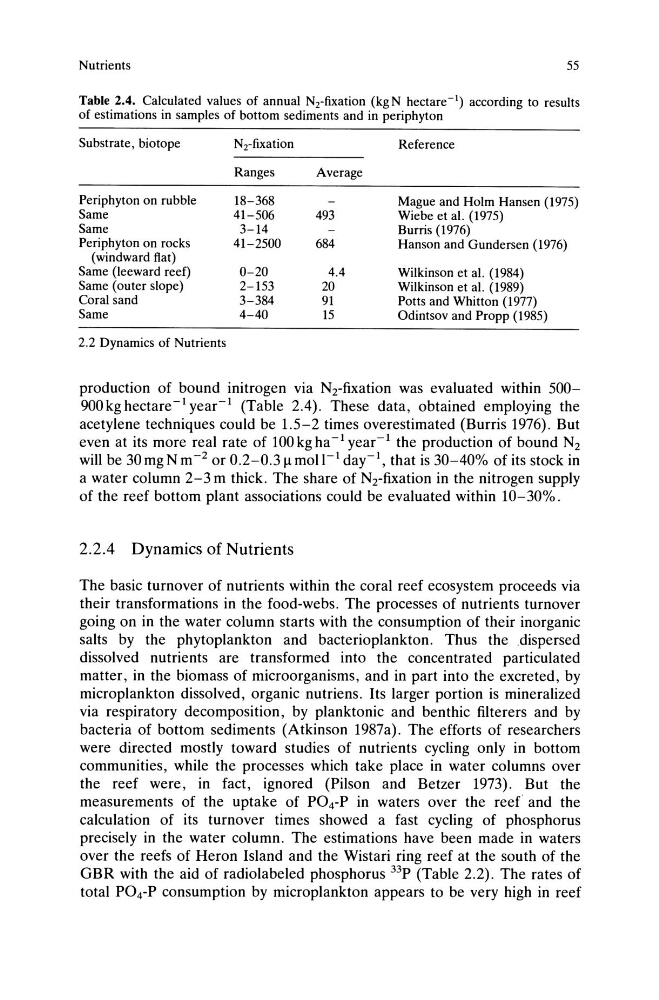
production of bound initrogen via N2-fixation was evaluated within 500900kghectare- 1 year- 1 (Table 2.4). These data, obtained employing the
acetylene techniques could be 1.5-2 times overestimated (Burris 1976). But
even at its more real rate of 100 kg ha -I year- I the production of bound N2
will be 30mgNm- 2 or 0.2-0.3 Ilmoll-1 day-I, that is 30-40% of its stock in
a water column 2-3 m thick. The share of Nz-fixation in the nitrogen supply
of the reef bottom plant associations could be evaluated within 10-30%.
2.2.4 Dynamics of Nutrients
The basic turnover of nutrients within the coral reef ecosystem proceeds via
their transformations in the food-webs. The processes of nutrients turnover
going on in the water column starts with the consumption of their inorganic
salts by the phytoplankton and bacterioplankton. Thus the dispersed
dissolved nutrients are transformed into the concentrated particulated
matter, in the biomass of microorganisms, and in part into the excreted, by
microplankton dissolved, organic nutriens. Its larger portion is mineralized
via respiratory decomposition, by planktonic and benthic filterers and by
bacteria of bottom sediments (Atkinson 1987a). The efforts of researchers
were directed mostly toward studies of nutrients cycling only in bottom
communities, while the processes which take place in water columns over
the reef were, in fact, ignored (Pilson and Betzer 1973). But the
measurements of the uptake of P04-P in waters over the reef and the
calculation of its turnover times showed a fast cycling of phosphorus
precisely in the water column. The estimations have been made in waters
over the reefs of Heron Island and the Wistari ring reef at the south of the
GBR with the aid of radiolabeled phosphorus 33p (Table 2.2). The rates of
total P0 4 -P consumption by microplankton appears to be very high in reef
55
Table 2.4. Calculated values of annual Nz-fixation (kgN hectare-I) according to results
of estimations in samples of bottom sediments and in periphyton
Substrate, biotope
Nz-fixation
Ranges
Periphyton on rubble
18-368
Same
41-506
Same
3-14
Periphyton on rocks
41-2500
(windward flat)
Same (leeward reef)
0-20
Same (outer slope)
2-153
Coral sand
3-384
Same
4-40
2.2 Dynamics of Nutrients
Average
493
684
4.4
20
91
15
Reference
Mague and Holm Hansen (1975)
Wiebe et al. (1975)
Burris (1976)
Hanson and Gundersen (1976)
Wilkinson et al. (1984)
Wilkinson et al. (1989)
Potts and Whitton (1977)
Odintsov and Propp (1985)
production of bound initrogen via N2-fixation was evaluated within 500900kghectare- 1 year- 1 (Table 2.4). These data, obtained employing the
acetylene techniques could be 1.5-2 times overestimated (Burris 1976). But
even at its more real rate of 100 kg ha -I year- I the production of bound N2
will be 30mgNm- 2 or 0.2-0.3 Ilmoll-1 day-I, that is 30-40% of its stock in
a water column 2-3 m thick. The share of Nz-fixation in the nitrogen supply
of the reef bottom plant associations could be evaluated within 10-30%.
2.2.4 Dynamics of Nutrients
The basic turnover of nutrients within the coral reef ecosystem proceeds via
their transformations in the food-webs. The processes of nutrients turnover
going on in the water column starts with the consumption of their inorganic
salts by the phytoplankton and bacterioplankton. Thus the dispersed
dissolved nutrients are transformed into the concentrated particulated
matter, in the biomass of microorganisms, and in part into the excreted, by
microplankton dissolved, organic nutriens. Its larger portion is mineralized
via respiratory decomposition, by planktonic and benthic filterers and by
bacteria of bottom sediments (Atkinson 1987a). The efforts of researchers
were directed mostly toward studies of nutrients cycling only in bottom
communities, while the processes which take place in water columns over
the reef were, in fact, ignored (Pilson and Betzer 1973). But the
measurements of the uptake of P04-P in waters over the reef and the
calculation of its turnover times showed a fast cycling of phosphorus
precisely in the water column. The estimations have been made in waters
over the reefs of Heron Island and the Wistari ring reef at the south of the
GBR with the aid of radiolabeled phosphorus 33p (Table 2.2). The rates of
total P0 4 -P consumption by microplankton appears to be very high in reef