

Hydrodynamics and Thermohaline Features of Reef Waters
35
reef bottom communities and on their functioning. The amplitudes and the
periodicity of tides are very variable in different regions. On the Caribbean
reefs the tides are so small that they are called microtides (Kjerfve et al.
1982). Their amplitudes are only 15-30 cm (Roberts et al. 1975). But even
such microtides may induce significant tide currents with a velocity of up to
30cm/s- 1 (Geer and Kjerfve 1982). At the Pacific atolls, the heights of tides
are usually within 0.5-2.5 m (Gallagher et al. 1971; Sournia and Ricard
1976a; Atkinson et al. 1981). The average height of tides in the GBR area is
I-3m, but in some places it might be up to 9.5m (Ludington 1979; Frith
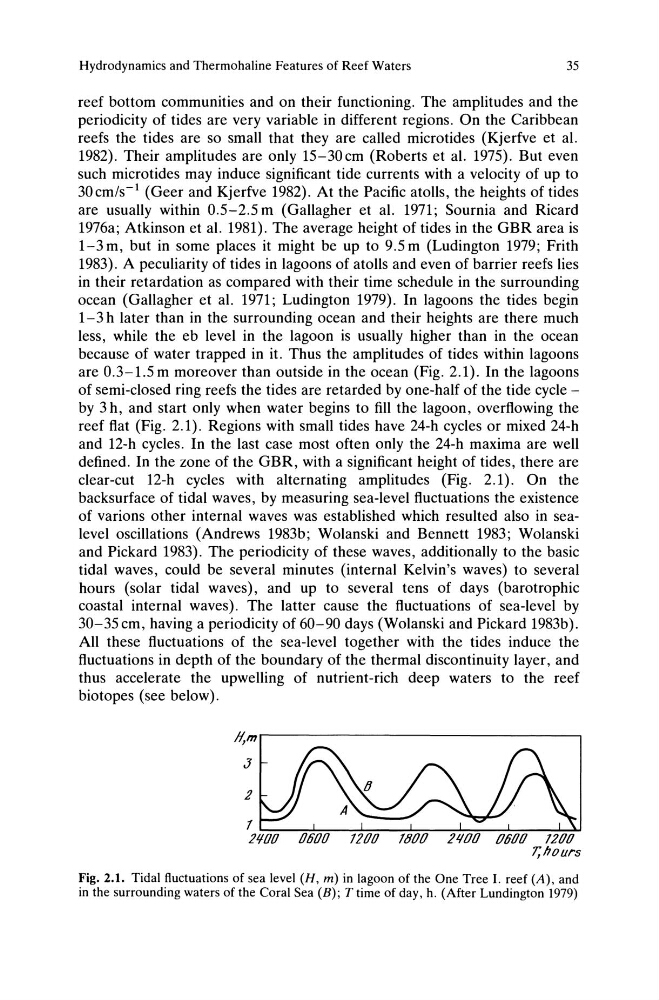
1983). A peculiarity of tides in lagoons of atolls and even of barrier reefs lies
in their retardation as compared with their time schedule in the surrounding
ocean (Gallagher et al. 1971; Ludington 1979). In lagoons the tides begin
1-3 h later than in the surrounding ocean and their heights are there much
less, while the eb level in the lagoon is usually higher than in the ocean
because of water trapped in it. Thus the amplitudes of tides within lagoons
are 0.3-1.5m moreover than outside in the ocean (Fig. 2.1). In the lagoons
of semi-closed ring reefs the tides are retarded by one-half of the tide cycle -
by 3 h, and start only when water begins to fill the lagoon, overflowing the
reef flat (Fig. 2.1). Regions with small tides have 24-h cycles or mixed 24-h
and 12-h cycles. In the last case most often only the 24-h maxima are well
defined. In the zone of the GBR, with a significant height of tides, there are
clear-cut 12-h cycles with alternating amplitudes (Fig. 2.1). On the
backsurface of tidal waves, by measuring sea-level fluctuations the existence
of varions other internal waves was established which resulted also in sealevel oscillations (Andrews 1983b; Wolanski and Bennett 1983; Wolanski
and Pickard 1983). The periodicity of these waves, additionally to the basic
tidal waves, could be several minutes (internal Kelvin's waves) to several
hours (solar tidal waves), and up to several tens of days (barotrophic
coastal internal waves). The latter cause the fluctuations of sea-level by
30-35 cm, having a periodicity of 60-90 days (Wolanski and Pickard 1983b).
All these fluctuations of the sea-level together with the tides induce the
fluctuations in depth of the boundary of the thermal discontinuity layer, and
thus accelerate the upwelling of nutrient-rich deep waters to the reef
biotopes (see below).
Fig. 2.1. Tidal fluctuations of sea level (H, m) in lagoon of the One Tree I. reef (AL and
in the surrounding waters of the Coral Sea (B); T time of day, h. (After Lundington 1979)
35
reef bottom communities and on their functioning. The amplitudes and the
periodicity of tides are very variable in different regions. On the Caribbean
reefs the tides are so small that they are called microtides (Kjerfve et al.
1982). Their amplitudes are only 15-30 cm (Roberts et al. 1975). But even
such microtides may induce significant tide currents with a velocity of up to
30cm/s- 1 (Geer and Kjerfve 1982). At the Pacific atolls, the heights of tides
are usually within 0.5-2.5 m (Gallagher et al. 1971; Sournia and Ricard
1976a; Atkinson et al. 1981). The average height of tides in the GBR area is
I-3m, but in some places it might be up to 9.5m (Ludington 1979; Frith
1983). A peculiarity of tides in lagoons of atolls and even of barrier reefs lies
in their retardation as compared with their time schedule in the surrounding
ocean (Gallagher et al. 1971; Ludington 1979). In lagoons the tides begin
1-3 h later than in the surrounding ocean and their heights are there much
less, while the eb level in the lagoon is usually higher than in the ocean
because of water trapped in it. Thus the amplitudes of tides within lagoons
are 0.3-1.5m moreover than outside in the ocean (Fig. 2.1). In the lagoons
of semi-closed ring reefs the tides are retarded by one-half of the tide cycle -
by 3 h, and start only when water begins to fill the lagoon, overflowing the
reef flat (Fig. 2.1). Regions with small tides have 24-h cycles or mixed 24-h
and 12-h cycles. In the last case most often only the 24-h maxima are well
defined. In the zone of the GBR, with a significant height of tides, there are
clear-cut 12-h cycles with alternating amplitudes (Fig. 2.1). On the
backsurface of tidal waves, by measuring sea-level fluctuations the existence
of varions other internal waves was established which resulted also in sealevel oscillations (Andrews 1983b; Wolanski and Bennett 1983; Wolanski
and Pickard 1983). The periodicity of these waves, additionally to the basic
tidal waves, could be several minutes (internal Kelvin's waves) to several
hours (solar tidal waves), and up to several tens of days (barotrophic
coastal internal waves). The latter cause the fluctuations of sea-level by
30-35 cm, having a periodicity of 60-90 days (Wolanski and Pickard 1983b).
All these fluctuations of the sea-level together with the tides induce the
fluctuations in depth of the boundary of the thermal discontinuity layer, and
thus accelerate the upwelling of nutrient-rich deep waters to the reef
biotopes (see below).
Fig. 2.1. Tidal fluctuations of sea level (H, m) in lagoon of the One Tree I. reef (AL and
in the surrounding waters of the Coral Sea (B); T time of day, h. (After Lundington 1979)