

410
Destruction and Recovery of Reef Systems, Reef and Man
Table 11.3. Changes in structure of coral communities on
the polluted reef A 5 km off the port of Eilat, and on the
nonpolluted (control) reef B situated in the Gulf of Aquaba
(Red Sea) after the mass mortality event of 1970, caused by
extra-low ebb. (After Loya 1976a)
Parameters of community structure
Reef A ReefB
Total number of species, 1973
23
39
Number of new species appearing since
0
10
1970
Number of species disappearing after 1970 19
4
Percentage of bottom areas recolonized by 23
86
corals after 1970
Percentage of recolonized corals
2
42
appearing after recruitment of planulae
for dissolving ores. These waters, being toxic for reef fauna, also stimulate
the processes of eutrophication in reef waters (Carey 1981).
Oil pollution, especially long-term pollution, injures the reef benthic
communities and undrmines their ability to regenerate after natural
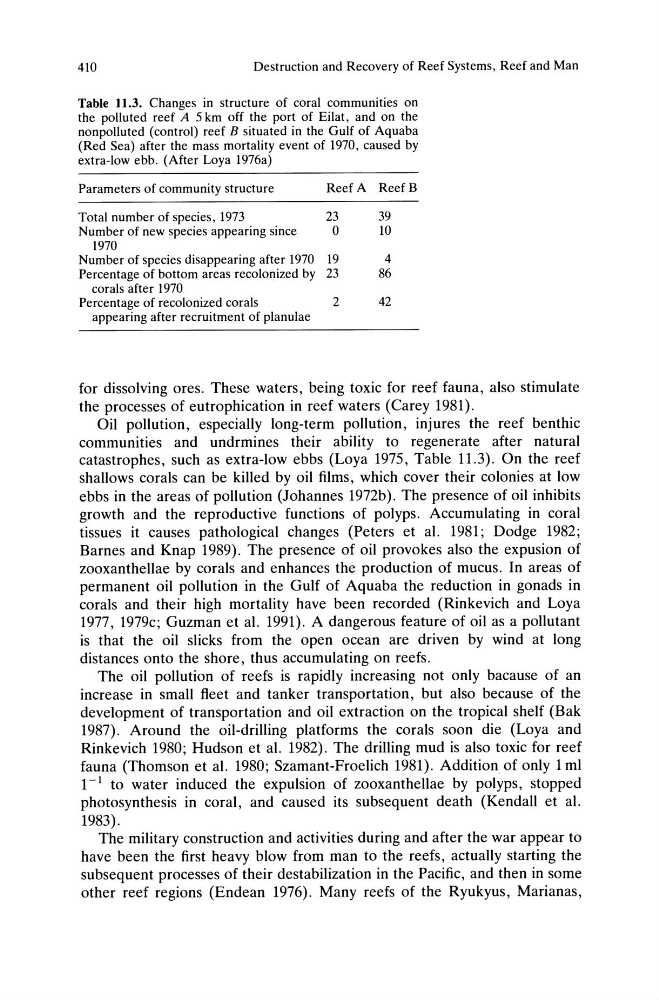
catastrophes, such as extra-low ebbs (Loya 1975, Table 11.3). On the reef
shallows corals can be killed by oil films, which cover their colonies at low
ebbs in the areas of pollution (Johannes 1972b). The presence of oil inhibits
growth and the reproductive functions of polyps. Accumulating in coral
tissues it causes pathological changes (Peters et al. 1981; Dodge 1982;
Barnes and Knap 1989). The presence of oil provokes also the expusion of
zooxanthellae by corals and enhances the production of mucus. In areas of
permanent oil pollution in the Gulf of Aquaba the reduction in gonads in
corals and their high mortality have been recorded (Rinkevich and Loya
1977, 1979c; Guzman et al. 1991). A dangerous feature of oil as a pollutant
is that the oil slicks from the open ocean are driven by wind at long
distances onto the shore, thus accumulating on reefs.
The oil pollution of reefs is rapidly increasing not only bacause of an
increase in small fleet and tanker transportation, but also because of the
development of transportation and oil extraction on the tropical shelf (Bak
1987). Around the oil-drilling platforms the corals soon die (Loya and
Rinkevich 1980; Hudson et al. 1982). The drilling mud is also toxic for reef
fauna (Thomson et al. 1980; Szamant-Froelich 1981). Addition of only 1 ml
1-1 to water induced the expulsion of zooxanthellae by polyps, stopped
photosynthesis in coral, and caused its subsequent death (Kendall et al.
1983).
The military construction and activities during and after the war appear to
have been the first heavy blow from man to the reefs, actually starting the
subsequent processes of their destabilization in the Pacific, and then in some
other reef regions (Endean 1976). Many reefs of the Ryukyus, Marianas,
Destruction and Recovery of Reef Systems, Reef and Man
Table 11.3. Changes in structure of coral communities on
the polluted reef A 5 km off the port of Eilat, and on the
nonpolluted (control) reef B situated in the Gulf of Aquaba
(Red Sea) after the mass mortality event of 1970, caused by
extra-low ebb. (After Loya 1976a)
Parameters of community structure
Reef A ReefB
Total number of species, 1973
23
39
Number of new species appearing since
0
10
1970
Number of species disappearing after 1970 19
4
Percentage of bottom areas recolonized by 23
86
corals after 1970
Percentage of recolonized corals
2
42
appearing after recruitment of planulae
for dissolving ores. These waters, being toxic for reef fauna, also stimulate
the processes of eutrophication in reef waters (Carey 1981).
Oil pollution, especially long-term pollution, injures the reef benthic
communities and undrmines their ability to regenerate after natural
catastrophes, such as extra-low ebbs (Loya 1975, Table 11.3). On the reef
shallows corals can be killed by oil films, which cover their colonies at low
ebbs in the areas of pollution (Johannes 1972b). The presence of oil inhibits
growth and the reproductive functions of polyps. Accumulating in coral
tissues it causes pathological changes (Peters et al. 1981; Dodge 1982;
Barnes and Knap 1989). The presence of oil provokes also the expusion of
zooxanthellae by corals and enhances the production of mucus. In areas of
permanent oil pollution in the Gulf of Aquaba the reduction in gonads in
corals and their high mortality have been recorded (Rinkevich and Loya
1977, 1979c; Guzman et al. 1991). A dangerous feature of oil as a pollutant
is that the oil slicks from the open ocean are driven by wind at long
distances onto the shore, thus accumulating on reefs.
The oil pollution of reefs is rapidly increasing not only bacause of an
increase in small fleet and tanker transportation, but also because of the
development of transportation and oil extraction on the tropical shelf (Bak
1987). Around the oil-drilling platforms the corals soon die (Loya and
Rinkevich 1980; Hudson et al. 1982). The drilling mud is also toxic for reef
fauna (Thomson et al. 1980; Szamant-Froelich 1981). Addition of only 1 ml
1-1 to water induced the expulsion of zooxanthellae by polyps, stopped
photosynthesis in coral, and caused its subsequent death (Kendall et al.
1983).
The military construction and activities during and after the war appear to
have been the first heavy blow from man to the reefs, actually starting the
subsequent processes of their destabilization in the Pacific, and then in some
other reef regions (Endean 1976). Many reefs of the Ryukyus, Marianas,