

Destruction of Corals by Physical Stress
403
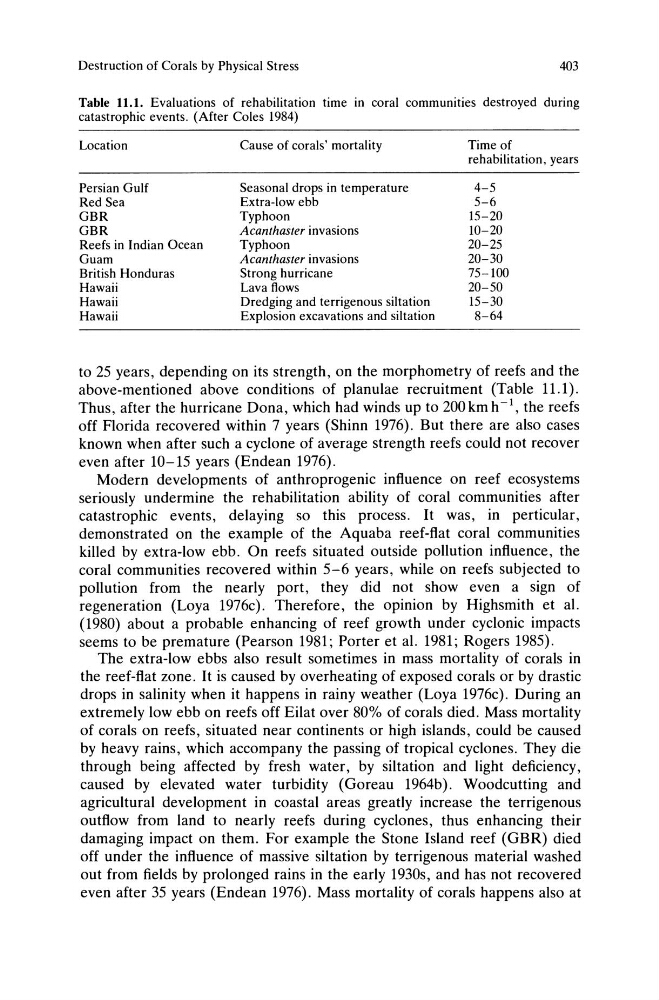
Table 11.1. Evaluations of rehabilitation time in coral communities destroyed during
catastrophic events. (After Coles 1984)
Location
Persian Gulf
Red Sea
GBR
GBR
Reefs in Indian Ocean
Guam
British Honduras
Hawaii
Hawaii
Hawaii
Cause of corals' mortality
Seasonal drops in temperature
Extra-low ebb
Typhoon
Acanthaster invasions
Typhoon
Acanthaster invasions
Strong hurricane
Lava flows
Dredging and terrigenous siltation
Explosion excavations and siltation
Time of
rehabilitation, years
4-5
5-6
15-20
10-20
20-25
20-30
75-100
20-50
15-30
8-64
to 25 years, depending on its strength, on the morphometry of reefs and the
above-mentioned above conditions of planulae recruitment (Table 11.1).
Thus, after the hurricane Dona, which had winds up to 200 km h -1, the reefs
off Florida recovered within 7 years (Shinn 1976). But there are also cases
known when after such a cyclone of average strength reefs could not recover
even after 10-15 years (Endean 1976).
Modern developments of anthroprogenic influence on reef ecosystems
seriously undermine the rehabilitation ability of coral communities after
catastrophic events, delaying so this process. It was, in perticular,
demonstrated on the example of the Aquaba reef-flat coral communities
killed by extra-low ebb. On reefs situated outside pollution influence, the
coral communities recovered within 5-6 years, while on reefs subjected to
pollution from the nearly port, they did not show even a sign of
regeneration (Loya 1976c). Therefore, the opinion by Highsmith et al.
(1980) about a probable enhancing of reef growth under cyclonic impacts
seems to be premature (Pearson 1981; Porter et al. 1981; Rogers 1985).
The extra-low ebbs also result sometimes in mass mortality of corals in
the reef-flat zone. It is caused by overheating of exposed corals or by drastic
drops in salinity when it happens in rainy weather (Loya 1976c). During an
extremely low ebb on reefs off Eilat over 80% of corals died. Mass mortality
of corals on reefs, situated near continents or high islands, could be caused
by heavy rains, which accompany the passing of tropical cyclones. They die
through being affected by fresh water, by siltation and light deficiency,
caused by elevated water turbidity (Goreau 1964b). Woodcutting and
agricultural development in coastal areas greatly increase the terrigenous
outflow from land to nearly reefs during cyclones, thus enhancing their
damaging impact on them. For example the Stone Island reef (GBR) died
off under the influence of massive siltation by terrigenous material washed
out from fields by prolonged rains in the early 1930s, and has not recovered
even after 35 years (Endean 1976). Mass mortality of corals happens also at
403
Table 11.1. Evaluations of rehabilitation time in coral communities destroyed during
catastrophic events. (After Coles 1984)
Location
Persian Gulf
Red Sea
GBR
GBR
Reefs in Indian Ocean
Guam
British Honduras
Hawaii
Hawaii
Hawaii
Cause of corals' mortality
Seasonal drops in temperature
Extra-low ebb
Typhoon
Acanthaster invasions
Typhoon
Acanthaster invasions
Strong hurricane
Lava flows
Dredging and terrigenous siltation
Explosion excavations and siltation
Time of
rehabilitation, years
4-5
5-6
15-20
10-20
20-25
20-30
75-100
20-50
15-30
8-64
to 25 years, depending on its strength, on the morphometry of reefs and the
above-mentioned above conditions of planulae recruitment (Table 11.1).
Thus, after the hurricane Dona, which had winds up to 200 km h -1, the reefs
off Florida recovered within 7 years (Shinn 1976). But there are also cases
known when after such a cyclone of average strength reefs could not recover
even after 10-15 years (Endean 1976).
Modern developments of anthroprogenic influence on reef ecosystems
seriously undermine the rehabilitation ability of coral communities after
catastrophic events, delaying so this process. It was, in perticular,
demonstrated on the example of the Aquaba reef-flat coral communities
killed by extra-low ebb. On reefs situated outside pollution influence, the
coral communities recovered within 5-6 years, while on reefs subjected to
pollution from the nearly port, they did not show even a sign of
regeneration (Loya 1976c). Therefore, the opinion by Highsmith et al.
(1980) about a probable enhancing of reef growth under cyclonic impacts
seems to be premature (Pearson 1981; Porter et al. 1981; Rogers 1985).
The extra-low ebbs also result sometimes in mass mortality of corals in
the reef-flat zone. It is caused by overheating of exposed corals or by drastic
drops in salinity when it happens in rainy weather (Loya 1976c). During an
extremely low ebb on reefs off Eilat over 80% of corals died. Mass mortality
of corals on reefs, situated near continents or high islands, could be caused
by heavy rains, which accompany the passing of tropical cyclones. They die
through being affected by fresh water, by siltation and light deficiency,
caused by elevated water turbidity (Goreau 1964b). Woodcutting and
agricultural development in coastal areas greatly increase the terrigenous
outflow from land to nearly reefs during cyclones, thus enhancing their
damaging impact on them. For example the Stone Island reef (GBR) died
off under the influence of massive siltation by terrigenous material washed
out from fields by prolonged rains in the early 1930s, and has not recovered
even after 35 years (Endean 1976). Mass mortality of corals happens also at