

394
Early
Bipinnaria
Destruction and Recovery of Reef Systems, Reef and Man
Adult star
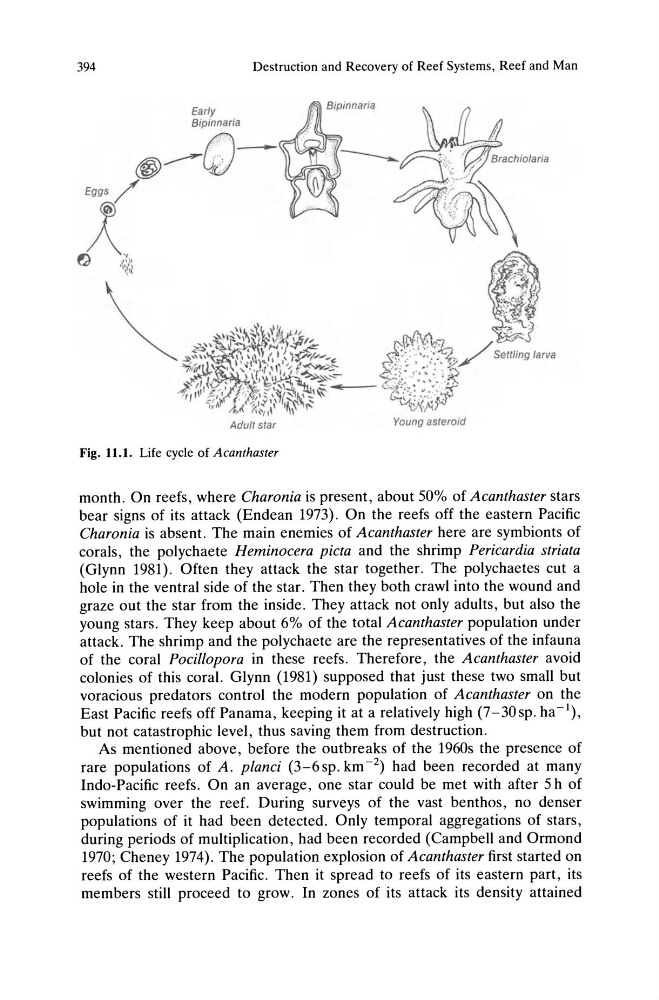
Fig. 11.1. Life cycle of Acanthaster
month. On reefs, where Charonia is present, about 50% of Acanthaster stars
bear signs of its attack (Endean 1973). On the reefs off the eastern Pacific
Charonia is absent. The main enemies of Acanthaster here are symbionts of
corals, the polychaete Heminocera picta and the shrimp Pericardia striata
(Glynn 1981). Often they attack the star together. The polychaetes cut a
hole in the ventral side of the star. Then they both crawl into the wound and
graze out the star from the inside. They attack not only adults, but also the
young stars. They keep about 6% of the total Acanthaster population under
attack. The shrimp and the polychaete are the representatives of the infauna
of the coral Pocillopora in these reefs. Therefore, the Acanthaster avoid
colonies of this coral. Glynn (1981) supposed that just these two small but
voracious predators control the modern population of Acanthaster on the
East Pacific reefs off Panama, keeping it at a relatively high (7-30sp. ha- I ),
but not catastrophic level, thus saving them from destruction.
As mentioned above, before the outbreaks of the 1960s the presence of
rare populations of A. planci (3-6 sp. km -2) had been recorded at many
Indo-Pacific reefs. On an average, one star could be met with after 5 h of
swimming over the reef. During surveys of the vast benthos, no denser
populations of it had been detected. Only temporal aggregations of stars,
during periods of multiplication, had been recorded (Campbell and Ormond
1970; Cheney 1974). The population explosion of Acanthaster first started on
reefs of the western Pacific. Then it spread to reefs of its eastern part, its
members still proceed to grow. In zones of its attack its density attained
Early
Bipinnaria
Destruction and Recovery of Reef Systems, Reef and Man
Adult star
Fig. 11.1. Life cycle of Acanthaster
month. On reefs, where Charonia is present, about 50% of Acanthaster stars
bear signs of its attack (Endean 1973). On the reefs off the eastern Pacific
Charonia is absent. The main enemies of Acanthaster here are symbionts of
corals, the polychaete Heminocera picta and the shrimp Pericardia striata
(Glynn 1981). Often they attack the star together. The polychaetes cut a
hole in the ventral side of the star. Then they both crawl into the wound and
graze out the star from the inside. They attack not only adults, but also the
young stars. They keep about 6% of the total Acanthaster population under
attack. The shrimp and the polychaete are the representatives of the infauna
of the coral Pocillopora in these reefs. Therefore, the Acanthaster avoid
colonies of this coral. Glynn (1981) supposed that just these two small but
voracious predators control the modern population of Acanthaster on the
East Pacific reefs off Panama, keeping it at a relatively high (7-30sp. ha- I ),
but not catastrophic level, thus saving them from destruction.
As mentioned above, before the outbreaks of the 1960s the presence of
rare populations of A. planci (3-6 sp. km -2) had been recorded at many
Indo-Pacific reefs. On an average, one star could be met with after 5 h of
swimming over the reef. During surveys of the vast benthos, no denser
populations of it had been detected. Only temporal aggregations of stars,
during periods of multiplication, had been recorded (Campbell and Ormond
1970; Cheney 1974). The population explosion of Acanthaster first started on
reefs of the western Pacific. Then it spread to reefs of its eastern part, its
members still proceed to grow. In zones of its attack its density attained