

30
Reef Lime Constructions
\(1,% of total
.f(j
/.j(J
J(J
2(J
J(J
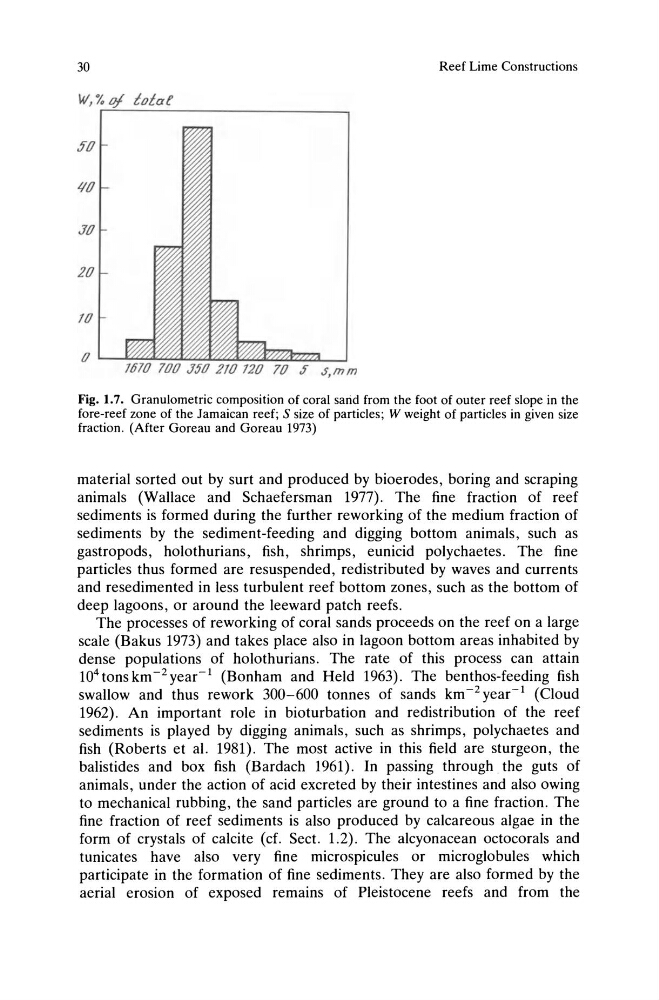
Fig. 1.7. Granulometric composition of coral sand from the foot of outer reef slope in the
fore-reef zone of the Jamaican reef; S size of particles; W weight of particles in given size
fraction. (After Gareau and Gareau 1973)
material sorted out by surt and produced by bioerodes, boring and scraping
animals (Wallace and Schaefersman 1977). The fine fraction of reef
sediments is formed during the further reworking of the medium fraction of
sediments by the sediment-feeding and digging bottom animals, such as
gastropods, holothurians, fish, shrimps, eunicid polychaetes. The fine
particles thus formed are resuspended, redistributed by waves and currents
and resedimented in less turbulent reef bottom zones, such as the bottom of
deep lagoons, or around the leeward patch reefs.
The processes of reworking of coral sands proceeds on the reef on a large
scale (Bakus 1973) and takes place also in lagoon bottom areas inhabited by
dense populations of holothurians. The rate of this process can attain
10 4 tonskm- 2 year- 1 (Bonham and Held 1963). The benthos-feeding fish
swallow and thus rework 300-600 tonnes of sands km- 2 year- 1 (Cloud
1962). An important role in bioturbation and redistribution of the reef
sediments is played by digging animals, such as shrimps, polychaetes and
fish (Roberts et al. 1981). The most active in this field are sturgeon, the
balistides and box fish (Bardach 1961). In passing through. the guts of
animals, under the action of acid excreted by their intestines and also owing
to mechanical rubbing, the sand particles are ground to a fine fraction. The
fine fraction of reef sediments is also produced by calcareous algae in the
form of crystals of calcite (cf. Sect. 1.2). The alcyonacean octocorals and
tunicates have also very fine microspicules or microglobules which
participate in the formation of fine sediments. They are also formed by the
aerial erosion of exposed remains of Pleistocene reefs and from the
Reef Lime Constructions
\(1,% of total
.f(j
/.j(J
J(J
2(J
J(J
Fig. 1.7. Granulometric composition of coral sand from the foot of outer reef slope in the
fore-reef zone of the Jamaican reef; S size of particles; W weight of particles in given size
fraction. (After Gareau and Gareau 1973)
material sorted out by surt and produced by bioerodes, boring and scraping
animals (Wallace and Schaefersman 1977). The fine fraction of reef
sediments is formed during the further reworking of the medium fraction of
sediments by the sediment-feeding and digging bottom animals, such as
gastropods, holothurians, fish, shrimps, eunicid polychaetes. The fine
particles thus formed are resuspended, redistributed by waves and currents
and resedimented in less turbulent reef bottom zones, such as the bottom of
deep lagoons, or around the leeward patch reefs.
The processes of reworking of coral sands proceeds on the reef on a large
scale (Bakus 1973) and takes place also in lagoon bottom areas inhabited by
dense populations of holothurians. The rate of this process can attain
10 4 tonskm- 2 year- 1 (Bonham and Held 1963). The benthos-feeding fish
swallow and thus rework 300-600 tonnes of sands km- 2 year- 1 (Cloud
1962). An important role in bioturbation and redistribution of the reef
sediments is played by digging animals, such as shrimps, polychaetes and
fish (Roberts et al. 1981). The most active in this field are sturgeon, the
balistides and box fish (Bardach 1961). In passing through. the guts of
animals, under the action of acid excreted by their intestines and also owing
to mechanical rubbing, the sand particles are ground to a fine fraction. The
fine fraction of reef sediments is also produced by calcareous algae in the
form of crystals of calcite (cf. Sect. 1.2). The alcyonacean octocorals and
tunicates have also very fine microspicules or microglobules which
participate in the formation of fine sediments. They are also formed by the
aerial erosion of exposed remains of Pleistocene reefs and from the