

382
Biogeochemical Metabolism and Energy Flows in Reef Ecosystems
ttl
8
~-?h
IIIlI+Pn
2 I~~~--~~~-- Lr~--2T~~
NOll tlls
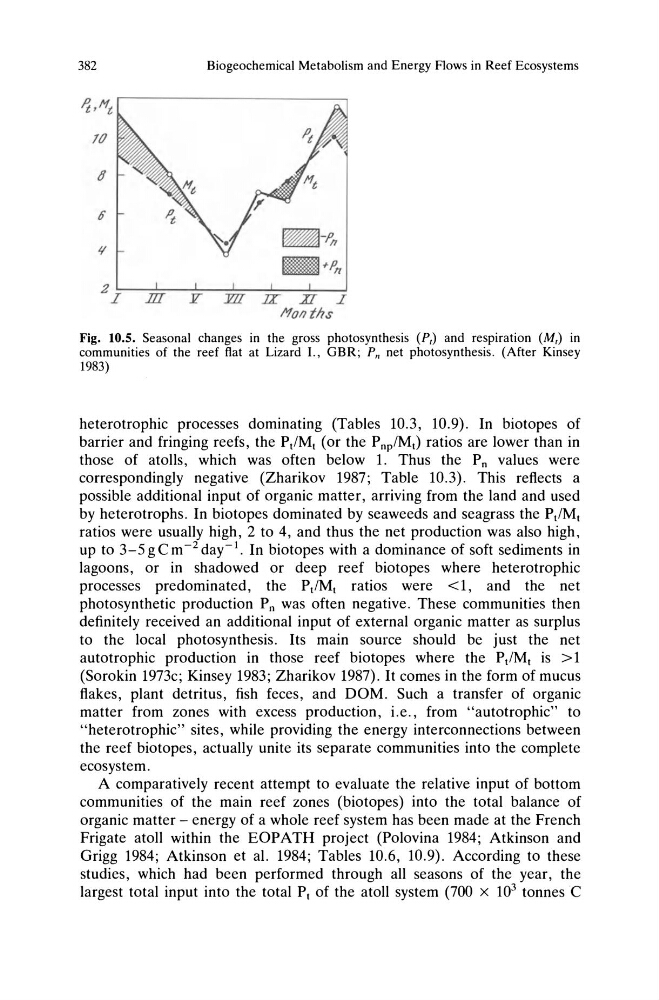
Fig. 10.5. Seasonal changes in the gross photosynthesis (PI) and respiration (MI) in
communities of the reef flat at Lizard I., GBR; P" net photosynthesis. (After Kinsey
1983)
heterotrophic processes dominating (Tables 10.3, 10.9). In biotopes of
barrier and fringing reefs, the Pt/Mt (or the Pnp/Mt) ratios are lower than in
those of atolls, which was often below 1. Thus the P n values were
correspondingly negative (Zharikov 1987; Table 10.3). This reflects a
possible additional input of organic matter, arriving from the land and used
by heterotrophs. In biotopes dominated by seaweeds and seagrass the Pt/Mt
ratios were usually high, 2 to 4, and thus the net production was also high,
up to 3-5gCm- 2 day-1. In biotopes with a dominance of soft sediments in
lagoons, or in shadowed or deep reef biotopes where heterotrophic
processes predominated, the Pt/Mt ratios were < 1, and the net
photosynthetic production P n was often negative. These communities then
definitely received an additional input of external organic matter as surplus
to the local photosynthesis. Its main source should be just the net
autotrophic production in those reef biotopes where the Pt/Mt is > 1
(Sorokin 1973c; Kinsey 1983; Zharikov 1987). It comes in the form of mucus
flakes, plant detritus, fish feces, and DOM. Such a transfer of organic
matter from zones with excess production, i.e., from "autotrophic" to
"heterotrophic" sites, while providing the energy interconnections between
the reef biotopes, actually unite its separate communities into the complete
ecosystem.
A comparatively recent attempt to evaluate the relative input of bottom
communities of the main reef zones (biotopes) into the total balance of
organic matter - energy of a whole reef system has been made at the French
Frigate atoll within the EOPATH project (Polovina 1984; Atkinson and
Grigg 1984; Atkinson et at. 1984; Tables 10.6, 10.9). According to these
studies, which had been performed through all seasons of the year, the
largest total input into the total Pt of the atoll system (700 x 10 3 tonnesC
Biogeochemical Metabolism and Energy Flows in Reef Ecosystems
ttl
8
~-?h
IIIlI+Pn
2 I~~~--~~~-- Lr~--2T~~
NOll tlls
Fig. 10.5. Seasonal changes in the gross photosynthesis (PI) and respiration (MI) in
communities of the reef flat at Lizard I., GBR; P" net photosynthesis. (After Kinsey
1983)
heterotrophic processes dominating (Tables 10.3, 10.9). In biotopes of
barrier and fringing reefs, the Pt/Mt (or the Pnp/Mt) ratios are lower than in
those of atolls, which was often below 1. Thus the P n values were
correspondingly negative (Zharikov 1987; Table 10.3). This reflects a
possible additional input of organic matter, arriving from the land and used
by heterotrophs. In biotopes dominated by seaweeds and seagrass the Pt/Mt
ratios were usually high, 2 to 4, and thus the net production was also high,
up to 3-5gCm- 2 day-1. In biotopes with a dominance of soft sediments in
lagoons, or in shadowed or deep reef biotopes where heterotrophic
processes predominated, the Pt/Mt ratios were < 1, and the net
photosynthetic production P n was often negative. These communities then
definitely received an additional input of external organic matter as surplus
to the local photosynthesis. Its main source should be just the net
autotrophic production in those reef biotopes where the Pt/Mt is > 1
(Sorokin 1973c; Kinsey 1983; Zharikov 1987). It comes in the form of mucus
flakes, plant detritus, fish feces, and DOM. Such a transfer of organic
matter from zones with excess production, i.e., from "autotrophic" to
"heterotrophic" sites, while providing the energy interconnections between
the reef biotopes, actually unite its separate communities into the complete
ecosystem.
A comparatively recent attempt to evaluate the relative input of bottom
communities of the main reef zones (biotopes) into the total balance of
organic matter - energy of a whole reef system has been made at the French
Frigate atoll within the EOPATH project (Polovina 1984; Atkinson and
Grigg 1984; Atkinson et at. 1984; Tables 10.6, 10.9). According to these
studies, which had been performed through all seasons of the year, the
largest total input into the total Pt of the atoll system (700 x 10 3 tonnesC