

380
Biogeochemical Metabolism and Energy Flows in Reef Ecosystems
of its global value, it is necessary to take also into account that the abovementioned level referred mostly to atoll systems. But most reefs of the
World Ocean belong to the barrier and fringing types, in which the relative
areas of lagoons are much smaller than in atolls, and their lagoons are more
productive than those of the atolls. Therefore, it would be more reasonable
to accept the referee values of their generalized annual Pt and P nt at the
levels of 1.8 and 1.SkgCm- 2 .
The rate of metabolism in aquatic animals depends on the water
temperature decreasing 2-2.S times for each drop of 10 0c. In high-latitude
reef systems the seasonal changes in temperature (and illumination), and
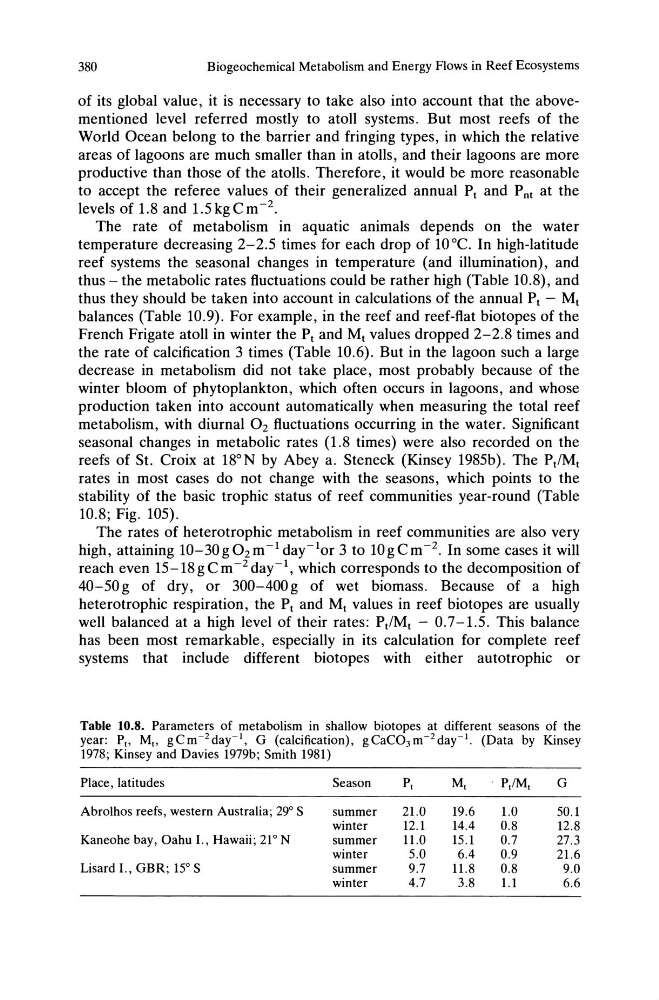
thus - the metabolic rates fluctuations could be rather high (Table 10.8), and
thus they should be taken into account in calculations of the annual Pt - Mt
balances (Table 10.9). For example, in the reef and reef-flat biotopes of the
French Frigate atoll in winter the Pt and Mt values dropped 2-2.8 times and
the rate of calcification 3 times (Table 10.6). But in the lagoon such a large
decrease in metabolism did not take place, most probably because of the
winter bloom of phytoplankton, which often occurs in lagoons, and whose
production taken into account automatically when measuring the total reef
metabolism, with diurnal O2 fluctuations occurring in the water. Significant
seasonal changes in metabolic rates (1.8 times) were also recorded on the
reefs of St. Croix at 18°N by Abey a. Steneck (Kinsey 1985b). The Pt/Mt
rates in most cases do not change with the seasons, which points to the
stability of the basic trophic status of reef communities year-round (Table
10.8; Fig. lOS).
The rates of heterotrophic metabolism in reef communities are also very
high, attaining 10-30g0 2 m- 1 day- 1 or 3 to lOgCm-2. In some cases it will
reach even IS-18 g C m- 2 day-I, which corresponds to the decomposition of
40-S0 g of dry, or 300-400 g of wet biomass. Because of a high
heterotrophic respiration, the Pt and Mt values in reef biotopes are usually
well balanced at a high level of their rates: Pt/Mt - 0.7-1.S. This balance
has been most remarkable, especially in its calculation for complete reef
systems that include different biotopes with either autotrophic or
Table 10.S. Parameters of metabolism in shallow biotopes at different seasons of the
year: P" M" gCm- 2 day-l, G (calcification), gCaC0 3 m- 2 day-l. (Data by Kinsey
1978; Kinsey and Davies 1979b; Smith 1981)
Place, latitudes
Season
P,
M,
P,IM,
G
Abrolhos reefs, western Australia; 29° S
summer
21.0
19.6
1.0
50.1
winter
12.1
14.4
0.8
12.8
Kaneohe bay, Oahu I., Hawaii; 21° N
summer
11.0
15.1
0.7
27.3
winter
5.0
6.4
0.9
21.6
Lisard I., GBR; 15° S
summer
9.7
11.8
0.8
9.0
winter
4.7
3.8
1.1
6.6
Biogeochemical Metabolism and Energy Flows in Reef Ecosystems
of its global value, it is necessary to take also into account that the abovementioned level referred mostly to atoll systems. But most reefs of the
World Ocean belong to the barrier and fringing types, in which the relative
areas of lagoons are much smaller than in atolls, and their lagoons are more
productive than those of the atolls. Therefore, it would be more reasonable
to accept the referee values of their generalized annual Pt and P nt at the
levels of 1.8 and 1.SkgCm- 2 .
The rate of metabolism in aquatic animals depends on the water
temperature decreasing 2-2.S times for each drop of 10 0c. In high-latitude
reef systems the seasonal changes in temperature (and illumination), and
thus - the metabolic rates fluctuations could be rather high (Table 10.8), and
thus they should be taken into account in calculations of the annual Pt - Mt
balances (Table 10.9). For example, in the reef and reef-flat biotopes of the
French Frigate atoll in winter the Pt and Mt values dropped 2-2.8 times and
the rate of calcification 3 times (Table 10.6). But in the lagoon such a large
decrease in metabolism did not take place, most probably because of the
winter bloom of phytoplankton, which often occurs in lagoons, and whose
production taken into account automatically when measuring the total reef
metabolism, with diurnal O2 fluctuations occurring in the water. Significant
seasonal changes in metabolic rates (1.8 times) were also recorded on the
reefs of St. Croix at 18°N by Abey a. Steneck (Kinsey 1985b). The Pt/Mt
rates in most cases do not change with the seasons, which points to the
stability of the basic trophic status of reef communities year-round (Table
10.8; Fig. lOS).
The rates of heterotrophic metabolism in reef communities are also very
high, attaining 10-30g0 2 m- 1 day- 1 or 3 to lOgCm-2. In some cases it will
reach even IS-18 g C m- 2 day-I, which corresponds to the decomposition of
40-S0 g of dry, or 300-400 g of wet biomass. Because of a high
heterotrophic respiration, the Pt and Mt values in reef biotopes are usually
well balanced at a high level of their rates: Pt/Mt - 0.7-1.S. This balance
has been most remarkable, especially in its calculation for complete reef
systems that include different biotopes with either autotrophic or
Table 10.S. Parameters of metabolism in shallow biotopes at different seasons of the
year: P" M" gCm- 2 day-l, G (calcification), gCaC0 3 m- 2 day-l. (Data by Kinsey
1978; Kinsey and Davies 1979b; Smith 1981)
Place, latitudes
Season
P,
M,
P,IM,
G
Abrolhos reefs, western Australia; 29° S
summer
21.0
19.6
1.0
50.1
winter
12.1
14.4
0.8
12.8
Kaneohe bay, Oahu I., Hawaii; 21° N
summer
11.0
15.1
0.7
27.3
winter
5.0
6.4
0.9
21.6
Lisard I., GBR; 15° S
summer
9.7
11.8
0.8
9.0
winter
4.7
3.8
1.1
6.6