

364
Nutrition of Corals
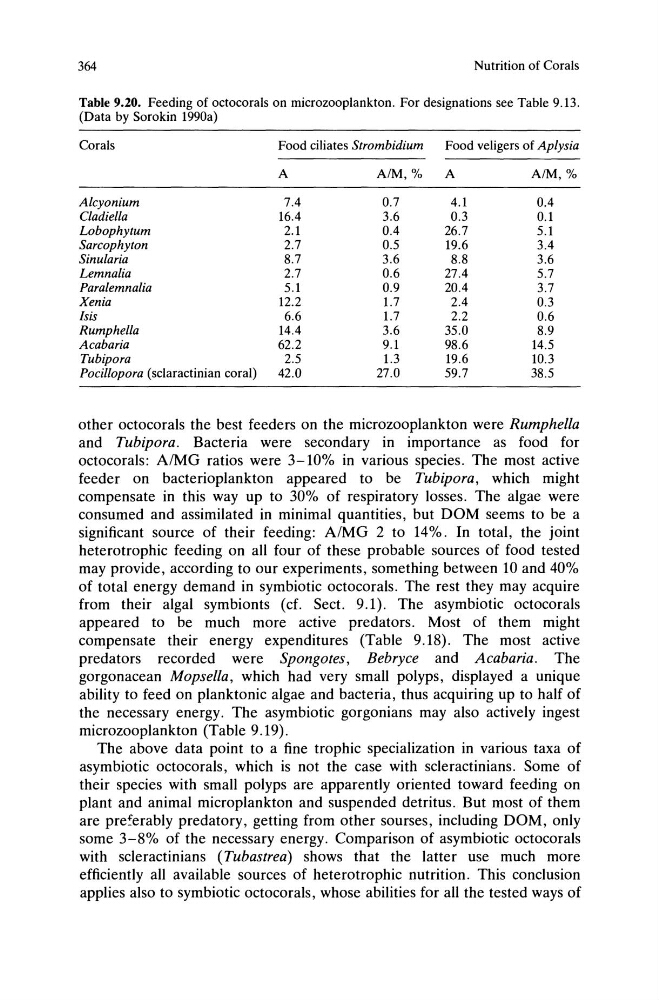
Table 9.20. Feeding of octocorals on microzooplankton. For designations see Table 9.13.
(Data by Sorokin 1990a)
Corals
Food ciliates Strombidium
Food veligers of Aplysia
A
AIM, %
A
AIM, %
Alcyonium
7.4
0.7
4.1
0.4
Cladiella
16.4
3.6
0.3
0.1
Lobophytum
2.1
0.4
26.7
5.1
Sarcophyton
2.7
0.5
19.6
3.4
Sinularia
8.7
3.6
8.8
3.6
Lemnalia
2.7
0.6
27.4
5.7
Paralemnalia
5.1
0.9
20.4
3.7
Xenia
12.2
1.7
2.4
0.3
Isis
6.6
1.7
2.2
0.6
Rumphella
14.4
3.6
35.0
8.9
Acabaria
62.2
9.1
98.6
14.5
Tubipora
2.5
1.3
19.6
10.3
Pocillopora (sciaractinian coral)
42.0
27.0
59.7
38.5
other octocorals the best feeders on the microzooplankton were Rumphella
and Tubipora. Bacteria were secondary in importance as food for
octocorals: A/MG ratios were 3-10% in various species. The most active
feeder on bacterioplankton appeared to be Tubipora, which might
compensate in this way up to 30% of respiratory losses. The algae were
consumed and assimilated in minimal quantities, but DOM seems to be a
significant source of their feeding: A/MG 2 to 14%. In total, the joint
heterotrophic feeding on all four of these probable sources of food tested
may provide, according to our experiments, something between 10 and 40%
of total energy demand in symbiotic octocorals. The rest they may acquire
from their algal symbionts (cf. Sect. 9.1). The asymbiotic octo corals
appeared to be much more active predators. Most of them might
compensate their energy expenditures (Table 9.18). The most active
predators recorded were Spongotes, Bebryce and Acabaria. The
gorgonacean Mopsella, which had very small polyps, displayed a unique
ability to feed on planktonic algae and bacteria, thus acquiring up to half of
the necessary energy. The asymbiotic gorgonians may also actively ingest
microzooplankton (Table 9.19).
The above data point to a fine trophic specialization in various taxa of
asymbiotic octocorals, which is not the case with scleractinians. Some of
their species with small polyps are apparently oriented toward feeding on
plant and animal microplankton and suspended detritus. But most of them
are pre~erably predatory, getting from other sourses, including DOM, only
some 3-8% of the necessary energy. Comparison of asymbiotic octocorals
with scleractinians (Tubastrea) shows that the latter use much more
efficiently all available sources of heterotrophic nutrition. This conclusion
applies also to symbiotic octocorals, whose abilities for all the tested ways of
Nutrition of Corals
Table 9.20. Feeding of octocorals on microzooplankton. For designations see Table 9.13.
(Data by Sorokin 1990a)
Corals
Food ciliates Strombidium
Food veligers of Aplysia
A
AIM, %
A
AIM, %
Alcyonium
7.4
0.7
4.1
0.4
Cladiella
16.4
3.6
0.3
0.1
Lobophytum
2.1
0.4
26.7
5.1
Sarcophyton
2.7
0.5
19.6
3.4
Sinularia
8.7
3.6
8.8
3.6
Lemnalia
2.7
0.6
27.4
5.7
Paralemnalia
5.1
0.9
20.4
3.7
Xenia
12.2
1.7
2.4
0.3
Isis
6.6
1.7
2.2
0.6
Rumphella
14.4
3.6
35.0
8.9
Acabaria
62.2
9.1
98.6
14.5
Tubipora
2.5
1.3
19.6
10.3
Pocillopora (sciaractinian coral)
42.0
27.0
59.7
38.5
other octocorals the best feeders on the microzooplankton were Rumphella
and Tubipora. Bacteria were secondary in importance as food for
octocorals: A/MG ratios were 3-10% in various species. The most active
feeder on bacterioplankton appeared to be Tubipora, which might
compensate in this way up to 30% of respiratory losses. The algae were
consumed and assimilated in minimal quantities, but DOM seems to be a
significant source of their feeding: A/MG 2 to 14%. In total, the joint
heterotrophic feeding on all four of these probable sources of food tested
may provide, according to our experiments, something between 10 and 40%
of total energy demand in symbiotic octocorals. The rest they may acquire
from their algal symbionts (cf. Sect. 9.1). The asymbiotic octo corals
appeared to be much more active predators. Most of them might
compensate their energy expenditures (Table 9.18). The most active
predators recorded were Spongotes, Bebryce and Acabaria. The
gorgonacean Mopsella, which had very small polyps, displayed a unique
ability to feed on planktonic algae and bacteria, thus acquiring up to half of
the necessary energy. The asymbiotic gorgonians may also actively ingest
microzooplankton (Table 9.19).
The above data point to a fine trophic specialization in various taxa of
asymbiotic octocorals, which is not the case with scleractinians. Some of
their species with small polyps are apparently oriented toward feeding on
plant and animal microplankton and suspended detritus. But most of them
are pre~erably predatory, getting from other sourses, including DOM, only
some 3-8% of the necessary energy. Comparison of asymbiotic octocorals
with scleractinians (Tubastrea) shows that the latter use much more
efficiently all available sources of heterotrophic nutrition. This conclusion
applies also to symbiotic octocorals, whose abilities for all the tested ways of