

Heterotrophic Feeding of Corals
361
Si!1{/lorio
Ec/ti!1oporio
/'fO,D.Jt'tlo
A/H~ ________ -r~ ______ ~ ________ ~
50
1./5
30
75
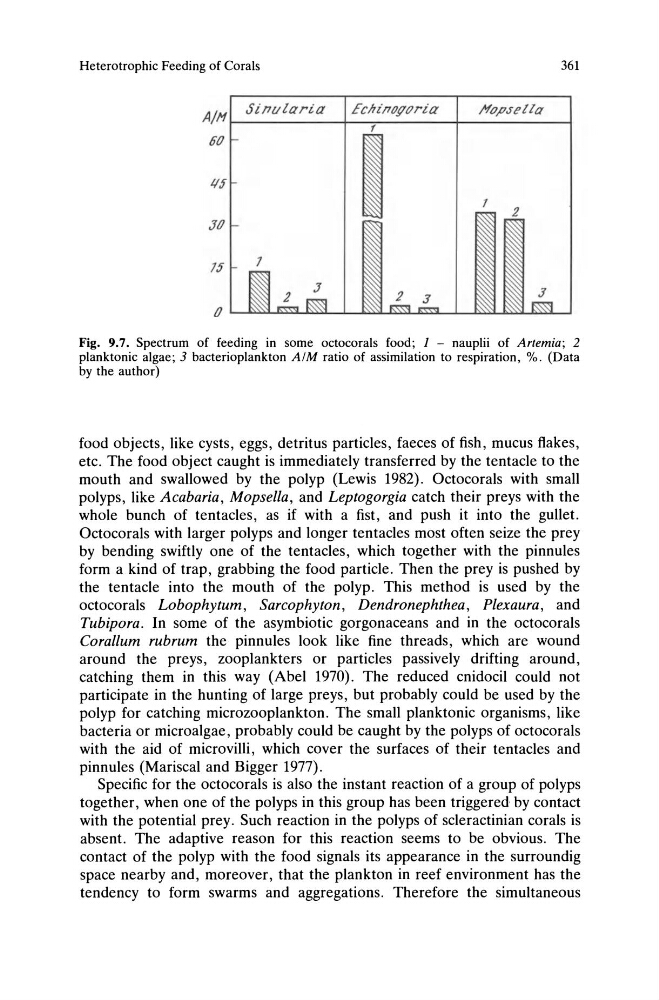
Fig. 9.7. Spectrum of feeding in some octo corals food; 1 - nauplii of Artemia; 2
planktonic algae; 3 bacterioplankton AIM ratio of assimilation to respiration, %. (Data
by the author)
food objects, like cysts, eggs, detritus particles, faeces of fish, mucus flakes,
etc. The food object caught is immediately transferred by the tentacle to the
mouth and swallowed by the polyp (Lewis 1982). Octocorals with small
polyps, like Acabaria, Mopsella, and Leptogorgia catch their preys with the
whole bunch of tentacles, as if with a fist, and push it into the gullet.
Octocorals with larger polyps and longer tentacles most often seize the prey
by bending swiftly one of the tentacles, which together with the pinnules
form a kind of trap, grabbing the food particle. Then the prey is pushed by
the tentacle into the mouth of the polyp. This method is used by the
octocorals Lobophytum, Sarcophyton, Dendronephthea, Plexaura, and
Tubipora. In some of the asymbiotic gorgonaceans and in the octocorals
Corallum rub rum the pinnules look like fine threads, which are wound
around the preys, zooplankters or particles passively drifting around,
catching them in this way (Abel 1970). The reduced cnidocil could not
participate in the hunting of large preys, but probably could be used by the
polyp for catching microzooplankton. The small planktonic organisms, like
bacteria or microalgae, probably could be caught by the polyps of octocorals
with the aid of microvilli, which cover the surfaces of their tentacles and
pinnules (Mariscal and Bigger 1977).
Specific for the octocorals is also the instant reaction of a group of polyps
together, when one of the polyps in this group has been triggered by contact
with the potential prey. Such reaction in the polyps of scleractinian corals is
absent. The adaptive reason for this reaction seems to be obvious. The
contact of the polyp with the food signals its appearance in the surroundig
space nearby and, moreover, that the plankton in reef environment has the
tendency to form swarms and aggregations. Therefore the simultaneous
361
Si!1{/lorio
Ec/ti!1oporio
/'fO,D.Jt'tlo
A/H~ ________ -r~ ______ ~ ________ ~
50
1./5
30
75
Fig. 9.7. Spectrum of feeding in some octo corals food; 1 - nauplii of Artemia; 2
planktonic algae; 3 bacterioplankton AIM ratio of assimilation to respiration, %. (Data
by the author)
food objects, like cysts, eggs, detritus particles, faeces of fish, mucus flakes,
etc. The food object caught is immediately transferred by the tentacle to the
mouth and swallowed by the polyp (Lewis 1982). Octocorals with small
polyps, like Acabaria, Mopsella, and Leptogorgia catch their preys with the
whole bunch of tentacles, as if with a fist, and push it into the gullet.
Octocorals with larger polyps and longer tentacles most often seize the prey
by bending swiftly one of the tentacles, which together with the pinnules
form a kind of trap, grabbing the food particle. Then the prey is pushed by
the tentacle into the mouth of the polyp. This method is used by the
octocorals Lobophytum, Sarcophyton, Dendronephthea, Plexaura, and
Tubipora. In some of the asymbiotic gorgonaceans and in the octocorals
Corallum rub rum the pinnules look like fine threads, which are wound
around the preys, zooplankters or particles passively drifting around,
catching them in this way (Abel 1970). The reduced cnidocil could not
participate in the hunting of large preys, but probably could be used by the
polyp for catching microzooplankton. The small planktonic organisms, like
bacteria or microalgae, probably could be caught by the polyps of octocorals
with the aid of microvilli, which cover the surfaces of their tentacles and
pinnules (Mariscal and Bigger 1977).
Specific for the octocorals is also the instant reaction of a group of polyps
together, when one of the polyps in this group has been triggered by contact
with the potential prey. Such reaction in the polyps of scleractinian corals is
absent. The adaptive reason for this reaction seems to be obvious. The
contact of the polyp with the food signals its appearance in the surroundig
space nearby and, moreover, that the plankton in reef environment has the
tendency to form swarms and aggregations. Therefore the simultaneous