

356
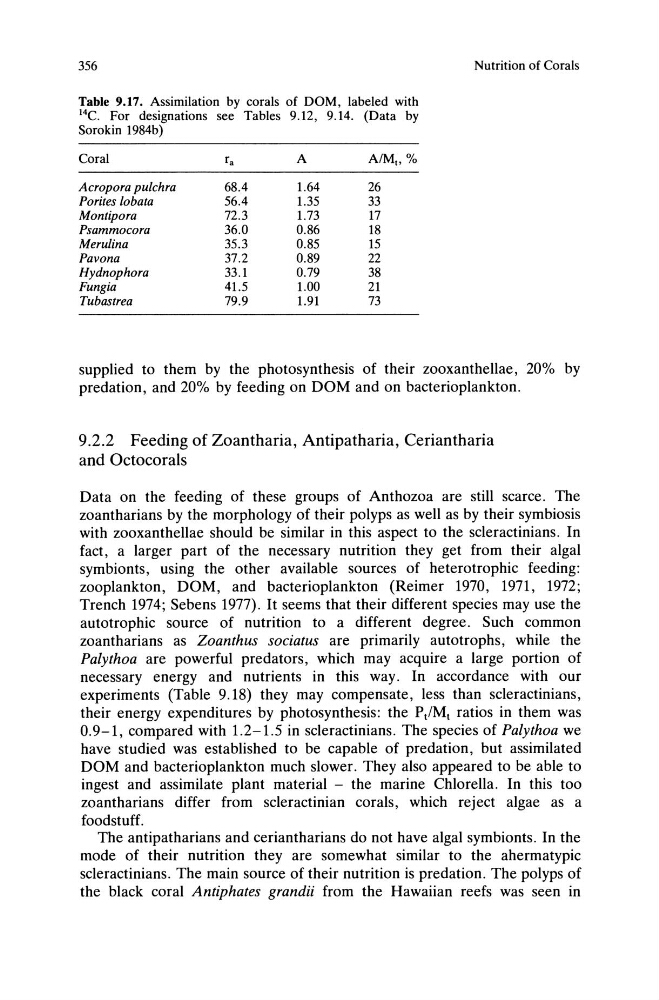
Table 9.17. Assimilation by corals of DOM, labeled with
14c. For designations see Tables 9.12, 9.14. (Data by
Sorokin 1984b)
Coral
ra
A
AIM" %
Acropora pulchra
68.4
1.64
26
Porites lobata
56.4
1.35
33
Montipora
72.3
1.73
17
Psammocora
36.0
0.86
18
Merulina
35.3
0.85
15
Pavona
37.2
0.89
22
Hydnophora
33.1
0.79
38
Fungia
41.5
1.00
21
Tubastrea
79.9
1.91
73
Nutrition of Corals
supplied to them by the photosynthesis of their zooxanthellae, 20% by
predation, and 20% by feeding on DOM and on bacterioplankton.
9.2.2 Feeding of Zoantharia, Antipatharia, Ceriantharia
and Octocorals
Data on the feeding of these groups of Anthozoa are still scarce. The
zoantharians by the morphology of their polyps as well as by their symbiosis
with zooxanthellae should be similar in this aspect to the scleractinians. In
fact, a larger part of the necessary nutrition they get from their algal
symbionts, using the other available sources of heterotrophic feeding:
zooplankton, DOM, and bacterioplankton (Reimer 1970, 1971, 1972;
Trench 1974; Sebens 1977). It seems that their different species may use the
autotrophic source of nutrition to a different degree. Such common
zoantharians as Zoanthus sociatus are primarily autotrophs, while the
Palythoa are powerful predators, which may acquire a large portion of
necessary energy and nutrients in this way. In accordance with our
experiments (Table 9.18) they may compensate, less than scleractinians,
their energy expenditures by photosynthesis: the Pt/Mt ratios in them was
0.9-1, compared with 1.2-1.5 in scleractinians. The species of Palythoa we
have studied was established to be capable of predation, but assimilated
DOM and bacterioplankton much slower. They also appeared to be able to
ingest and assimilate plant material - the marine Chlorella. In this too
zoantharians differ from scleractinian corals, which reject algae as a
foodstuff.
The antipatharians and ceriantharians do not have algal symbionts. In the
mode of their nutrition they are somewhat similar to the ahermatypic
scleractinians. The main source of their nutrition is predation. The polyps of
the black coral Antiphates grandii from the Hawaiian reefs was seen in
Table 9.17. Assimilation by corals of DOM, labeled with
14c. For designations see Tables 9.12, 9.14. (Data by
Sorokin 1984b)
Coral
ra
A
AIM" %
Acropora pulchra
68.4
1.64
26
Porites lobata
56.4
1.35
33
Montipora
72.3
1.73
17
Psammocora
36.0
0.86
18
Merulina
35.3
0.85
15
Pavona
37.2
0.89
22
Hydnophora
33.1
0.79
38
Fungia
41.5
1.00
21
Tubastrea
79.9
1.91
73
Nutrition of Corals
supplied to them by the photosynthesis of their zooxanthellae, 20% by
predation, and 20% by feeding on DOM and on bacterioplankton.
9.2.2 Feeding of Zoantharia, Antipatharia, Ceriantharia
and Octocorals
Data on the feeding of these groups of Anthozoa are still scarce. The
zoantharians by the morphology of their polyps as well as by their symbiosis
with zooxanthellae should be similar in this aspect to the scleractinians. In
fact, a larger part of the necessary nutrition they get from their algal
symbionts, using the other available sources of heterotrophic feeding:
zooplankton, DOM, and bacterioplankton (Reimer 1970, 1971, 1972;
Trench 1974; Sebens 1977). It seems that their different species may use the
autotrophic source of nutrition to a different degree. Such common
zoantharians as Zoanthus sociatus are primarily autotrophs, while the
Palythoa are powerful predators, which may acquire a large portion of
necessary energy and nutrients in this way. In accordance with our
experiments (Table 9.18) they may compensate, less than scleractinians,
their energy expenditures by photosynthesis: the Pt/Mt ratios in them was
0.9-1, compared with 1.2-1.5 in scleractinians. The species of Palythoa we
have studied was established to be capable of predation, but assimilated
DOM and bacterioplankton much slower. They also appeared to be able to
ingest and assimilate plant material - the marine Chlorella. In this too
zoantharians differ from scleractinian corals, which reject algae as a
foodstuff.
The antipatharians and ceriantharians do not have algal symbionts. In the
mode of their nutrition they are somewhat similar to the ahermatypic
scleractinians. The main source of their nutrition is predation. The polyps of
the black coral Antiphates grandii from the Hawaiian reefs was seen in