

Heterotrophic Feeding of Corals
C
16
72
8
343
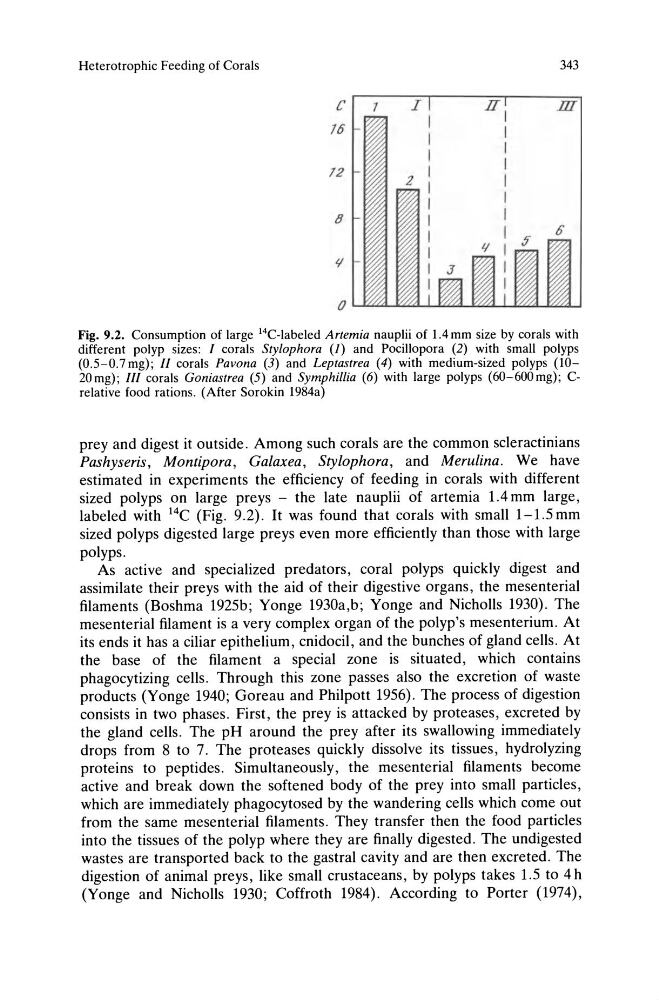
Fig. 9.2. Consumption of large 14C-labeled Artemia nauplii of l.4 mm size by corals with
different polyp sizes: I corals Stylophora (I) and Pocillopora (2) with small polyps
(0.5-0.7mg); II corals Pavona (3) and Leptastrea (4) with medium-sized polyps (1020 mg); III corals Goniastrea (5) and Symphillia (6) with large polyps (60-600 mg); Crelative food rations. (After Sorokin 1984a)
prey and digest it outside. Among such corals are the common scleractinians
Pashyseris, Montipora, Galaxea, Stylophora, and Merulina. We have
estimated in experiments the efficiency of feeding in corals with different
sized polyps on large preys - the late nauplii of artemia 1.4 mm large,
labeled with 14C (Fig. 9.2). It was found that corals with small 1-1.5 mm
sized polyps digested large preys even more efficiently than those with large
polyps.
As active and specialized predators, coral polyps quickly digest and
assimilate their preys with the aid of their digestive organs, the mesenterial
filaments (Boshma 1925b; Yonge 1930a,b; Yonge and Nicholls 1930). The
mesenterial filament is a very complex organ of the polyp's mesenterium. At
its ends it has a ciliar epithelium, cnidocil, and the bunches of gland cells. At
the base of the filament a special zone is situated, which contains
phagocytizing cells. Through this zone passes also the excretion of waste
products (Yonge 1940; Goreau and Philpott 1956). The process of digestion
consists in two phases. First, the prey is attacked by proteases, excreted by
the gland cells. The pH around the prey after its swallowing immediately
drops from 8 to 7. The proteases quickly dissolve its tissues, hydrolyzing
proteins to peptides. Simultaneously, the mesenterial filaments become
active and break down the softened body of the prey into small particles,
which are immediately phagocytosed by the wandering cells which come out
from the same mesenterial filaments. They transfer then the food particles
into the tissues of the polyp where they are finally digested. The undigested
wastes are transported back to the gastral cavity and are then excreted. The
digestion of animal preys, like small crustaceans, by polyps takes 1.5 to 4 h
(Yonge and Nicholls 1930; Coffroth 1984). According to Porter (1974),
C
16
72
8
343
Fig. 9.2. Consumption of large 14C-labeled Artemia nauplii of l.4 mm size by corals with
different polyp sizes: I corals Stylophora (I) and Pocillopora (2) with small polyps
(0.5-0.7mg); II corals Pavona (3) and Leptastrea (4) with medium-sized polyps (1020 mg); III corals Goniastrea (5) and Symphillia (6) with large polyps (60-600 mg); Crelative food rations. (After Sorokin 1984a)
prey and digest it outside. Among such corals are the common scleractinians
Pashyseris, Montipora, Galaxea, Stylophora, and Merulina. We have
estimated in experiments the efficiency of feeding in corals with different
sized polyps on large preys - the late nauplii of artemia 1.4 mm large,
labeled with 14C (Fig. 9.2). It was found that corals with small 1-1.5 mm
sized polyps digested large preys even more efficiently than those with large
polyps.
As active and specialized predators, coral polyps quickly digest and
assimilate their preys with the aid of their digestive organs, the mesenterial
filaments (Boshma 1925b; Yonge 1930a,b; Yonge and Nicholls 1930). The
mesenterial filament is a very complex organ of the polyp's mesenterium. At
its ends it has a ciliar epithelium, cnidocil, and the bunches of gland cells. At
the base of the filament a special zone is situated, which contains
phagocytizing cells. Through this zone passes also the excretion of waste
products (Yonge 1940; Goreau and Philpott 1956). The process of digestion
consists in two phases. First, the prey is attacked by proteases, excreted by
the gland cells. The pH around the prey after its swallowing immediately
drops from 8 to 7. The proteases quickly dissolve its tissues, hydrolyzing
proteins to peptides. Simultaneously, the mesenterial filaments become
active and break down the softened body of the prey into small particles,
which are immediately phagocytosed by the wandering cells which come out
from the same mesenterial filaments. They transfer then the food particles
into the tissues of the polyp where they are finally digested. The undigested
wastes are transported back to the gastral cavity and are then excreted. The
digestion of animal preys, like small crustaceans, by polyps takes 1.5 to 4 h
(Yonge and Nicholls 1930; Coffroth 1984). According to Porter (1974),