

Biological Factors of Formation and Erosion
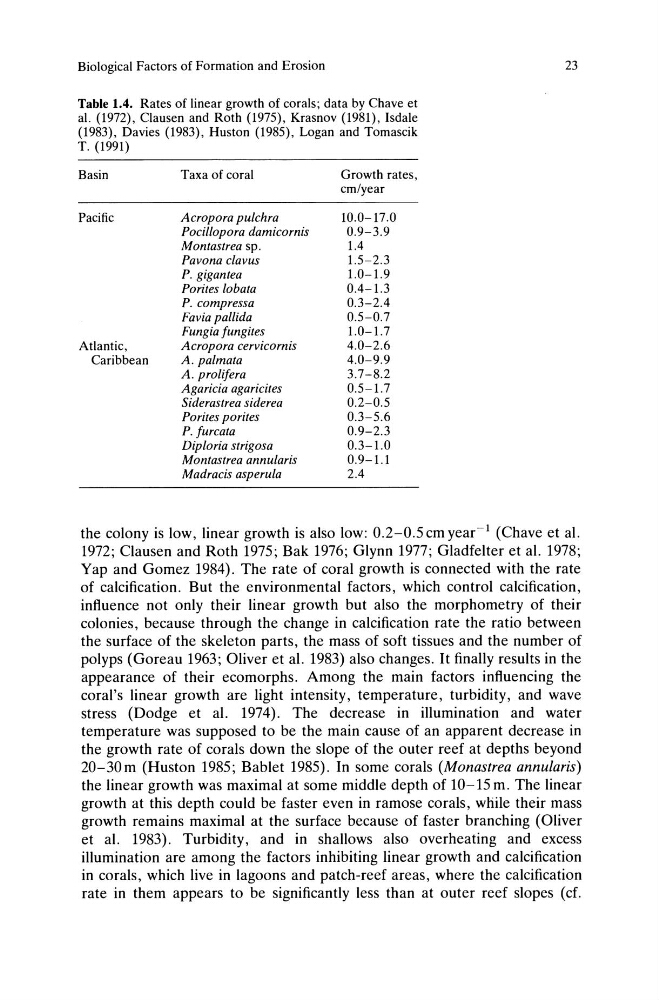
Table 1.4. Rates of linear growth of corals; data by Chave et
al. (1972), Clausen and Roth (197S), Krasnov (1981), Isdale
(1983), Davies (1983), Huston (198S), Logan and Tomascik
T. (1991)
Basin
Pacific
Atlantic,
Caribbean
Taxa of coral
Acropora pulchra
Pocillopora damicornis
Montastrea sp.
Pavona clavus
P. gigantea
Porites lobata
P. compressa
Favia pallida
Fungia fungites
Acropora cervicornis
A. palmata
A. prolifera
Agaricia agaricites
Siderastrea side rea
Porites porites
P. furcata
Diploria strigosa
Montastrea annularis
Madracis asperula
Growth rates,
cm/year
10.0-17.0
0.9-3.9
1.4
1.S-2.3
1.0-1.9
0.4-1.3
0.3-2.4
0.S-0.7
1.0-1.7
4.0-2.6
4.0-9.9
3.7-8.2
O.S-1.7
0.2-0.S
0.3-S.6
0.9-2.3
0.3-1.0
0.9-1.1
2.4
23
the colony is low, linear growth is also low: 0.2-0.5 cm year- 1 (Chave et al.
1972; Clausen and Roth 1975; Bak 1976; Glynn 1977; Gladfelter et al. 1978;
Yap and Gomez 1984). The rate of coral growth is connected with the rate
of calcification. But the environmental factors, which control calcification,
influence not only their linear growth but also the morphometry of their
colonies, because through the change in calcification rate the ratio between
the surface of the skeleton parts, the mass of soft tissues and the number of
polyps (Goreau 1963; Oliver et al. 1983) also changes. It finally results in the
appearance of their ecomorphs. Among the main factors influencing the
coral's linear growth are light intensity, temperature, turbidity, and wave
stress (Dodge et al. 1974). The decrease in illumination and water
temperature was supposed to be the main cause of an apparent decrease in
the growth rate of corals down the slope of the outer reef at depths beyond
20-30m (Huston 1985; Bablet 1985). In some corals (Monastrea annularis)
the linear growth was maximal at some middle depth of 10-15 m. The linear
growth at this depth could be faster even in ramose corals, while their mass
growth remains maximal at the surface because of faster branching (Oliver
et al. 1983). Turbidity, and in shallows also overheating and excess
illumination are among the factors inhibiting linear growth and calcification
in corals, which live in lagoons and patch-reef areas, where the calcification
rate in them appears to be significantly less than at outer reef slopes (cf.
Table 1.4. Rates of linear growth of corals; data by Chave et
al. (1972), Clausen and Roth (197S), Krasnov (1981), Isdale
(1983), Davies (1983), Huston (198S), Logan and Tomascik
T. (1991)
Basin
Pacific
Atlantic,
Caribbean
Taxa of coral
Acropora pulchra
Pocillopora damicornis
Montastrea sp.
Pavona clavus
P. gigantea
Porites lobata
P. compressa
Favia pallida
Fungia fungites
Acropora cervicornis
A. palmata
A. prolifera
Agaricia agaricites
Siderastrea side rea
Porites porites
P. furcata
Diploria strigosa
Montastrea annularis
Madracis asperula
Growth rates,
cm/year
10.0-17.0
0.9-3.9
1.4
1.S-2.3
1.0-1.9
0.4-1.3
0.3-2.4
0.S-0.7
1.0-1.7
4.0-2.6
4.0-9.9
3.7-8.2
O.S-1.7
0.2-0.S
0.3-S.6
0.9-2.3
0.3-1.0
0.9-1.1
2.4
23
the colony is low, linear growth is also low: 0.2-0.5 cm year- 1 (Chave et al.
1972; Clausen and Roth 1975; Bak 1976; Glynn 1977; Gladfelter et al. 1978;
Yap and Gomez 1984). The rate of coral growth is connected with the rate
of calcification. But the environmental factors, which control calcification,
influence not only their linear growth but also the morphometry of their
colonies, because through the change in calcification rate the ratio between
the surface of the skeleton parts, the mass of soft tissues and the number of
polyps (Goreau 1963; Oliver et al. 1983) also changes. It finally results in the
appearance of their ecomorphs. Among the main factors influencing the
coral's linear growth are light intensity, temperature, turbidity, and wave
stress (Dodge et al. 1974). The decrease in illumination and water
temperature was supposed to be the main cause of an apparent decrease in
the growth rate of corals down the slope of the outer reef at depths beyond
20-30m (Huston 1985; Bablet 1985). In some corals (Monastrea annularis)
the linear growth was maximal at some middle depth of 10-15 m. The linear
growth at this depth could be faster even in ramose corals, while their mass
growth remains maximal at the surface because of faster branching (Oliver
et al. 1983). Turbidity, and in shallows also overheating and excess
illumination are among the factors inhibiting linear growth and calcification
in corals, which live in lagoons and patch-reef areas, where the calcification
rate in them appears to be significantly less than at outer reef slopes (cf.