

Ecological and Physiological Aspects of Endosymbiosis
309
K,P
10
B
2
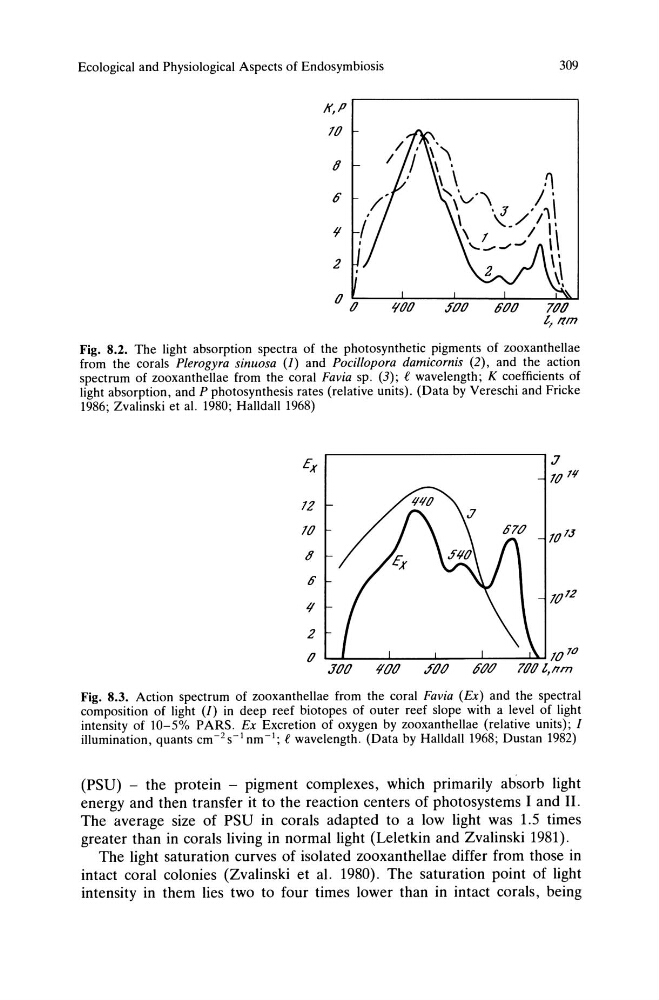
Fig. 8.2. The light absorption spectra of the photosynthetic pigments of zooxanthellae
from the corals Plerogyra sinuosa (1) and Pocillopora damicornis (2), and the action
spectrum of zooxanthellae from the coral Favia sp. (3); e wavelength; K coefficients of
light absorption, and P photosynthesis rates (relative units). (Data by Vereschi and Fricke
1986; Zvalinski et al. 1980; Halldall 1968)
Ex
12
10
B
5
/f
2
0
.7
10 ' /1
L..-L...-_---' _ _ ---L. _ _ ...J... _ _ ....L...lo..I 10 '0
JOO
/fOO
.f'1J0
tf(J1l 700 i,l7m
Fig. 8.3. Action spectrum of zooxanthellae from the coral Favia (Ex) and the spectral
composition of light (1) in deep reef biotopes of outer reef slope with a level of light
intensity of to-5% PARS. Ex Excretion of oxygen by zooxanthellae (relative units); I
illumination, quants cm- 2 s- 1 nm- 1 ; e wavelength. (Data by Halldall 1968; Dustan 1982)
(PSU) - the protein - pigment complexes, which primarily ab'sorb light
energy and then transfer it to the reaction centers of photosystems I and II.
The average size of PSU in corals adapted to a low light was 1.5 times
greater than in corals living in normal light (Leletkin and Zvalinski 1981).
The light saturation curves of isolated zooxanthellae differ from those in
intact coral colonies (Zvalinski et al. 1980). The saturation point of light
intensity in them lies two to four times lower than in intact corals, being
309
K,P
10
B
2
Fig. 8.2. The light absorption spectra of the photosynthetic pigments of zooxanthellae
from the corals Plerogyra sinuosa (1) and Pocillopora damicornis (2), and the action
spectrum of zooxanthellae from the coral Favia sp. (3); e wavelength; K coefficients of
light absorption, and P photosynthesis rates (relative units). (Data by Vereschi and Fricke
1986; Zvalinski et al. 1980; Halldall 1968)
Ex
12
10
B
5
/f
2
0
.7
10 ' /1
L..-L...-_---' _ _ ---L. _ _ ...J... _ _ ....L...lo..I 10 '0
JOO
/fOO
.f'1J0
tf(J1l 700 i,l7m
Fig. 8.3. Action spectrum of zooxanthellae from the coral Favia (Ex) and the spectral
composition of light (1) in deep reef biotopes of outer reef slope with a level of light
intensity of to-5% PARS. Ex Excretion of oxygen by zooxanthellae (relative units); I
illumination, quants cm- 2 s- 1 nm- 1 ; e wavelength. (Data by Halldall 1968; Dustan 1982)
(PSU) - the protein - pigment complexes, which primarily ab'sorb light
energy and then transfer it to the reaction centers of photosystems I and II.
The average size of PSU in corals adapted to a low light was 1.5 times
greater than in corals living in normal light (Leletkin and Zvalinski 1981).
The light saturation curves of isolated zooxanthellae differ from those in
intact coral colonies (Zvalinski et al. 1980). The saturation point of light
intensity in them lies two to four times lower than in intact corals, being