

Ecological and Physiological Aspects of Endosymbiosis
- - - - - - - - - - - - - -
3
In the host's
ceU
305
- - - - - -- -
7n the culture
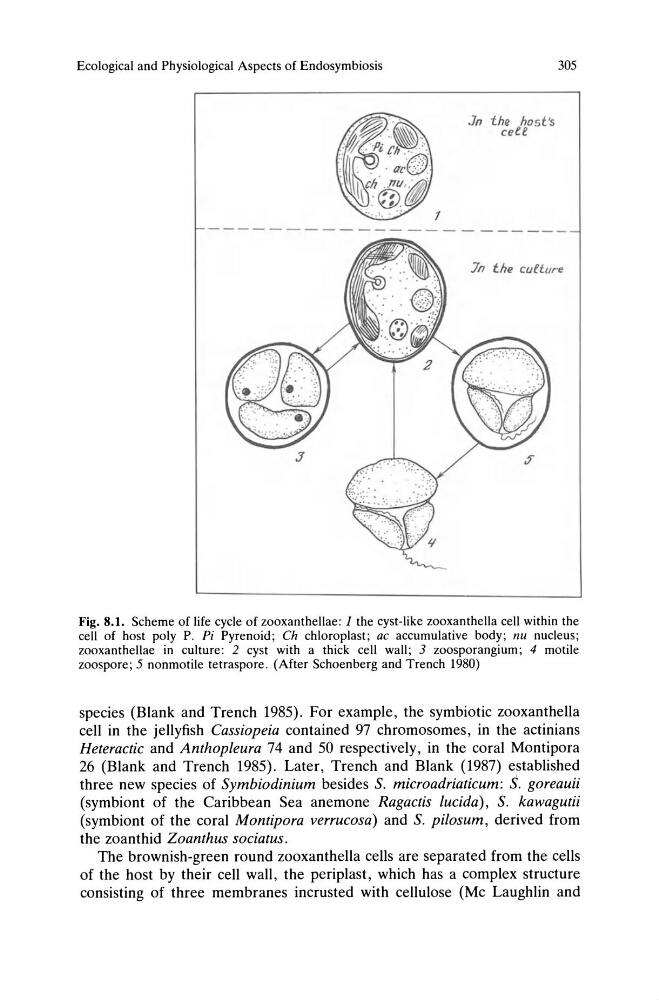
Fig. 8.1. Scheme of life cycle of zooxanthellae: 1 the cyst-like zooxanthella cell within the
cell of host poly P. Pi Pyrenoid; Ch chloroplast; ac accumulative body ; nu nucleus;
zooxanthellae in culture: 2 cyst with a thick cell wall; 3 zoosporangium; 4 motile
zoospore; 5 nonmotile tetraspore. (After Schoenberg and Trench 1980)
species (Blank and Trench 1985). For example, the symbiotic zooxanthella
cell in the jellyfish Cassiopeia contained 97 chromosomes, in the actinians
Heteractic and Anthopleura 74 and 50 respectively, in the coral Montipora
26 (Blank and Trench 1985). Later, Trench and Blank (1987) established
three new species of Symbiodinium besides S. microadriaticum: S. goreauii
(symbiont of the Caribbean Sea anemone Ragactis Lucida), S. kawagutii
(symbiont of the coral Montipora verrucosa) and S. pilosum, derived from
the zoanthid Zoanthus sociatus.
The brownish-green round zooxanthella cells are separated from the cells
of the host by their cell wall, the periplast, which has a complex structure
consisting of three membranes incrusted with cellulose (Mc Laughlin and
- - - - - - - - - - - - - -
3
In the host's
ceU
305
- - - - - -- -
7n the culture
Fig. 8.1. Scheme of life cycle of zooxanthellae: 1 the cyst-like zooxanthella cell within the
cell of host poly P. Pi Pyrenoid; Ch chloroplast; ac accumulative body ; nu nucleus;
zooxanthellae in culture: 2 cyst with a thick cell wall; 3 zoosporangium; 4 motile
zoospore; 5 nonmotile tetraspore. (After Schoenberg and Trench 1980)
species (Blank and Trench 1985). For example, the symbiotic zooxanthella
cell in the jellyfish Cassiopeia contained 97 chromosomes, in the actinians
Heteractic and Anthopleura 74 and 50 respectively, in the coral Montipora
26 (Blank and Trench 1985). Later, Trench and Blank (1987) established
three new species of Symbiodinium besides S. microadriaticum: S. goreauii
(symbiont of the Caribbean Sea anemone Ragactis Lucida), S. kawagutii
(symbiont of the coral Montipora verrucosa) and S. pilosum, derived from
the zoanthid Zoanthus sociatus.
The brownish-green round zooxanthella cells are separated from the cells
of the host by their cell wall, the periplast, which has a complex structure
consisting of three membranes incrusted with cellulose (Mc Laughlin and