

Ecological and Physiological Aspects of Endosymbiosis
303
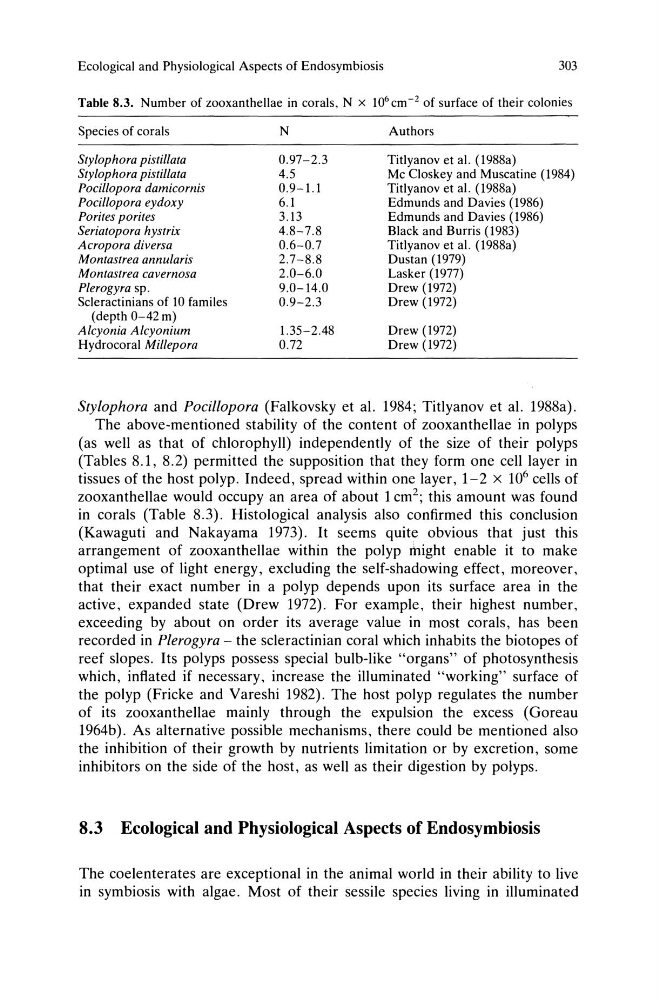
Table 8.3. Number of zooxanthellae in corals, N x 10 6 cm- 2 of surface of their colonies
Species of corals
Stylophora pistillata
Stylophora pistillata
Pocillopora damicornis
Pocillopora eydoxy
Porites porites
Seriatopora hystrix
Acropora diversa
Montastrea annularis
Montastrea cavernosa
Plerogyra sp.
Scleractinians of 10 familes
(depth 0-42m)
Alcyonia Alcyonium
Hydrocoral Millepora
N
0.97-2.3
4.5
0.9-1.1
6.1
3.13
4.8-7.8
0.6-0.7
2.7-8.8
2.0-6.0
9.0-14.0
0.9-2.3
1.35-2.48
0.72
Authors
Titlyanov et al. (1988a)
Mc Closkey and Muscatine (1984)
Titlyanov et al. (1988a)
Edmunds and Davies (1986)
Edmunds and Davies (1986)
Black and Burris (1983)
Titlyanov et al. (1988a)
Dustan (1979)
Lasker (1977)
Drew (1972)
Drew (1972)
Drew (1972)
Drew (1972)
Stylophora and Pocillopora (Falkovsky et al. 1984; Titlyanov et al. 1988a).
The above-mentioned stability of the content of zooxanthellae in polyps
(as well as that of chlorophyll) independently of the size of their polyps
(Tables 8.1, 8.2) permitted the supposition that they form one cell layer in
tissues of the host polyp. Indeed, spread within one layer, 1-2 x 10 6 cells of
zooxanthellae would occupy an area of about 1 cm 2 ; this amount was found
in corals (Table 8.3). Histological analysis also confirmed this conclusion
(Kawaguti and Nakayama 1973). It seems quite obvious that just this
arrangement of zooxanthellae within the polyp might enable it to make
optimal use of light energy, excluding the self-shadowing effect, moreover,
that their exact number in a polyp depends upon its surface area in the
active, expanded state (Drew 1972). For example, their highest number,
exceeding by about on order its average value in most corals, has been
recorded in Plerogyra - the scleractinian coral which inhabits the biotopes of
reef slopes. Its polyps possess special bulb-like "organs" of photosynthesis
which, inflated if necessary, increase the illuminated "working" surface of
the polyp (Fricke and Vareshi 1982). The host polyp regulates the number
of its zooxanthellae mainly through the expulsion the excess (Goreau
1964b). As alternative possible mechanisms, there could be mentioned also
the inhibition of their growth by nutrients limitation or by excretion, some
inhibitors on the side of the host, as well as their digestion by polyps.
8.3 Ecological and Physiological Aspects of Endosymhiosis
The coelenterates are exceptional in the animal world in their ability to live
in symbiosis with algae. Most of their sessile species living in illuminated
303
Table 8.3. Number of zooxanthellae in corals, N x 10 6 cm- 2 of surface of their colonies
Species of corals
Stylophora pistillata
Stylophora pistillata
Pocillopora damicornis
Pocillopora eydoxy
Porites porites
Seriatopora hystrix
Acropora diversa
Montastrea annularis
Montastrea cavernosa
Plerogyra sp.
Scleractinians of 10 familes
(depth 0-42m)
Alcyonia Alcyonium
Hydrocoral Millepora
N
0.97-2.3
4.5
0.9-1.1
6.1
3.13
4.8-7.8
0.6-0.7
2.7-8.8
2.0-6.0
9.0-14.0
0.9-2.3
1.35-2.48
0.72
Authors
Titlyanov et al. (1988a)
Mc Closkey and Muscatine (1984)
Titlyanov et al. (1988a)
Edmunds and Davies (1986)
Edmunds and Davies (1986)
Black and Burris (1983)
Titlyanov et al. (1988a)
Dustan (1979)
Lasker (1977)
Drew (1972)
Drew (1972)
Drew (1972)
Drew (1972)
Stylophora and Pocillopora (Falkovsky et al. 1984; Titlyanov et al. 1988a).
The above-mentioned stability of the content of zooxanthellae in polyps
(as well as that of chlorophyll) independently of the size of their polyps
(Tables 8.1, 8.2) permitted the supposition that they form one cell layer in
tissues of the host polyp. Indeed, spread within one layer, 1-2 x 10 6 cells of
zooxanthellae would occupy an area of about 1 cm 2 ; this amount was found
in corals (Table 8.3). Histological analysis also confirmed this conclusion
(Kawaguti and Nakayama 1973). It seems quite obvious that just this
arrangement of zooxanthellae within the polyp might enable it to make
optimal use of light energy, excluding the self-shadowing effect, moreover,
that their exact number in a polyp depends upon its surface area in the
active, expanded state (Drew 1972). For example, their highest number,
exceeding by about on order its average value in most corals, has been
recorded in Plerogyra - the scleractinian coral which inhabits the biotopes of
reef slopes. Its polyps possess special bulb-like "organs" of photosynthesis
which, inflated if necessary, increase the illuminated "working" surface of
the polyp (Fricke and Vareshi 1982). The host polyp regulates the number
of its zooxanthellae mainly through the expulsion the excess (Goreau
1964b). As alternative possible mechanisms, there could be mentioned also
the inhibition of their growth by nutrients limitation or by excretion, some
inhibitors on the side of the host, as well as their digestion by polyps.
8.3 Ecological and Physiological Aspects of Endosymhiosis
The coelenterates are exceptional in the animal world in their ability to live
in symbiosis with algae. Most of their sessile species living in illuminated