

Communities Structure of Reef Corals
275
A
8
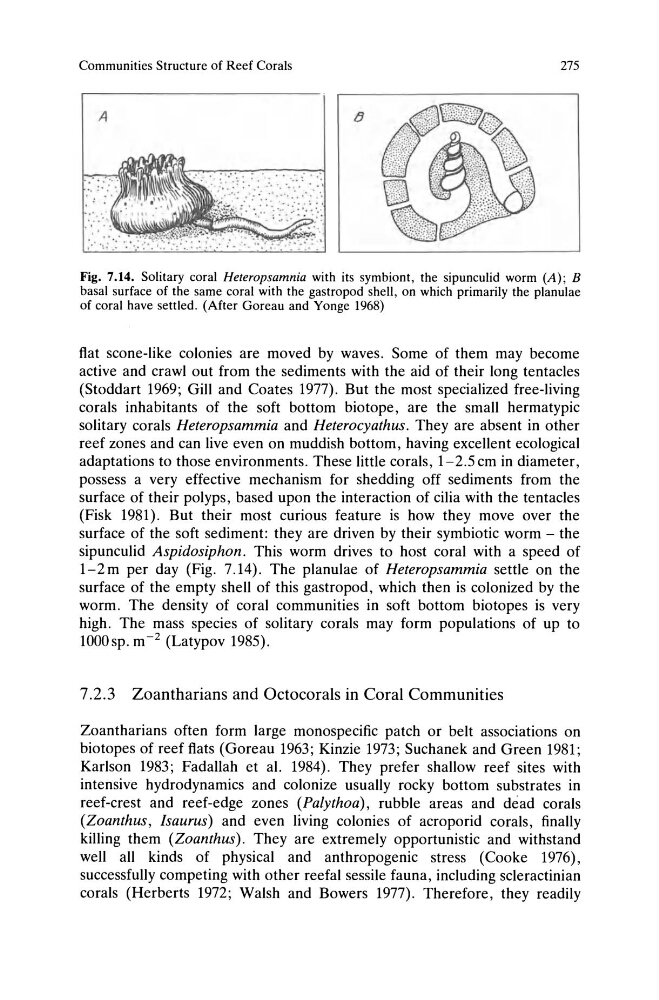
Fig. 7.14. Solitary coral Heteropsamnia with its symbiont, the sipunculid worm (A); B
basal surface of the same coral with the gastropod shell, on which primarily the planulae
of coral have settled. (After Goreau and Yonge 1968)
flat scone-like colonies are moved by waves. Some of them may become
active and crawl out from the sediments with the aid of their long tentacles
(Stoddart 1969; Gill and Coates 1977). But the most specialized free-living
corals inhabitants of the soft bottom biotope, are the small hermatypic
solitary corals Heteropsammia and Heterocyathus. They are absent in other
reef zones and can live even on muddish bottom, having excellent ecological
adaptations to those environments. These little corals, 1-2.5cm in diameter,
possess a very effective mechanism for shedding off sediments from the
surface of their polyps, based upon the interaction of cilia with the tentacles
(Fisk 1981). But their most curious feature is how they move over the
surface of the soft sediment: they are driven by their symbiotic worm - the
sipunculid Aspidosiphon. This worm drives to host coral with a speed of
I-2m per day (Fig. 7.14). The planulae of Heteropsammia settle on the
surface of the empty shell of this gastropod, which then is colonized by the
worm. The density of coral communities in soft bottom biotopes is very
high. The mass species of solitary corals may form popUlations of up to
lOOOsp. m- 2 (Latypov 1985).
7.2.3 Zoantharians and Octocorals in Coral Communities
Zoantharians often form large monospecific patch or belt associations on
biotopes of reef flats (Goreau 1963; Kinzie 1973; Suchanek and Green 1981;
Karlson 1983; Fadallah et al. 1984). They prefer shallow reef sites with
intensive hydrodynamics and colonize usually rocky bottom substrates in
reef-crest and reef-edge zones (Palythoa), rubble areas and dead corals
(Zoanthus, Isaurus) and even living colonies of acroporid corals, finally
killing them (Zoanthus). They are extremely opportunistic and withstand
well all kinds of physical and anthropogenic stress (Cooke 1976),
successfully competing with other reefal sessile fauna, including scleractinian
corals (Herberts 1972; Walsh and Bowers 1977). Therefore, they readily
275
A
8
Fig. 7.14. Solitary coral Heteropsamnia with its symbiont, the sipunculid worm (A); B
basal surface of the same coral with the gastropod shell, on which primarily the planulae
of coral have settled. (After Goreau and Yonge 1968)
flat scone-like colonies are moved by waves. Some of them may become
active and crawl out from the sediments with the aid of their long tentacles
(Stoddart 1969; Gill and Coates 1977). But the most specialized free-living
corals inhabitants of the soft bottom biotope, are the small hermatypic
solitary corals Heteropsammia and Heterocyathus. They are absent in other
reef zones and can live even on muddish bottom, having excellent ecological
adaptations to those environments. These little corals, 1-2.5cm in diameter,
possess a very effective mechanism for shedding off sediments from the
surface of their polyps, based upon the interaction of cilia with the tentacles
(Fisk 1981). But their most curious feature is how they move over the
surface of the soft sediment: they are driven by their symbiotic worm - the
sipunculid Aspidosiphon. This worm drives to host coral with a speed of
I-2m per day (Fig. 7.14). The planulae of Heteropsammia settle on the
surface of the empty shell of this gastropod, which then is colonized by the
worm. The density of coral communities in soft bottom biotopes is very
high. The mass species of solitary corals may form popUlations of up to
lOOOsp. m- 2 (Latypov 1985).
7.2.3 Zoantharians and Octocorals in Coral Communities
Zoantharians often form large monospecific patch or belt associations on
biotopes of reef flats (Goreau 1963; Kinzie 1973; Suchanek and Green 1981;
Karlson 1983; Fadallah et al. 1984). They prefer shallow reef sites with
intensive hydrodynamics and colonize usually rocky bottom substrates in
reef-crest and reef-edge zones (Palythoa), rubble areas and dead corals
(Zoanthus, Isaurus) and even living colonies of acroporid corals, finally
killing them (Zoanthus). They are extremely opportunistic and withstand
well all kinds of physical and anthropogenic stress (Cooke 1976),
successfully competing with other reefal sessile fauna, including scleractinian
corals (Herberts 1972; Walsh and Bowers 1977). Therefore, they readily