

272
Communities of Corals in Reef Ecosystems
#,mr-----------------------------.-------,
7.3
~m
,
1,.1
7,0
12J'fS
T, flours
O~--------------------------~--~
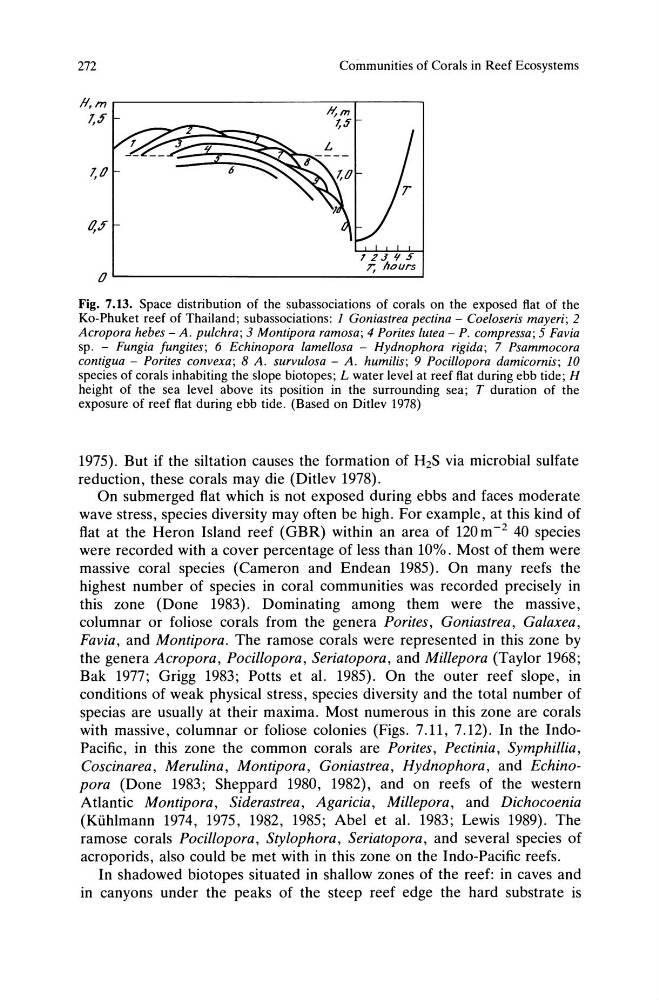
Fig. 7.13. Space distribution of the subassociations of corals on the exposed flat of the
Ko-Phuket reef of Thailand; subassociations: 1 Goniastrea pectina - Coeloseris mayeri; 2
Acropora hebes - A. pulchra; 3 Montipora ramosa; 4 Porites lutea - P. compressa; 5 Favia
sp. - Fungia fungites; 6 Echinopora lameliosa - Hydnophora rigida; 7 Psammocora
contigua - Porites convexa; 8 A. survulosa - A. humilis; 9 Pociliopora damicornis; 10
species of corals inhabiting the slope biotopes; L water level at reef flat during ebb tide; H
height of the sea level above its position in the surrounding sea; T duration of the
exposure of reef flat during ebb tide. (Based on Ditlev 1978)
1975). But if the siltation causes the formation of HzS via microbial sulfate
reduction, these corals may die (Ditlev 1978).
On submerged flat which is not exposed during ebbs and faces moderate
wave stress, species diversity may often be high. For example, at this kind of
flat at the Heron Island reef (GBR) within an area of 120m- z 40 species
were recorded with a cover percentage of less than 10%. Most of them were
massive coral species (Cameron and Endean 1985). On many reefs the
highest number of species in coral communities was recorded precisely in
this zone (Done 1983). Dominating among them were the massive,
columnar or foliose corals from the genera Porites, Goniastrea, Galaxea,
Favia, and Montipora. The ramose corals were represented in this zone by
the genera Acropora, Pocillopora, Seriatopora, and Millepora (Taylor 1968;
Bak 1977; Grigg 1983; Potts et al. 1985). On the outer reef slope, in
conditions of weak physical stress, species diversity and the total number of
specias are usually at their maxima. Most numerous in this zone are corals
with massive, columnar or foliose colonies (Figs. 7.11, 7.12). In the IndoPacific, in this zone the common corals are Porites, Pectinia, Symphillia,
Coscinarea, Merulina, Montipora, Goniastrea, Hydnophora, and Echinopora (Done 1983; Sheppard 1980, 1982), and on reefs of the western
Atlantic Montipora, Siderastrea, Agaricia, Millepora, and Dichocoenia
(Kuhlmann 1974, 1975, 1982, 1985; Abel et al. 1983; Lewis 1989). The
ramose corals Pocillopora, Stylophora, Seriatopora, and several species of
acroporids, also could be met with in this zone on the Indo-Pacific reefs.
In shadowed biotopes situated in shallow zones of the reef: in caves and
in canyons under the peaks of the steep reef edge the hard substrate is
Communities of Corals in Reef Ecosystems
#,mr-----------------------------.-------,
7.3
~m
,
1,.1
7,0
12J'fS
T, flours
O~--------------------------~--~
Fig. 7.13. Space distribution of the subassociations of corals on the exposed flat of the
Ko-Phuket reef of Thailand; subassociations: 1 Goniastrea pectina - Coeloseris mayeri; 2
Acropora hebes - A. pulchra; 3 Montipora ramosa; 4 Porites lutea - P. compressa; 5 Favia
sp. - Fungia fungites; 6 Echinopora lameliosa - Hydnophora rigida; 7 Psammocora
contigua - Porites convexa; 8 A. survulosa - A. humilis; 9 Pociliopora damicornis; 10
species of corals inhabiting the slope biotopes; L water level at reef flat during ebb tide; H
height of the sea level above its position in the surrounding sea; T duration of the
exposure of reef flat during ebb tide. (Based on Ditlev 1978)
1975). But if the siltation causes the formation of HzS via microbial sulfate
reduction, these corals may die (Ditlev 1978).
On submerged flat which is not exposed during ebbs and faces moderate
wave stress, species diversity may often be high. For example, at this kind of
flat at the Heron Island reef (GBR) within an area of 120m- z 40 species
were recorded with a cover percentage of less than 10%. Most of them were
massive coral species (Cameron and Endean 1985). On many reefs the
highest number of species in coral communities was recorded precisely in
this zone (Done 1983). Dominating among them were the massive,
columnar or foliose corals from the genera Porites, Goniastrea, Galaxea,
Favia, and Montipora. The ramose corals were represented in this zone by
the genera Acropora, Pocillopora, Seriatopora, and Millepora (Taylor 1968;
Bak 1977; Grigg 1983; Potts et al. 1985). On the outer reef slope, in
conditions of weak physical stress, species diversity and the total number of
specias are usually at their maxima. Most numerous in this zone are corals
with massive, columnar or foliose colonies (Figs. 7.11, 7.12). In the IndoPacific, in this zone the common corals are Porites, Pectinia, Symphillia,
Coscinarea, Merulina, Montipora, Goniastrea, Hydnophora, and Echinopora (Done 1983; Sheppard 1980, 1982), and on reefs of the western
Atlantic Montipora, Siderastrea, Agaricia, Millepora, and Dichocoenia
(Kuhlmann 1974, 1975, 1982, 1985; Abel et al. 1983; Lewis 1989). The
ramose corals Pocillopora, Stylophora, Seriatopora, and several species of
acroporids, also could be met with in this zone on the Indo-Pacific reefs.
In shadowed biotopes situated in shallow zones of the reef: in caves and
in canyons under the peaks of the steep reef edge the hard substrate is