

268
Communities of Corals in Reef Ecosystems
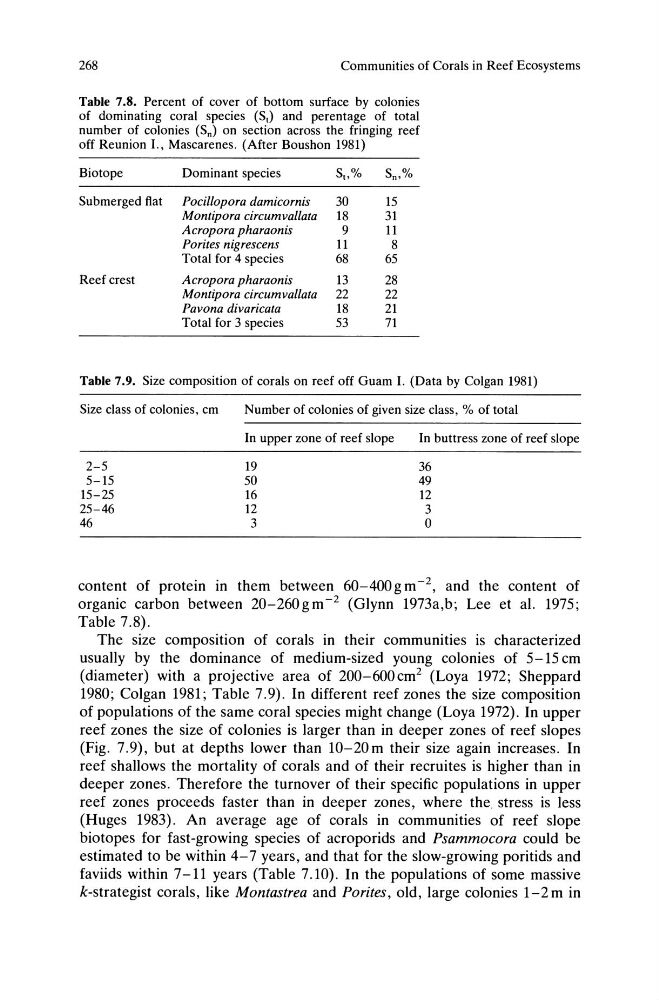
Table 7.S. Percent of cover of bottom surface by colonies
of dominating coral species (St) and perentage of total
number of colonies (Sn) on section across the fringing reef
off Reunion I., Mascarenes. (After Boushon 1981)
Biotope
Dominant species
S,,%
Sn,%
Submerged flat
Pocillopora damicornis
30
15
Montipora circumvallata
18
31
Acropora pharaonis
9
11
Porites nigrescens
11
8
Total for 4 species
68
65
Reef crest
Acropora pharaonis
13
28
Montipora circumvallata 22
22
Pavona divaricata
18
21
Total for 3 species
53
71
Table 7.9. Size composition of corals on reef off Guam I. (Data by Colgan 1981)
Size class of colonies, cm
2-5
5-15
15-25
25-46
46
Number of colonies of given size class, % of total
In upper zone of reef slope
19
50
16
12
3
In buttress zone of reef slope
36
49
12
3
o
content of protein in them between 60-400 g m -2, and the content of
organic carbon between 20-260gm- 2 (Glynn 1973a,b; Lee et al. 1975;
Table 7.8).
The size composition of corals in their communities is characterized
usually by the dominance of medium-sized young colonies of 5-15 cm
(diameter) with a projective area of 200-600cm 2 (Loya 1972; Sheppard
1980; Colgan 1981; Table 7.9). In different reef zones the size composition
of populations of the same coral species might change (Loya 1972). In upper
reef zones the size of colonies is larger than in deeper zones of reef slopes
(Fig. 7.9), but at depths lower than 1O-20m their size again increases. In
reef shallows the mortality of corals and of their recruites is higher than in
deeper zones. Therefore the turnover of their specific populations in upper
reef zones proceeds faster than in deeper zones, where the. stress is less
(Huges 1983). An average age of corals in communities of reef slope
biotopes for fast-growing species of acroporids and Psammocora could be
estimated to be within 4-7 years, and that for the slow-growing poritids and
faviids within 7-11 years (Table 7.10). In the populations of some massive
k-strategist corals, like Montastrea and Porites, old, large colonies I-2m in
Communities of Corals in Reef Ecosystems
Table 7.S. Percent of cover of bottom surface by colonies
of dominating coral species (St) and perentage of total
number of colonies (Sn) on section across the fringing reef
off Reunion I., Mascarenes. (After Boushon 1981)
Biotope
Dominant species
S,,%
Sn,%
Submerged flat
Pocillopora damicornis
30
15
Montipora circumvallata
18
31
Acropora pharaonis
9
11
Porites nigrescens
11
8
Total for 4 species
68
65
Reef crest
Acropora pharaonis
13
28
Montipora circumvallata 22
22
Pavona divaricata
18
21
Total for 3 species
53
71
Table 7.9. Size composition of corals on reef off Guam I. (Data by Colgan 1981)
Size class of colonies, cm
2-5
5-15
15-25
25-46
46
Number of colonies of given size class, % of total
In upper zone of reef slope
19
50
16
12
3
In buttress zone of reef slope
36
49
12
3
o
content of protein in them between 60-400 g m -2, and the content of
organic carbon between 20-260gm- 2 (Glynn 1973a,b; Lee et al. 1975;
Table 7.8).
The size composition of corals in their communities is characterized
usually by the dominance of medium-sized young colonies of 5-15 cm
(diameter) with a projective area of 200-600cm 2 (Loya 1972; Sheppard
1980; Colgan 1981; Table 7.9). In different reef zones the size composition
of populations of the same coral species might change (Loya 1972). In upper
reef zones the size of colonies is larger than in deeper zones of reef slopes
(Fig. 7.9), but at depths lower than 1O-20m their size again increases. In
reef shallows the mortality of corals and of their recruites is higher than in
deeper zones. Therefore the turnover of their specific populations in upper
reef zones proceeds faster than in deeper zones, where the. stress is less
(Huges 1983). An average age of corals in communities of reef slope
biotopes for fast-growing species of acroporids and Psammocora could be
estimated to be within 4-7 years, and that for the slow-growing poritids and
faviids within 7-11 years (Table 7.10). In the populations of some massive
k-strategist corals, like Montastrea and Porites, old, large colonies I-2m in