

Communities Structure of Reef Corals
261
Coastal
Zone of
Reef
Upper
Deeper
Coral species
zone
Acropora
Zone of rocky flat
edge
reef
reef
pa/mata
slope
slope
-
Madracis mirabilis
Madracis pharensis
--- -
Acropora pa/mata
--Agaricia agaricites
-
'\
Agaricia /amarckii
Siderastrea sederea
Porites asteroides
'\
Dip/oria clivosa
~-=Dip/oria strigosa
Montastrea annu/aris
- -'
Montastrea cavernosa - - - -
.l.
-
Meandrina meandrites
-
-
'\
Dichocoenia stokesii
- - -
Mycetophyllia aliciae
---- -
Eusmilia fastigata
-
-
Millepora sp.
Sco/ymia /acera
o
20
50
75
100
125
-1
Percent of coral cover:
-
-1-5
-
-5-25
-
-25-50
_
-50-100
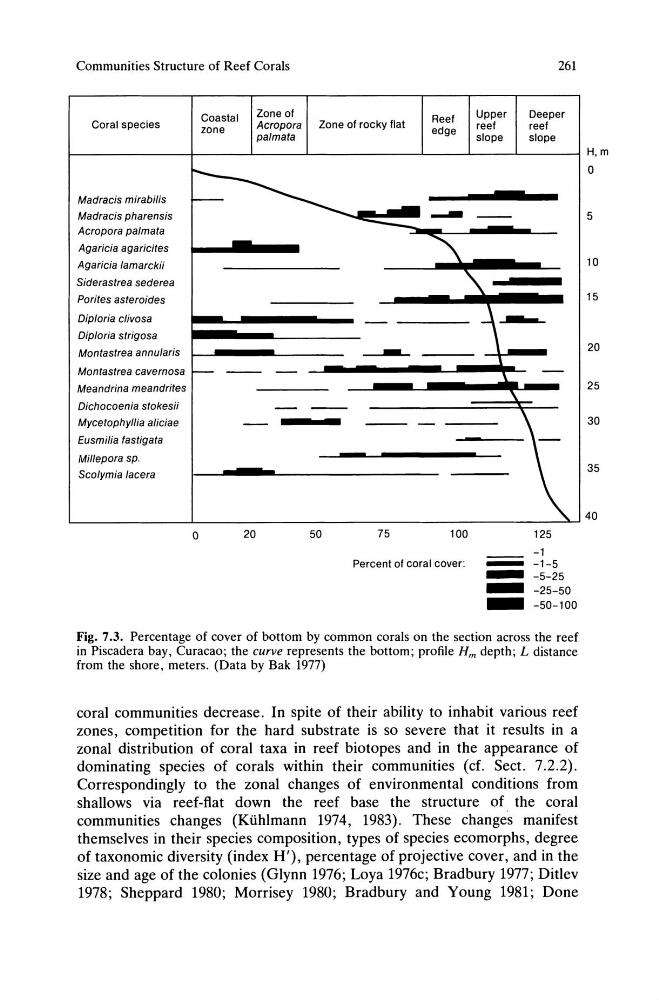
Fig. 7.3. Percentage of cover of bottom by common corals on the section across the reef
in Piscadera bay, Curacao; the curve represents the bottom; profile Hm depth; L distance
from the shore, meters. (Data by Bak 1977)
coral communities decrease. In spite of their ability to inhabit various reef
zones, competition for the hard substrate is so severe that it results in a
zonal distribution of coral taxa in reef biotopes and in the appearance of
dominating species of corals within their communities (cf. Sect. 7.2.2).
Correspondingly to the zonal changes of environmental conditions from
shallows via reef-flat down the reef base the structure of the coral
communities changes (Kuhlmann 1974, 1983). These changes manifest
themselves in their species composition, types of species ecomorphs, degree
of taxonomic diversity (index H'), percentage of projective cover, and in the
size and age of the colonies (Glynn 1976; Loya 1976c; Bradbury 1977; Ditlev
1978; Sheppard 1980; Morrisey 1980; Bradbury and Young 1981; Done
H,m
o
5
10
15
20
25
30
35
40
261
Coastal
Zone of
Reef
Upper
Deeper
Coral species
zone
Acropora
Zone of rocky flat
edge
reef
reef
pa/mata
slope
slope
-
Madracis mirabilis
Madracis pharensis
--- -
Acropora pa/mata
--Agaricia agaricites
-
'\
Agaricia /amarckii
Siderastrea sederea
Porites asteroides
'\
Dip/oria clivosa
~-=Dip/oria strigosa
Montastrea annu/aris
- -'
Montastrea cavernosa - - - -
.l.
-
Meandrina meandrites
-
-
'\
Dichocoenia stokesii
- - -
Mycetophyllia aliciae
---- -
Eusmilia fastigata
-
-
Millepora sp.
Sco/ymia /acera
o
20
50
75
100
125
-1
Percent of coral cover:
-
-1-5
-
-5-25
-
-25-50
_
-50-100
Fig. 7.3. Percentage of cover of bottom by common corals on the section across the reef
in Piscadera bay, Curacao; the curve represents the bottom; profile Hm depth; L distance
from the shore, meters. (Data by Bak 1977)
coral communities decrease. In spite of their ability to inhabit various reef
zones, competition for the hard substrate is so severe that it results in a
zonal distribution of coral taxa in reef biotopes and in the appearance of
dominating species of corals within their communities (cf. Sect. 7.2.2).
Correspondingly to the zonal changes of environmental conditions from
shallows via reef-flat down the reef base the structure of the coral
communities changes (Kuhlmann 1974, 1983). These changes manifest
themselves in their species composition, types of species ecomorphs, degree
of taxonomic diversity (index H'), percentage of projective cover, and in the
size and age of the colonies (Glynn 1976; Loya 1976c; Bradbury 1977; Ditlev
1978; Sheppard 1980; Morrisey 1980; Bradbury and Young 1981; Done
H,m
o
5
10
15
20
25
30
35
40