

240
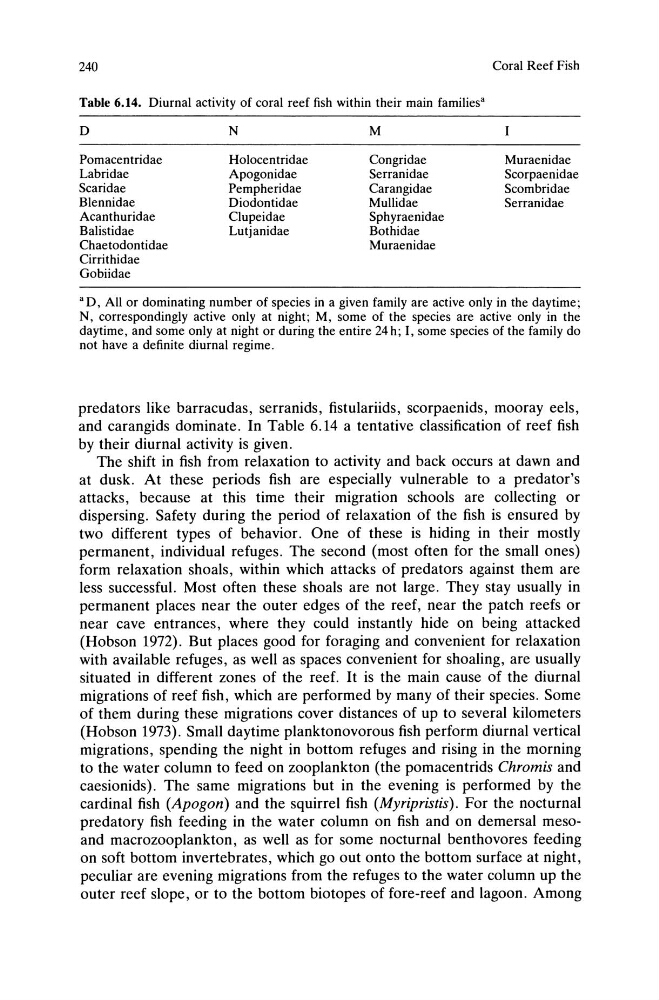
Table 6.14. Diurnal activity of coral reef fish within their main families a
D
Pomacentridae
Labridae
Scaridae
Blennidae
Acanthuridae
Balistidae
Chaetodontidae
Cirrithidae
Gobiidae
N
Holocentridae
Apogonidae
Pempheridae
Diodontidae
Clupeidae
Lutjanidae
M
Congridae
Serranidae
Carangidae
Mullidae
Sphyraenidae
Bothidae
Muraenidae
Coral Reef Fish
Muraenidae
Scorpaenidae
Scombridae
Serranidae
a D, All or dominating number of species in a given family are active only in the daytime;
N, correspondingly active only at night; M, some of the species are active only in the
daytime, and some only at night or during the entire 24 h; I, some species of the family do
not have a definite diurnal regime.
predators like barracudas, serranids, fistulariids, scorpaenids, moo ray eels,
and carangids dominate. In Table 6.14 a tentative classification of reef fish
by their diurnal activity is given.
The shift in fish from relaxation to activity and back occurs at dawn and
at dusk. At these periods fish are especially vulnerable to a predator's
attacks, because at this time their migration schools are collecting or
dispersing. Safety during the period of relaxation of the fish is ensured by
two different types of behavior. One of these is hiding in their mostly
permanent, individual refuges. The second (most often for the small ones)
form relaxation shoals, within which attacks of predators against them are
less successful. Most often these shoals are not large. They stay usually in
permanent places near the outer edges of the reef, near the patch reefs or
near cave entrances, where they could instantly hide on being attacked
(Hobson 1972). But places good for foraging and convenient for relaxation
with available refuges, as well as spaces convenient for shoaling, are usually
situated in different zones of the reef. It is the main cause of the diurnal
migrations of reef fish, which are performed by many of their species. Some
of them during these migrations cover distances of up to several kilometers
(Hobson 1973). Small daytime planktonovorous fish perform diurnal vertical
migrations, spending the night in bottom refuges and rising in the morning
to the water column to feed on zooplankton (the pomacentrids Chromis and
caesionids). The same migrations but in the evening is performed by the
cardinal fish (Apogon) and the squirrel fish (Myripristis). For the nocturnal
predatory fish feeding in the water column on fish and on demersal mesoand macrozooplankton, as well as for some nocturnal benthovores feeding
on soft bottom invertebrates, which go out onto the bottom surface at night,
peculiar are evening migrations from the refuges to the water column up the
outer reef slope, or to the bottom biotopes of fore-reef and lagoon. Among
Table 6.14. Diurnal activity of coral reef fish within their main families a
D
Pomacentridae
Labridae
Scaridae
Blennidae
Acanthuridae
Balistidae
Chaetodontidae
Cirrithidae
Gobiidae
N
Holocentridae
Apogonidae
Pempheridae
Diodontidae
Clupeidae
Lutjanidae
M
Congridae
Serranidae
Carangidae
Mullidae
Sphyraenidae
Bothidae
Muraenidae
Coral Reef Fish
Muraenidae
Scorpaenidae
Scombridae
Serranidae
a D, All or dominating number of species in a given family are active only in the daytime;
N, correspondingly active only at night; M, some of the species are active only in the
daytime, and some only at night or during the entire 24 h; I, some species of the family do
not have a definite diurnal regime.
predators like barracudas, serranids, fistulariids, scorpaenids, moo ray eels,
and carangids dominate. In Table 6.14 a tentative classification of reef fish
by their diurnal activity is given.
The shift in fish from relaxation to activity and back occurs at dawn and
at dusk. At these periods fish are especially vulnerable to a predator's
attacks, because at this time their migration schools are collecting or
dispersing. Safety during the period of relaxation of the fish is ensured by
two different types of behavior. One of these is hiding in their mostly
permanent, individual refuges. The second (most often for the small ones)
form relaxation shoals, within which attacks of predators against them are
less successful. Most often these shoals are not large. They stay usually in
permanent places near the outer edges of the reef, near the patch reefs or
near cave entrances, where they could instantly hide on being attacked
(Hobson 1972). But places good for foraging and convenient for relaxation
with available refuges, as well as spaces convenient for shoaling, are usually
situated in different zones of the reef. It is the main cause of the diurnal
migrations of reef fish, which are performed by many of their species. Some
of them during these migrations cover distances of up to several kilometers
(Hobson 1973). Small daytime planktonovorous fish perform diurnal vertical
migrations, spending the night in bottom refuges and rising in the morning
to the water column to feed on zooplankton (the pomacentrids Chromis and
caesionids). The same migrations but in the evening is performed by the
cardinal fish (Apogon) and the squirrel fish (Myripristis). For the nocturnal
predatory fish feeding in the water column on fish and on demersal mesoand macrozooplankton, as well as for some nocturnal benthovores feeding
on soft bottom invertebrates, which go out onto the bottom surface at night,
peculiar are evening migrations from the refuges to the water column up the
outer reef slope, or to the bottom biotopes of fore-reef and lagoon. Among