

Communities Structure, Abundance, Distribution
225
Because of relative stability of space and trophic sources in reef biotopes
the local fish associations, and even their diurnally migrating shoals, have a
constant composition. The resident adult fish, which occupy permanent
places in the biotope, enjoy a preference before newcomers and actively
attack them. These strict residents provide the stability of species
composition in fish communities in a particulr r reef biotope. Among them
there are species from the families Pomacentridae, Eleotridae, Gobiidae,
Muraenidae, and Seorpaenidae, which accomplish the function of "core
species" in the community. Less strict residents, like labrides, scarids,
serranids, fistulariids, and acanthurids, may use various kinds of substrate as
their permanent or temporary refuges. These fish create a diversity of
communities in similar reef biotopes.
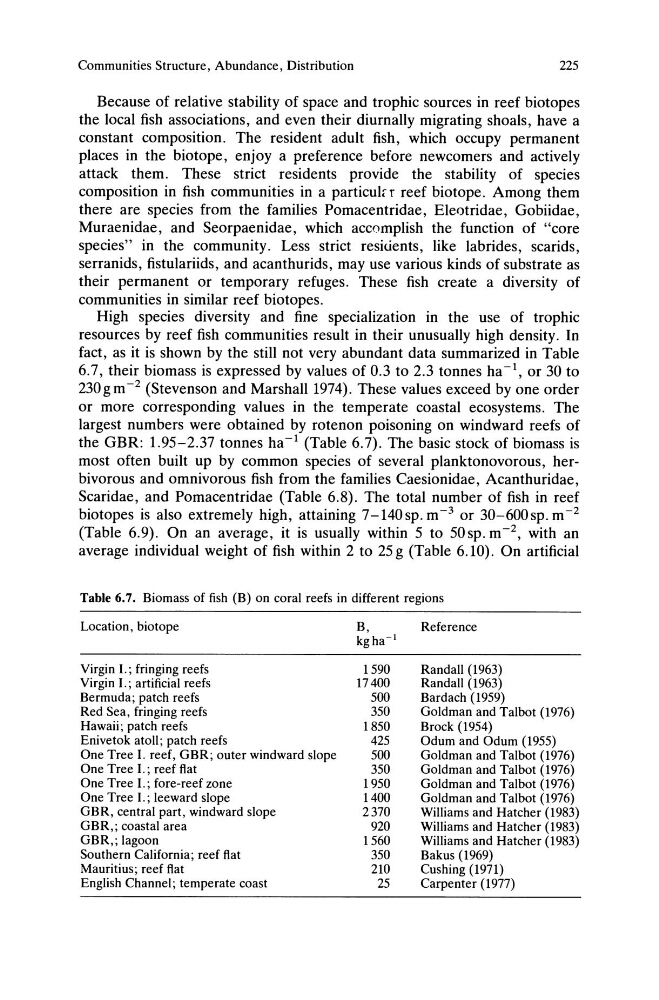
High species diversity and fine specialization in the use of trophic
resources by reef fish communities result in their unusually high density. In
fact, as it is shown by the still not very abundant data summarized in Table
6.7, their biomass is expressed by values of 0.3 to 2.3 tonnes ha -1, or 30 to
230gm- 2 (Stevenson and Marshall 1974). These values exceed by one order
or more corresponding values in the temperate coastal ecosystems. The
largest numbers were obtained by rotenon poisoning on windward reefs of
the GBR: 1.95-2.37 tonnes ha- 1 (Table 6.7). The basic stock of biomass is
most often built up by common species of several planktonovorous, herbivorous and omnivorous fish from the families Caesionidae, Acanthuridae,
Scaridae, and Pomacentridae (Table 6.8). The total number of fish in reef
biotopes is also extremely high, attaining 7-140sp. m- 3 or 30-600sp. m- 2
(Table 6.9). On an average, it is usually within 5 to 50sp. m- 2 , with an
average individual weight of fish within 2 to 25 g (Table 6.10). On artificial
Table 6.7. Biomass of fish (B) on coral reefs in different regions
Location, biotope
Virgin I.; fringing reefs
Virgin I.; artificial reefs
Bermuda; patch reefs
Red Sea, fringing reefs
Hawaii; patch reefs
Enivetok atoll; patch reefs
One Tree I. reef, GBR; outer windward slope
One Tree I.; reef flat
One Tree I.; fore-reef zone
One Tree I.; leeward slope
GBR, central part, windward slope
GBR,; coastal area
GBR,; lagoon
Southern California; reef flat
Mauritius; reef flat
English Channel; temperate coast
B,
kgha- 1
1590
17400
500
350
1850
425
500
350
1950
1400
2370
920
1560
350
210
25
Reference
Randall (1963)
Randall (1963)
Bardach (1959)
Goldman and Talbot (1976)
Brock (1954)
Odum and Odum (1955)
Goldman and Talbot (1976)
Goldman and Talbot (1976)
Goldman and Talbot (1976)
Goldman and Talbot (1976)
Williams and Hatcher (1983)
Williams and Hatcher (1983)
Williams and Hatcher (1983)
Bakus (1969)
Cushing (1971)
Carpenter (1977)
225
Because of relative stability of space and trophic sources in reef biotopes
the local fish associations, and even their diurnally migrating shoals, have a
constant composition. The resident adult fish, which occupy permanent
places in the biotope, enjoy a preference before newcomers and actively
attack them. These strict residents provide the stability of species
composition in fish communities in a particulr r reef biotope. Among them
there are species from the families Pomacentridae, Eleotridae, Gobiidae,
Muraenidae, and Seorpaenidae, which accomplish the function of "core
species" in the community. Less strict residents, like labrides, scarids,
serranids, fistulariids, and acanthurids, may use various kinds of substrate as
their permanent or temporary refuges. These fish create a diversity of
communities in similar reef biotopes.
High species diversity and fine specialization in the use of trophic
resources by reef fish communities result in their unusually high density. In
fact, as it is shown by the still not very abundant data summarized in Table
6.7, their biomass is expressed by values of 0.3 to 2.3 tonnes ha -1, or 30 to
230gm- 2 (Stevenson and Marshall 1974). These values exceed by one order
or more corresponding values in the temperate coastal ecosystems. The
largest numbers were obtained by rotenon poisoning on windward reefs of
the GBR: 1.95-2.37 tonnes ha- 1 (Table 6.7). The basic stock of biomass is
most often built up by common species of several planktonovorous, herbivorous and omnivorous fish from the families Caesionidae, Acanthuridae,
Scaridae, and Pomacentridae (Table 6.8). The total number of fish in reef
biotopes is also extremely high, attaining 7-140sp. m- 3 or 30-600sp. m- 2
(Table 6.9). On an average, it is usually within 5 to 50sp. m- 2 , with an
average individual weight of fish within 2 to 25 g (Table 6.10). On artificial
Table 6.7. Biomass of fish (B) on coral reefs in different regions
Location, biotope
Virgin I.; fringing reefs
Virgin I.; artificial reefs
Bermuda; patch reefs
Red Sea, fringing reefs
Hawaii; patch reefs
Enivetok atoll; patch reefs
One Tree I. reef, GBR; outer windward slope
One Tree I.; reef flat
One Tree I.; fore-reef zone
One Tree I.; leeward slope
GBR, central part, windward slope
GBR,; coastal area
GBR,; lagoon
Southern California; reef flat
Mauritius; reef flat
English Channel; temperate coast
B,
kgha- 1
1590
17400
500
350
1850
425
500
350
1950
1400
2370
920
1560
350
210
25
Reference
Randall (1963)
Randall (1963)
Bardach (1959)
Goldman and Talbot (1976)
Brock (1954)
Odum and Odum (1955)
Goldman and Talbot (1976)
Goldman and Talbot (1976)
Goldman and Talbot (1976)
Goldman and Talbot (1976)
Williams and Hatcher (1983)
Williams and Hatcher (1983)
Williams and Hatcher (1983)
Bakus (1969)
Cushing (1971)
Carpenter (1977)