

216
Coral Reef Fish
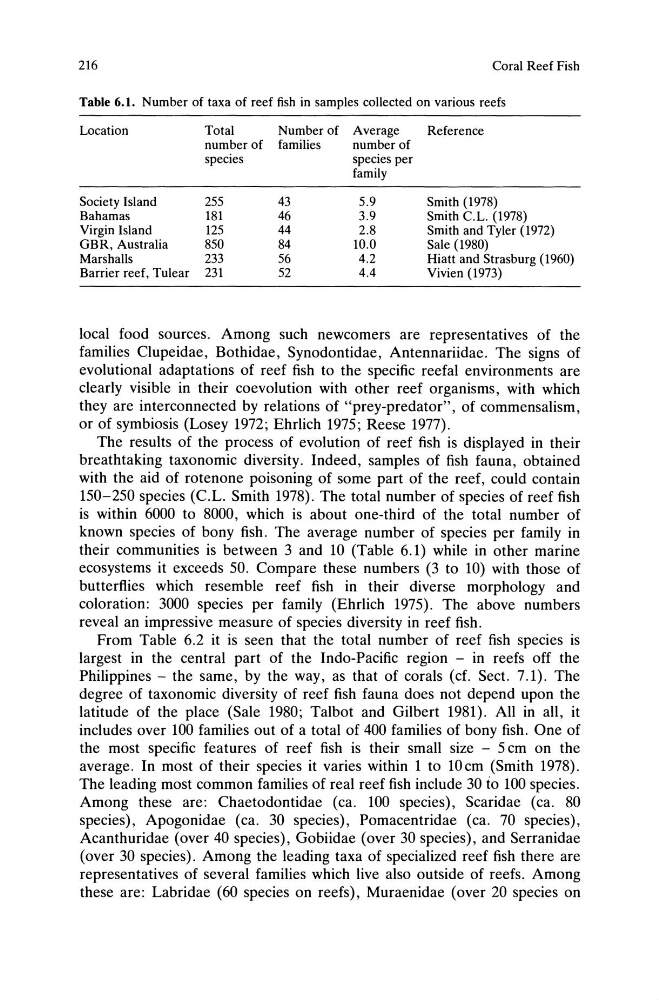
Table 6.1. Number of taxa of reef fish in samples collected on various reefs
Location
Total
Number of Average
Reference
number of families
number of
species
species per
family
Society Island
255
43
5.9
Smith (1978)
Bahamas
181
46
3.9
Smith c.L. (1978)
Virgin Island
125
44
2.8
Smith and Tyler (1972)
GBR, Australia
850
84
10.0
Sale (1980)
Marshalls
233
56
4.2
Hiatt and Strasburg (1960)
Barrier reef, Tulear 231
52
4.4
Vivien (1973)
local food sources. Among such newcomers are representatives of the
families Clupeidae, Bothidae, Synodontidae, Antennariidae. The signs of
evolutional adaptations of reef fish to the specific reefal environments are
clearly visible in their coevolution with other reef organisms, with which
they are interconnected by relations of "prey-predator", of commensalism,
or of symbiosis (Losey 1972; Ehrlich 1975; Reese 1977).
The results of the process of evolution of reef fish is displayed in their
breathtaking taxonomic diversity. Indeed, samples of fish fauna, obtained
with the aid of rotenone poisoning of some part of the reef, could contain
150-250 species (C.L. Smith 1978). The total number of species of reef fish
is within 6000 to 8000, which is about one-third of the total number of
known species of bony fish. The average number of species per family in
their communities is between 3 and 10 (Table 6.1) while in other marine
ecosystems it exceeds 50. Compare these numbers (3 to 10) with those of
butterflies which resemble reef fish in their diverse morphology and
coloration: 3000 species per family (Ehrlich 1975). The above numbers
reveal an impressive measure of species diversity in reef fish.
From Table 6.2 it is seen that the total number of reef fish species is
largest in the central part of the Indo-Pacific region - in reefs off the
Philippines - the same, by the way, as that of corals (d. Sect. 7.1). The
degree of taxonomic diversity of reef fish fauna does not depend upon the
latitude of the place (Sale 1980; Talbot and Gilbert 1981). All in all, it
includes over 100 families out of a total of 400 families of bony fish. One of
the most specific features of reef fish is their small size - 5 cm on the
average. In most of their species it varies within 1 to lOcm (Smith 1978).
The leading most common families of real reef fish include 30 to 100 species.
Among these are: Chaetodontidae (ca. 100 species), Scaridae (ca. 80
species), Apogonidae (ca. 30 species), Pomacentridae (ca. 70 species),
Acanthuridae (over 40 species), Gobiidae (over 30 species), and Serranidae
(over 30 species). Among the leading taxa of specialized reef fish there are
representatives of several families which live also outside of reefs. Among
these are: Labridae (60 species on reefs), Muraenidae (over 20 species on
Coral Reef Fish
Table 6.1. Number of taxa of reef fish in samples collected on various reefs
Location
Total
Number of Average
Reference
number of families
number of
species
species per
family
Society Island
255
43
5.9
Smith (1978)
Bahamas
181
46
3.9
Smith c.L. (1978)
Virgin Island
125
44
2.8
Smith and Tyler (1972)
GBR, Australia
850
84
10.0
Sale (1980)
Marshalls
233
56
4.2
Hiatt and Strasburg (1960)
Barrier reef, Tulear 231
52
4.4
Vivien (1973)
local food sources. Among such newcomers are representatives of the
families Clupeidae, Bothidae, Synodontidae, Antennariidae. The signs of
evolutional adaptations of reef fish to the specific reefal environments are
clearly visible in their coevolution with other reef organisms, with which
they are interconnected by relations of "prey-predator", of commensalism,
or of symbiosis (Losey 1972; Ehrlich 1975; Reese 1977).
The results of the process of evolution of reef fish is displayed in their
breathtaking taxonomic diversity. Indeed, samples of fish fauna, obtained
with the aid of rotenone poisoning of some part of the reef, could contain
150-250 species (C.L. Smith 1978). The total number of species of reef fish
is within 6000 to 8000, which is about one-third of the total number of
known species of bony fish. The average number of species per family in
their communities is between 3 and 10 (Table 6.1) while in other marine
ecosystems it exceeds 50. Compare these numbers (3 to 10) with those of
butterflies which resemble reef fish in their diverse morphology and
coloration: 3000 species per family (Ehrlich 1975). The above numbers
reveal an impressive measure of species diversity in reef fish.
From Table 6.2 it is seen that the total number of reef fish species is
largest in the central part of the Indo-Pacific region - in reefs off the
Philippines - the same, by the way, as that of corals (d. Sect. 7.1). The
degree of taxonomic diversity of reef fish fauna does not depend upon the
latitude of the place (Sale 1980; Talbot and Gilbert 1981). All in all, it
includes over 100 families out of a total of 400 families of bony fish. One of
the most specific features of reef fish is their small size - 5 cm on the
average. In most of their species it varies within 1 to lOcm (Smith 1978).
The leading most common families of real reef fish include 30 to 100 species.
Among these are: Chaetodontidae (ca. 100 species), Scaridae (ca. 80
species), Apogonidae (ca. 30 species), Pomacentridae (ca. 70 species),
Acanthuridae (over 40 species), Gobiidae (over 30 species), and Serranidae
(over 30 species). Among the leading taxa of specialized reef fish there are
representatives of several families which live also outside of reefs. Among
these are: Labridae (60 species on reefs), Muraenidae (over 20 species on