

Foraminifera and Other Benthic Protozoa
205
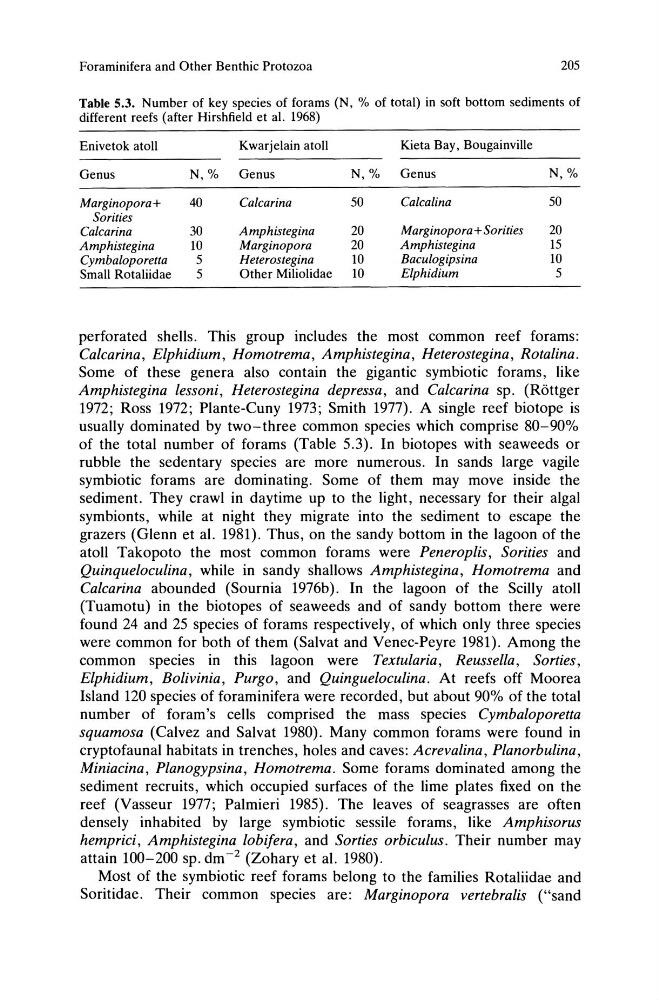
Table 5.3. Number of key species of forams (N, % of total) in soft bottom sediments of
different reefs (after Hirshfield et al. 1968)
Enivetok atoll
Kwarjelain atoll
Kieta Bay, Bougainville
Genus
N,%
Genus
N,%
Genus
N,%
Marginopora+
40
Calcarina
50
Calcalina
50
Sorities
Calcarina
30
Amphistegina
20
Marginopora+ Sorities
20
Amphistegina
10
Marginopora
20
Amphistegina
15
Cymbaloporetta
5
Heterostegina
10
Baculogipsina
10
Small Rotaliidae
5
Other Miliolidae
10
Elphidium
5
perforated shells. This group includes the most common reef forams:
Calcarina, Elphidium, Homotrema, Amphistegina, Heterostegina, Rotalina.
Some of these genera also contain the gigantic symbiotic forams, like
Amphistegina lessoni, Heterostegina depressa, and Calcarina sp. (R6ttger
1972; Ross 1972; Plante-Cuny 1973; Smith 1977). A single reef biotope is
usually dominated by two-three common species which comprise 80-90%
of the total number of forams (Table 5.3). In biotopes with seaweeds or
rubble the sedentary species are more numerous. In sands large vagile
symbiotic forams are dominating. Some of them may move inside the
sediment. They crawl in daytime up to the light, necessary for their algal
symbionts, while at night they migrate into the sediment to escape the
grazers (Glenn et al. 1981). Thus, on the sandy bottom in the lagoon of the
atoll Takopoto the most common forams were Peneroplis, Sorities and
Quinqueloculina, while in sandy shallows A mphistegina , Homotrema and
Calcarina abounded (Sournia 1976b). In the lagoon of the Scilly atoll
(Tuamotu) in the biotopes of seaweeds and of sandy bottom there were
found 24 and 25 species of forams respectively, of which only three species
were common for both of them (Salvat and Venec-Peyre 1981). Among the
common species in this lagoon were Textularia, Reussella, Sorties,
Elphidium, Bolivinia, Purgo, and Quingueloculina. At reefs off Moorea
Island 120 species of foraminifera were recorded, but about 90% of the total
number of foram's cells comprised the mass species Cymbaloporetta
squamosa (Calvez and Salvat 1980). Many common forams were found in
cryptofaunal habitats in trenches, holes and caves: Acrevalina, Planorbulina,
Miniacina, Planogypsina, Homotrema. Some forams dominated among the
sediment recruits, which occupied surfaces of the lime plates fixed on the
reef (Vasseur 1977; Palmieri 1985). The leaves of sea grasses are often
densely inhabited by large symbiotic sessile forams, like Amphisorus
hemprici, Amphistegina lobifera, and Sorties orbiculus. Their number may
attain 100-200 sp. dm- 2 (Zohary et al. 1980).
Most of the symbiotic reef forams belong to the families Rotaliidae and
Soritidae. Their common species are: Marginopora vertebralis ("sand
205
Table 5.3. Number of key species of forams (N, % of total) in soft bottom sediments of
different reefs (after Hirshfield et al. 1968)
Enivetok atoll
Kwarjelain atoll
Kieta Bay, Bougainville
Genus
N,%
Genus
N,%
Genus
N,%
Marginopora+
40
Calcarina
50
Calcalina
50
Sorities
Calcarina
30
Amphistegina
20
Marginopora+ Sorities
20
Amphistegina
10
Marginopora
20
Amphistegina
15
Cymbaloporetta
5
Heterostegina
10
Baculogipsina
10
Small Rotaliidae
5
Other Miliolidae
10
Elphidium
5
perforated shells. This group includes the most common reef forams:
Calcarina, Elphidium, Homotrema, Amphistegina, Heterostegina, Rotalina.
Some of these genera also contain the gigantic symbiotic forams, like
Amphistegina lessoni, Heterostegina depressa, and Calcarina sp. (R6ttger
1972; Ross 1972; Plante-Cuny 1973; Smith 1977). A single reef biotope is
usually dominated by two-three common species which comprise 80-90%
of the total number of forams (Table 5.3). In biotopes with seaweeds or
rubble the sedentary species are more numerous. In sands large vagile
symbiotic forams are dominating. Some of them may move inside the
sediment. They crawl in daytime up to the light, necessary for their algal
symbionts, while at night they migrate into the sediment to escape the
grazers (Glenn et al. 1981). Thus, on the sandy bottom in the lagoon of the
atoll Takopoto the most common forams were Peneroplis, Sorities and
Quinqueloculina, while in sandy shallows A mphistegina , Homotrema and
Calcarina abounded (Sournia 1976b). In the lagoon of the Scilly atoll
(Tuamotu) in the biotopes of seaweeds and of sandy bottom there were
found 24 and 25 species of forams respectively, of which only three species
were common for both of them (Salvat and Venec-Peyre 1981). Among the
common species in this lagoon were Textularia, Reussella, Sorties,
Elphidium, Bolivinia, Purgo, and Quingueloculina. At reefs off Moorea
Island 120 species of foraminifera were recorded, but about 90% of the total
number of foram's cells comprised the mass species Cymbaloporetta
squamosa (Calvez and Salvat 1980). Many common forams were found in
cryptofaunal habitats in trenches, holes and caves: Acrevalina, Planorbulina,
Miniacina, Planogypsina, Homotrema. Some forams dominated among the
sediment recruits, which occupied surfaces of the lime plates fixed on the
reef (Vasseur 1977; Palmieri 1985). The leaves of sea grasses are often
densely inhabited by large symbiotic sessile forams, like Amphisorus
hemprici, Amphistegina lobifera, and Sorties orbiculus. Their number may
attain 100-200 sp. dm- 2 (Zohary et al. 1980).
Most of the symbiotic reef forams belong to the families Rotaliidae and
Soritidae. Their common species are: Marginopora vertebralis ("sand