

186
Reef Zoo benthos
N
.fll
'Ill
30
20
10
Sa />fa Ap C
Il
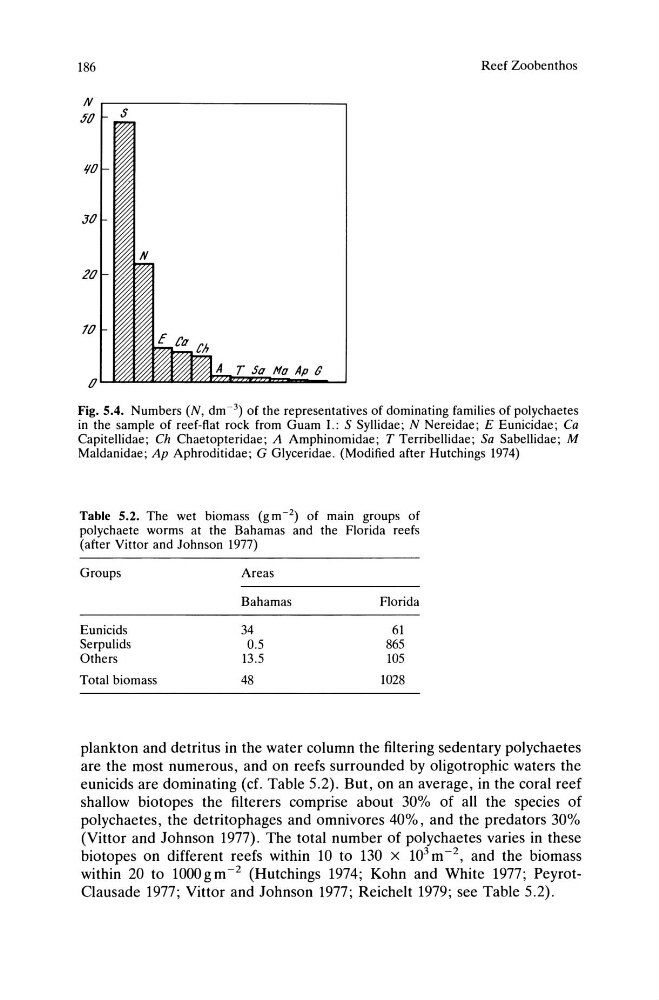
Fig. 5.4. Numbers (N, dm- 3 ) of the representatives of dominating families of polychaetes
in the sample of reef-flat rock from Guam I.: S Syllidae; N Nereidae; E Eunicidae; Ca
Capitellidae; Ch Chaetopteridae; A Amphinomidae; T Terribellidae; Sa Sabellidae; M
Maldanidae; Ap Aphroditidae; G Glyceridae. (Modified after Hutchings 1974)
Table 5.2. The wet biomass (g m -2) of main groups of
polychaete worms at the Bahamas and the Florida reefs
(after Vittor and Johnson 1977)
Groups
Areas
Bahamas
Florida
Eunicids
34
61
Serpulids
0.5
865
Others
13.5
105
Total biomass
48
1028
plankton and detritus in the water column the filtering sedentary polychaetes
are the most numerous, and on reefs surrounded by oligotroppic waters the
eunicids are dominating (cf. Table 5.2). But, on an average, in the coral reef
shallow biotopes the filterers comprise about 30% of all the species of
polychaetes, the detritophages and omnivores 40%, and the predators 30%
(Vittor and Johnson 1977). The total number of polychaetes varies in these
biotopes on different reefs within 10 to 130 X 10 3 m -2, and the biomass
within 20 to 1000gm- 2 (Hutchings 1974; Kohn and White 1977; PeyrotClausade 1977; Vittor and Johnson 1977; Reichelt 1979; see Table 5.2).
Reef Zoo benthos
N
.fll
'Ill
30
20
10
Sa />fa Ap C
Il
Fig. 5.4. Numbers (N, dm- 3 ) of the representatives of dominating families of polychaetes
in the sample of reef-flat rock from Guam I.: S Syllidae; N Nereidae; E Eunicidae; Ca
Capitellidae; Ch Chaetopteridae; A Amphinomidae; T Terribellidae; Sa Sabellidae; M
Maldanidae; Ap Aphroditidae; G Glyceridae. (Modified after Hutchings 1974)
Table 5.2. The wet biomass (g m -2) of main groups of
polychaete worms at the Bahamas and the Florida reefs
(after Vittor and Johnson 1977)
Groups
Areas
Bahamas
Florida
Eunicids
34
61
Serpulids
0.5
865
Others
13.5
105
Total biomass
48
1028
plankton and detritus in the water column the filtering sedentary polychaetes
are the most numerous, and on reefs surrounded by oligotroppic waters the
eunicids are dominating (cf. Table 5.2). But, on an average, in the coral reef
shallow biotopes the filterers comprise about 30% of all the species of
polychaetes, the detritophages and omnivores 40%, and the predators 30%
(Vittor and Johnson 1977). The total number of polychaetes varies in these
biotopes on different reefs within 10 to 130 X 10 3 m -2, and the biomass
within 20 to 1000gm- 2 (Hutchings 1974; Kohn and White 1977; PeyrotClausade 1977; Vittor and Johnson 1977; Reichelt 1979; see Table 5.2).