

174
Reef Zoo benthos
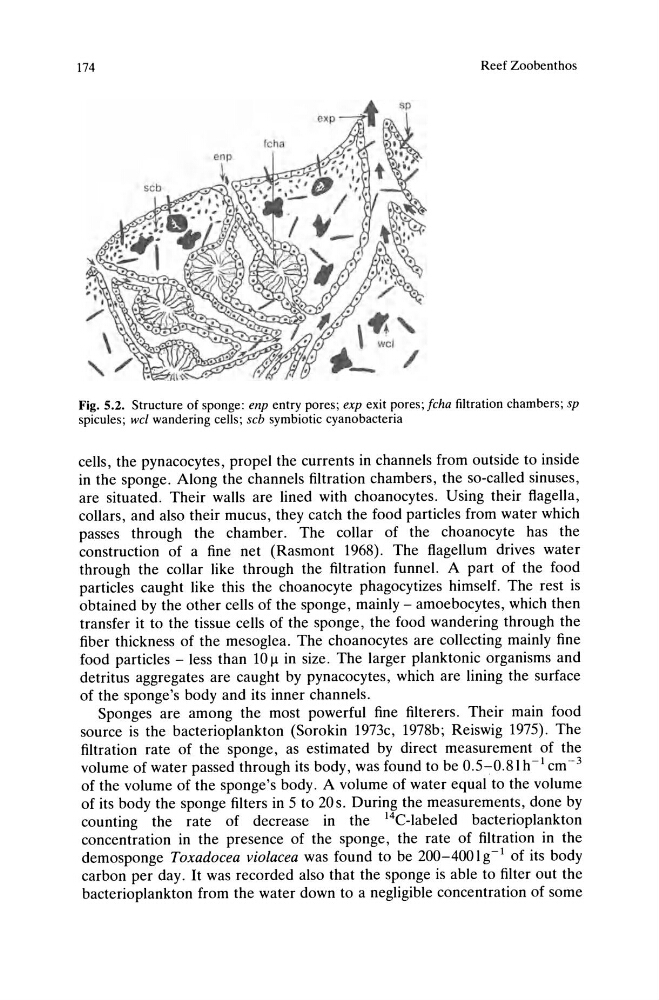
Fig. 5.2. Structure of sponge: enp entry pores; exp exit pores; fcha filtration chambers; sp
spicules; wcl wandering cells ; scb symbiotic cyanobacteria
cells, the pynacocytes, propel the currents in channels from outside to inside
in the sponge. Along the channels filtration chambers, the so-called sinuses,
are situated . Their walls are lined with choanocytes. Using their flagella,
collars, and also their mucus, they catch the food particles from water which
passes through the chamber. The collar of the choanocyte has the
construction of a fine net (Rasmont 1968) . The flagellum drives water
through the collar like through the filtration funnel. A part of the food
particles caught like this the choanocyte phagocytizes himself. The rest is
obtained by the other cells of the sponge, mainly - amoebocytes, which then
transfer it to the tissue cells of the sponge, the food wandering through the
fiber thickness of the mesoglea. The choanocytes are collecting mainly fine
food particles - less than 10 11 in size. The larger planktonic organisms and
detritus aggregates are caught by pynacocytes, which are lining the surface
of the sponge's body and its inner channels.
Sponges are among the most powerful fine filterers. Their main food
source is the bacterioplankton (Sorokin 1973c, 1978b; Reiswig 1975). The
filtration rate of the sponge , as estimated by direct measurement of the
volume of water passed through its body, was found to be 0.5-0.81 h -I cm - 3
of the volume of the sponge's body. A volume of water equal to the volume
of its body the sponge filters in 5 to 20s . During the measurements, done by
counting the rate of decrease in the 14C-Iabeled bacterioplankton
concentration in the presence of the sponge, the rate of filtration in the
demosponge Toxadocea violacea was found to be 200-400 I g-I of its body
carbon per day. It was recorded also that the sponge is able to filter out the
bacterioplankton from the water down to a negligible concentration of some
Reef Zoo benthos
Fig. 5.2. Structure of sponge: enp entry pores; exp exit pores; fcha filtration chambers; sp
spicules; wcl wandering cells ; scb symbiotic cyanobacteria
cells, the pynacocytes, propel the currents in channels from outside to inside
in the sponge. Along the channels filtration chambers, the so-called sinuses,
are situated . Their walls are lined with choanocytes. Using their flagella,
collars, and also their mucus, they catch the food particles from water which
passes through the chamber. The collar of the choanocyte has the
construction of a fine net (Rasmont 1968) . The flagellum drives water
through the collar like through the filtration funnel. A part of the food
particles caught like this the choanocyte phagocytizes himself. The rest is
obtained by the other cells of the sponge, mainly - amoebocytes, which then
transfer it to the tissue cells of the sponge, the food wandering through the
fiber thickness of the mesoglea. The choanocytes are collecting mainly fine
food particles - less than 10 11 in size. The larger planktonic organisms and
detritus aggregates are caught by pynacocytes, which are lining the surface
of the sponge's body and its inner channels.
Sponges are among the most powerful fine filterers. Their main food
source is the bacterioplankton (Sorokin 1973c, 1978b; Reiswig 1975). The
filtration rate of the sponge , as estimated by direct measurement of the
volume of water passed through its body, was found to be 0.5-0.81 h -I cm - 3
of the volume of the sponge's body. A volume of water equal to the volume
of its body the sponge filters in 5 to 20s . During the measurements, done by
counting the rate of decrease in the 14C-Iabeled bacterioplankton
concentration in the presence of the sponge, the rate of filtration in the
demosponge Toxadocea violacea was found to be 200-400 I g-I of its body
carbon per day. It was recorded also that the sponge is able to filter out the
bacterioplankton from the water down to a negligible concentration of some