

8
Reef Lime Constructions
Epochs
Reef building organisms
PrePaleozoic
Cenozoic
Mesozoic
Ter- Quarterbrian
Lower Middle Upper
tiary nary
Stromatolithic blue green algae
Red calcareous algae
~-1-- -
Green calcareous algae of codidae type
~- - - .• •
Archaeocyathides (animals?)
... - - - - - - ---- -
Stromatoporitidae (sponges?)
----Ancient corals (tabulates, rugoses)
Hermatypic hexacorallia
Bryozoans
~--- -
Polychaetes (sabellarids, sabellids, serpulids)
-
Foraminiferans
' - -Molluscs
~
--Plecypods
~
Ancient bryozoans (Fenstellidae)
-
Hydroids, hydrocorals
-
-
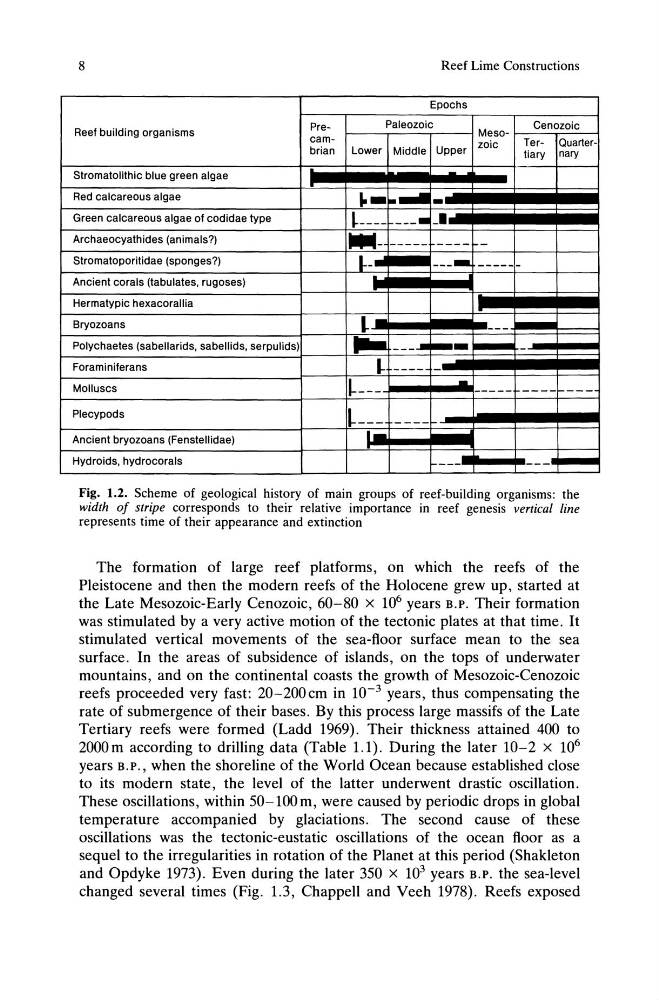
Fig. 1.2. Scheme of geological history of main groups of reef-building organisms: the
width of stripe corresponds to their relative importance in reef genesis vertical line
represents time of their appearance and extinction
The formation of large reef platforms, on which the reefs of the
Pleistocene and then the modern reefs of the Holocene grew up, started at
the Late Mesozoic-Early Cenozoic, 60-80 x 10 6 years B.P. Their formation
was stimulated by a very active motion of the tectonic plates at that time. It
stimulated vertical movements of the sea-floor surface mean to the sea
surface. In the areas of subsidence of islands, on the tops of underwater
mountains, and on the continental coasts the growth of Mesozoic-Cenozoic
reefs proceeded very fast: 20-200 cm in 10- 3 years, thus compensating the
rate of submergence of their bases. By this process large massifs of the Late
Tertiary reefs were formed (Ladd 1969). Their thickness attained 400 to
2000 m according to drilling data (Table 1. 1). During the later 10-2 x 10 6
years B.P., when the shoreline of the World Ocean because established close
to its modern state, the level of the latter underwent drastic oscillation.
These oscillations, within 50-100 m, were caused by periodic drops in global
temperature accompanied by glaciations. The second cause of these
oscillations was the tectonic-eustatic oscillations of the ocean floor as a
sequel to the irregularities in rotation of the Planet at this period (Shakleton
and Opdyke 1973). Even during the later 350 x 10 3 years B.P. the sea-level
changed several times (Fig. 1.3, Chappell and Veeh 1978). Reefs exposed
Reef Lime Constructions
Epochs
Reef building organisms
PrePaleozoic
Cenozoic
Mesozoic
Ter- Quarterbrian
Lower Middle Upper
tiary nary
Stromatolithic blue green algae
Red calcareous algae
~-1-- -
Green calcareous algae of codidae type
~- - - .• •
Archaeocyathides (animals?)
... - - - - - - ---- -
Stromatoporitidae (sponges?)
----Ancient corals (tabulates, rugoses)
Hermatypic hexacorallia
Bryozoans
~--- -
Polychaetes (sabellarids, sabellids, serpulids)
-
Foraminiferans
' - -Molluscs
~
--Plecypods
~
Ancient bryozoans (Fenstellidae)
-
Hydroids, hydrocorals
-
-
Fig. 1.2. Scheme of geological history of main groups of reef-building organisms: the
width of stripe corresponds to their relative importance in reef genesis vertical line
represents time of their appearance and extinction
The formation of large reef platforms, on which the reefs of the
Pleistocene and then the modern reefs of the Holocene grew up, started at
the Late Mesozoic-Early Cenozoic, 60-80 x 10 6 years B.P. Their formation
was stimulated by a very active motion of the tectonic plates at that time. It
stimulated vertical movements of the sea-floor surface mean to the sea
surface. In the areas of subsidence of islands, on the tops of underwater
mountains, and on the continental coasts the growth of Mesozoic-Cenozoic
reefs proceeded very fast: 20-200 cm in 10- 3 years, thus compensating the
rate of submergence of their bases. By this process large massifs of the Late
Tertiary reefs were formed (Ladd 1969). Their thickness attained 400 to
2000 m according to drilling data (Table 1. 1). During the later 10-2 x 10 6
years B.P., when the shoreline of the World Ocean because established close
to its modern state, the level of the latter underwent drastic oscillation.
These oscillations, within 50-100 m, were caused by periodic drops in global
temperature accompanied by glaciations. The second cause of these
oscillations was the tectonic-eustatic oscillations of the ocean floor as a
sequel to the irregularities in rotation of the Planet at this period (Shakleton
and Opdyke 1973). Even during the later 350 x 10 3 years B.P. the sea-level
changed several times (Fig. 1.3, Chappell and Veeh 1978). Reefs exposed