

Molluscs
169
PIB in natural populations of T. maxima is estimated as 0.2. In the lagoon of
the atoll Takapoto the population of T. maxima includes around 14 million
specimens, which produce annually about 120t of pure meat, having a basic
stock of biomass of 530 t in some units. High growth rates, large size and an
easy harvest make tridacnids a promising object for rational development of
reef resources via aquaculture. Moreover, their dry meat costs about
US$100 per kilo (Yamaguchi 1977; Munro and Gwyther 1981).
5.1.4 Boring Clams
The boring bivalves are extremely widespread in areas of the rocky flat and
especially in areas of active coral growth. They compose there a remarkable
portion of the total benthic biomass (Evseev and Silina 1982). They bore
into living scleractinian corals as well as dead coral heads and also the rocks
of the reef fl.at. Thus they are one of the main agents of bioerosion processes
on the reef (together with boring sponges), and their activity is an important
2,tl
!,tl
2
1,5
J(J
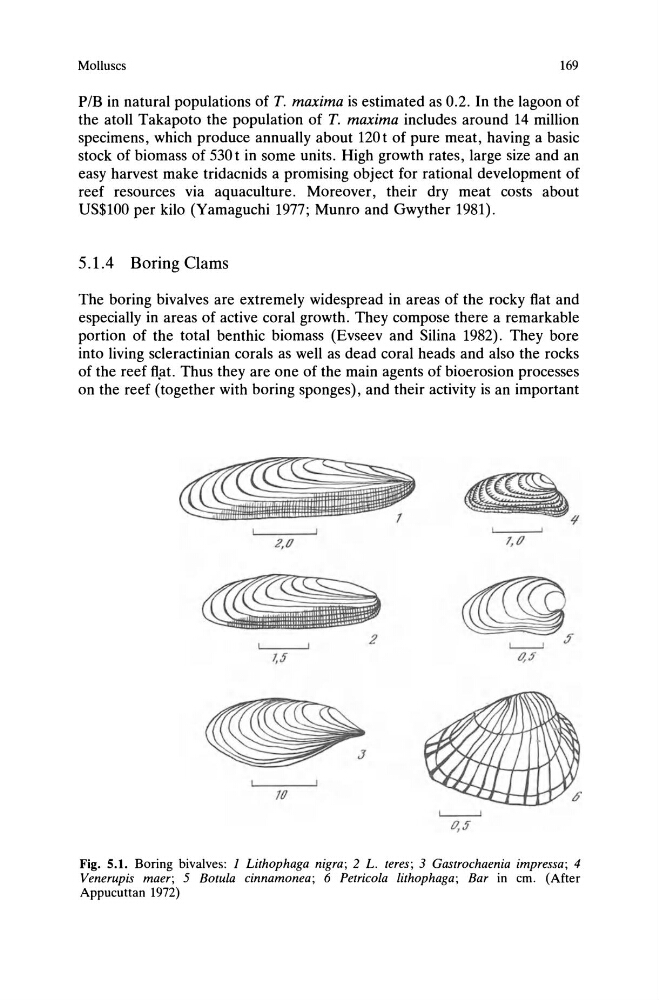
Fig. 5.1. Boring bivalves: 1 Lithophaga nigra; 2 L. teres; 3 Gastrochaenia impressa; 4
Venerupis maer; 5 Botula cinnamonea; 6 Petricola lithophaga; Bar in cm. (After
Appucuttan 1972)
169
PIB in natural populations of T. maxima is estimated as 0.2. In the lagoon of
the atoll Takapoto the population of T. maxima includes around 14 million
specimens, which produce annually about 120t of pure meat, having a basic
stock of biomass of 530 t in some units. High growth rates, large size and an
easy harvest make tridacnids a promising object for rational development of
reef resources via aquaculture. Moreover, their dry meat costs about
US$100 per kilo (Yamaguchi 1977; Munro and Gwyther 1981).
5.1.4 Boring Clams
The boring bivalves are extremely widespread in areas of the rocky flat and
especially in areas of active coral growth. They compose there a remarkable
portion of the total benthic biomass (Evseev and Silina 1982). They bore
into living scleractinian corals as well as dead coral heads and also the rocks
of the reef fl.at. Thus they are one of the main agents of bioerosion processes
on the reef (together with boring sponges), and their activity is an important
2,tl
!,tl
2
1,5
J(J
Fig. 5.1. Boring bivalves: 1 Lithophaga nigra; 2 L. teres; 3 Gastrochaenia impressa; 4
Venerupis maer; 5 Botula cinnamonea; 6 Petricola lithophaga; Bar in cm. (After
Appucuttan 1972)