

146
8
100
7.f
.f0
2.f
Q
Benthic Microflora, Periphyton and Plant Associations
,..-,
, / " - - -
/
\
/
/
\
I
/
X
I
I
\
/'
,I \
/
/'1 \
I
/
XI XII I
II
m IY Y ¥l
Months
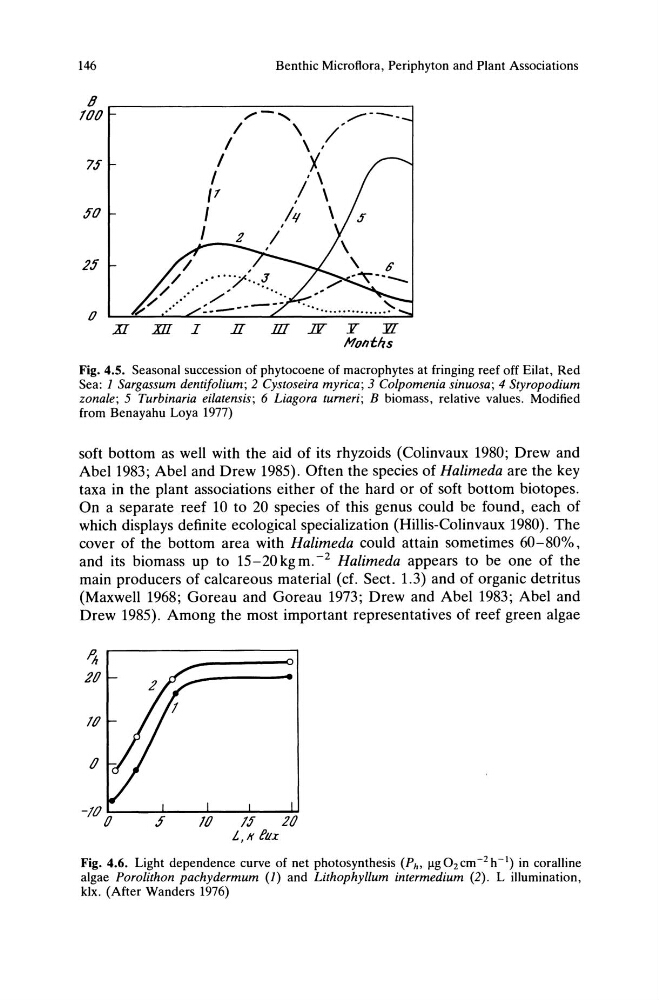
Fig. 4.5. Seasonal succession of phytocoene of macrophytes at fringing reef off Eilat, Red
Sea: 1 Sargassum dentifolium; 2 Cystoseira myrica; 3 Colpomenia sinuosa; 4 Styropodium
zonale; 5 Turbinaria eilatensis; 6 Liagora tumeri; B biomass, relative values. Modified
from Benayahu Loya 1977)
soft bottom as well with the aid of its rhyzoids (Colinvaux 1980; Drew and
Abel 1983; Abel and Drew 1985). Often the species of Halimeda are the key
taxa in the plant associations either of the hard or of soft bottom biotopes.
On a separate reef 10 to 20 species of this genus could be found, each of
which displays definite ecological specialization (Hillis-Colinvaux 1980). The
cover of the bottom area with Halimeda could attain sometimes 60-80%,
and its biomass up to 15-20kgm.- 2 Halimeda appears to be one of the
main producers of calcareous material (cf. Sect. 1.3) and of organic detritus
(Maxwell 1968; Goreau and Goreau 1973; Drew and Abel 1983; Abel and
Drew 1985). Among the most important representatives of reef green algae
fh
21l
!(J
(J
Fig. 4.6. Light dependence curve of net photosynthesis (Ph, ~g02cm~2h~1) in coralline
algae Porolithon pachydermum (1) and Lithophyllum intermedium (2). L illumination,
klx. (After Wanders 1976)
8
100
7.f
.f0
2.f
Q
Benthic Microflora, Periphyton and Plant Associations
,..-,
, / " - - -
/
\
/
/
\
I
/
X
I
I
\
/'
,I \
/
/'1 \
I
/
XI XII I
II
m IY Y ¥l
Months
Fig. 4.5. Seasonal succession of phytocoene of macrophytes at fringing reef off Eilat, Red
Sea: 1 Sargassum dentifolium; 2 Cystoseira myrica; 3 Colpomenia sinuosa; 4 Styropodium
zonale; 5 Turbinaria eilatensis; 6 Liagora tumeri; B biomass, relative values. Modified
from Benayahu Loya 1977)
soft bottom as well with the aid of its rhyzoids (Colinvaux 1980; Drew and
Abel 1983; Abel and Drew 1985). Often the species of Halimeda are the key
taxa in the plant associations either of the hard or of soft bottom biotopes.
On a separate reef 10 to 20 species of this genus could be found, each of
which displays definite ecological specialization (Hillis-Colinvaux 1980). The
cover of the bottom area with Halimeda could attain sometimes 60-80%,
and its biomass up to 15-20kgm.- 2 Halimeda appears to be one of the
main producers of calcareous material (cf. Sect. 1.3) and of organic detritus
(Maxwell 1968; Goreau and Goreau 1973; Drew and Abel 1983; Abel and
Drew 1985). Among the most important representatives of reef green algae
fh
21l
!(J
(J
Fig. 4.6. Light dependence curve of net photosynthesis (Ph, ~g02cm~2h~1) in coralline
algae Porolithon pachydermum (1) and Lithophyllum intermedium (2). L illumination,
klx. (After Wanders 1976)